


Getting a new article or webpage published feels like a small victory. You have written the content, added images, optimized the title, and finally clicked the publish button.
But there is one important question left: Can search engines actually find and index the page?
This is where an SEO Digital Marketing Rapid Index Checker can become a useful part of your SEO workflow.
For bloggers, website owners, marketers, and businesses, checking indexing status can provide a quick way to understand what is happening with important pages. Instead of publishing content and simply waiting, you can monitor whether your URLs are being discovered and indexed.
Indexing is not the same as ranking, but it is an important first step toward gaining visibility in search results.
SEO Digital Marketing Rapid Index Checker: What Is It?
An SEO Digital Marketing Rapid Index Checker is a tool or method used to check whether a webpage or URL has been indexed by a search engine.For anyone working in digital marketing, an SEO Digital Marketing Rapid Index Checker provides a simple way to keep track of important URLs.
When you publish a webpage, search engines need to discover and process that page before it can normally appear in their search index. Once a page is indexed, it becomes eligible to appear in search results when the search engine considers it relevant to a user’s query.
A rapid index checker makes this process easier to monitor.
For example, imagine you have just published a new article about digital marketing. You may want to know whether the URL has already been discovered by Google or whether it still needs attention.
Rather than guessing, an index checker can give you a quick indication of the page’s indexing status.
Why Is Search Indexing Important?
Search engines cannot send organic visitors to a page they have not properly discovered and indexed.
That makes indexing an important part of digital marketing and SEO.
A website can have excellent content, attractive design, and strong keywords, but if an important page is not indexed, its ability to receive organic search traffic can be limited.
This is particularly important for websites that publish content regularly.
A growing website might publish several articles every week. Without monitoring important URLs, it can be easy to assume that every page is being indexed correctly.
That assumption may not always be accurate.
An indexing check gives website owners another way to stay aware of what is happening behind the scenes.Using an SEO Digital Marketing Rapid Index Checker can make that monitoring process easier, especially when a website is publishing new content regularly.
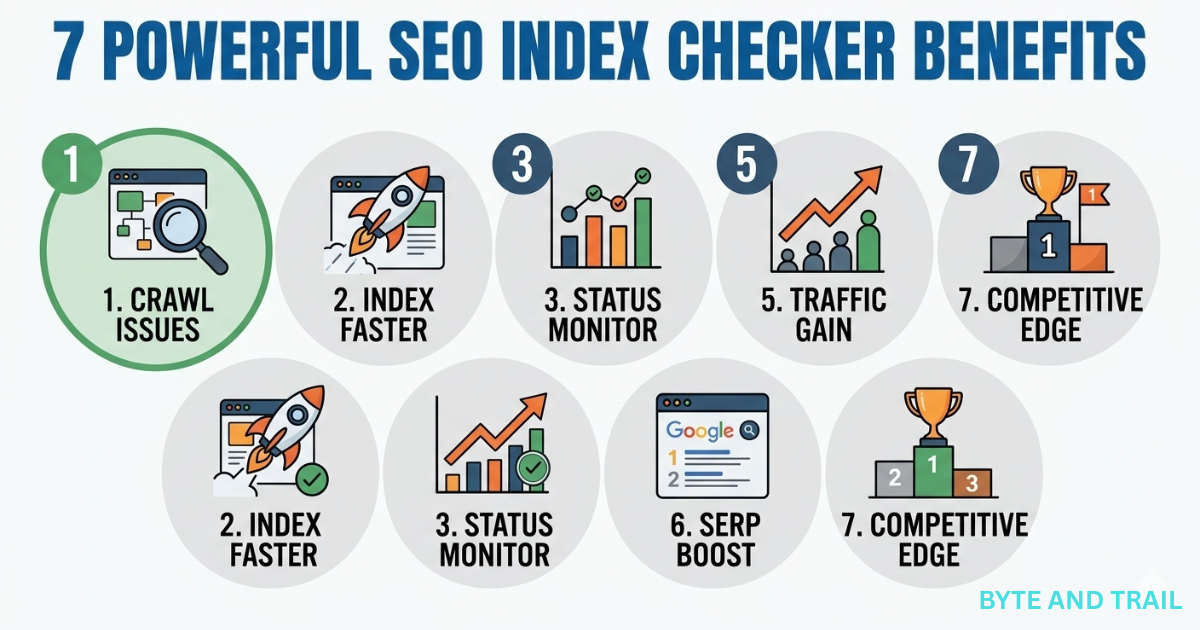
7 Powerful Benefits of Using an Index Checker
1. Quickly Check New Pages
One of the simplest benefits is the ability to check newly published URLs.
After publishing an important article, you can check its indexing status instead of leaving the page completely unmonitored.
This is useful for blogs, business websites, publishers, and marketers who regularly create fresh content.
A quick check can help you understand whether the page has already been discovered or whether it may need more time.
2. Find Potential SEO Problems
A page that is not indexed does not necessarily have a technical problem.
However, if an important page remains unindexed for an extended period, it is worth investigating.
Possible issues can include incorrect indexing settings, crawling restrictions, unsuitable canonical settings, duplicate content, or other technical SEO problems.
An index checker does not always tell you exactly why a page is not indexed, but it can tell you which URLs deserve a closer look.
3. Monitor Important Content
Not every page on your website has the same value.
Your homepage, important service pages, product pages, cornerstone articles, and high-value blog posts may deserve closer monitoring.
By checking these URLs regularly, you can create a simple SEO monitoring routine.
This is especially helpful as your website grows and the number of published pages increases.
4. Support a Better SEO Workflow
SEO works better when you follow a process rather than relying entirely on guesswork.
A simple workflow could look like this:
Create → Optimize → Publish → Check → Monitor → Improve
An index checker can fit naturally into this process.
After publishing and optimizing an article, you can check its indexing status and then continue monitoring its performance through your other SEO tools.
5. Save Time During SEO Checks
For marketers managing multiple URLs, manually checking every page can become frustrating.
A rapid checker can make basic indexing checks more convenient.
Instead of treating indexing as something you remember occasionally, you can make it part of your regular content publishing routine.
That small change can make SEO management feel more organized.
6. Help You Understand Your Website Better
Indexing checks can also reveal patterns.
For example, if most new articles are indexed normally but a particular group of pages repeatedly struggles to get indexed, that pattern may deserve investigation.
You might discover that certain page types have technical issues, weak internal linking, or unnecessary indexing restrictions.
Over time, these observations can help you understand how your website is being crawled and processed.
7. Give You More Confidence After Publishing
There is something reassuring about knowing that you have checked an important page rather than simply assuming everything is working.
An index checker does not guarantee rankings or traffic, but it can give you an additional signal about the status of your content.
For website owners who publish frequently, that extra visibility can be valuable.
Indexing Does Not Mean Ranking
This is one of the most important things to understand.
Indexing and ranking are two different stages of SEO.
If Google indexes your article, that does not mean the article will automatically appear at the top of search results.
For example, you could publish an article targeting a competitive keyword. Google may index the page successfully, but hundreds of other websites may also be competing for the same search term.
Your position can depend on factors such as content quality, relevance, search intent, competition, website authority, internal links, backlinks, technical SEO, and many other signals.
So, an SEO Digital Marketing Rapid Index Checker should be viewed as a monitoring tool, not a ranking guarantee.
What Should You Do If a Page Is Not Indexed?
Do not immediately assume that something is broken.
New pages can take time to be discovered and processed. Instead of repeatedly checking the same URL, give it some time and review the basic SEO settings.
Make sure the page is publicly accessible and that you have not accidentally added a noindex instruction.
You should also check whether the URL is blocked from crawling, whether the canonical URL is correct, and whether the page is connected to other relevant pages through internal links.
For deeper investigation, Google Search Console can provide more useful information about a specific URL.
The important point is simple: a “not indexed” result is a reason to investigate, not a reason to panic.
How to Use an Index Checker Effectively Without Overcomplicating SEO
SEO can sometimes feel much more complicated than it really is.
There are dozens of tools, reports, numbers, warnings, and technical terms. If you are running a small website or publishing your own blog, you do not need to turn every new article into a technical investigation.
A better approach is to build a simple routine and stick with it.
Once you understand what you are looking for, checking your pages becomes much easier.
Start With the URL You Actually Want to Check
It sounds obvious, but using the correct URL matters.
Websites often have different versions of what looks like the same page. A page may have an old URL, a redirected URL, or a slightly different permalink after an update.
Before checking a page, copy the current published URL directly from your website.
This avoids a surprisingly common problem: checking an old address and assuming the current page has an indexing issue.
For example, if you recently changed your article’s permalink, do not keep checking the previous URL. Check the new, live address instead.
Give New Content Some Time
One of the easiest mistakes to make is expecting a brand-new page to appear in search immediately.
You publish an article, check it five minutes later, and discover that it is not indexed. Naturally, you may start wondering whether something went wrong.
Usually, there is no need to panic.
Search engines crawl websites on their own schedules. A new page may be discovered quickly, or it may take longer depending on the website and the circumstances surrounding the page.
The important thing is not to treat indexing like a stopwatch.
Instead, publish the content properly, make sure your technical settings are correct, and then monitor the URL.An SEO Digital Marketing Rapid Index Checker can be useful here as a quick way to monitor newly published URLs without turning indexing into a daily obsession
Use Internal Links to Create a Clear Path
Think about your website from a reader’s perspective.
If someone lands on one article, can they easily find another useful article related to the same subject?
Internal links help create that connection.
They can also help search engines discover relationships between different pages on your website.
For example, suppose you have an article about digital marketing tools. You might naturally link to another article about digital marketing strategies, SEO basics, or marketing for small businesses.
The link should make sense to the reader.
Do not add internal links simply to increase the number of links on a page. A useful link is better than a forced one.
Keep Your Sitemap Healthy
Your XML sitemap is another important part of website discovery.
A sitemap gives search engines a structured list of URLs that you consider important on your website.
If you use WordPress with an SEO plugin, your sitemap may already be generated automatically.
That does not mean you should completely forget about it.
Occasionally check that your sitemap is available and that it is not filled with URLs that should not be included.
A clean website structure makes SEO management easier, especially when your site starts growing from a few articles into dozens or hundreds of pages.
Check for Accidental Noindex Settings
Sometimes the problem is not complicated at all.
A page may simply have a setting telling search engines not to index it.
This is known as a noindex directive.
It can be useful for pages that you intentionally do not want appearing in search results. But if you accidentally apply it to an important article, you have created an SEO problem without realizing it.
Before spending hours looking for complicated explanations, check the basics first.
Ask yourself:
- Is the page published?
- Can visitors open it normally?
- Is search indexing allowed?
- Is the URL correct?
- Is the page blocked from crawling?
- Is the canonical URL appropriate?
Simple checks can sometimes solve what appears to be a complicated problem.
Google Search Console Gives You a Deeper Look
An index checker is useful for a quick status check, but serious SEO work should not stop there.
Google Search Console gives website owners a much deeper view of how Google interacts with their website.
Its URL Inspection feature can be particularly helpful when you want to investigate an individual page.
You can use it to understand whether Google has discovered a URL and to investigate indexing-related information.
This is especially useful when a page is important to your website and you want more information than a simple “indexed” or “not indexed” result.
The two tools can work together nicely.
Use a rapid checker for quick monitoring, and use Search Console when you need a more detailed investigation.
Do Not Chase Instant Indexing
There is a temptation in SEO to look for shortcuts.
If a new article is not indexed quickly, you may start searching for a tool that promises instant indexing.
Be careful with that mindset.
Search visibility is not something you should build around artificial urgency. A healthy website should focus on useful content, a clear structure, good technical SEO, and a positive experience for visitors.
Fast discovery can be helpful, particularly for time-sensitive content, but fast does not automatically mean better.
Your long-term goal should be a website that search engines can consistently crawl and understand.
Watch the Pages That Matter Most
You do not necessarily need to check every URL on your website every single day.
That would quickly become a waste of time.
Instead, pay closer attention to pages that have real value.
These might include:
Important Business Pages
Your homepage, service pages, product pages, and other pages directly connected to your business deserve attention.
If one of these pages disappears from search visibility, the potential impact can be much greater than losing a low-value page.
New Articles
Newly published content can be checked as part of your normal publishing process.
This is particularly useful when you are building a new website and publishing regularly.
Updated Content
Do not think only about brand-new pages.
When you significantly update an older article, it can also be useful to monitor the URL and its search performance afterward.
Updating content should be about making it genuinely better, not simply changing a few words to make the page look fresh.
What If Your Page Is Indexed but Gets No Traffic?
This is where many beginners become confused.
You check the page and discover that it is indexed. Great.
But then you look at your analytics and see almost no visitors.
That does not necessarily mean the index checker failed.
It simply means you have moved to a different SEO question.
Your next questions should be:
What keywords is the page targeting?
Does the content match what people are searching for?
How competitive is the topic?
Is the title appealing enough to earn clicks?
Does the article provide something genuinely useful?
This is where content optimization and search performance become more important than indexing alone.
A More Natural SEO Routine
You do not need to spend your entire day watching indexing reports.
A simple routine can be enough.
After publishing an important article, check the URL. Make sure your internal links are in place and your technical settings are correct.
Then give the page time.
If there is a genuine indexing concern, investigate it through your SEO tools and Google Search Console.
Once the page is indexed, shift your attention toward what really matters: visibility, clicks, engagement, and the quality of the content.
That approach keeps SEO practical instead of turning it into a never-ending technical task.
9 Smart Indexing Practices Every Digital Marketer Should Follow
Checking whether a page has been indexed is useful, but the bigger picture matters more.
Good indexing starts with a website that is easy to understand, easy to navigate, and technically healthy. You do not need to become a technical SEO expert overnight. A few consistent habits can make a noticeable difference.
Here are some practical practices worth adding to your routine.
1. Publish Content That Deserves to Be Found
It is easy to become focused on getting pages indexed and forget why those pages exist in the first place.
Search engines are designed to help people find useful information.
Instead of asking, “How quickly can I get this page indexed?” also ask, “Would someone actually find this page helpful?”
A well-researched article with a clear purpose is a much better investment than publishing several weak pages simply to increase the number of URLs on your website.
2. Make Your Website Easy to Navigate
A visitor should not have to work hard to find your important content.
Your main pages should be connected logically through menus, categories, and internal links.
For example, a digital marketing website might organize content into SEO, social media, content marketing, advertising, and analytics.
This type of structure makes the website easier for people to browse and gives search engines a clearer understanding of how your content is connected.
3. Keep Your Important Pages Internally Linked
If an article is important to you, do not leave it isolated.
Look for natural opportunities to link to it from other relevant pages.
You can also update older articles with links to useful new content.
This creates a network inside your website rather than a collection of disconnected pages.
The goal is not to add links everywhere. The goal is to help readers move naturally from one useful piece of information to another.
4. Pay Attention to Technical SEO
Sometimes an indexing problem has nothing to do with the quality of the article.
A technical setting may be preventing search engines from properly accessing or processing the page.
Keep an eye on basics such as:
- Robots.txt settings
- Noindex directives
- Canonical URLs
- XML sitemap
- Website accessibility
- Redirects
- Broken links
- Mobile usability
- Page loading performance
You do not need to check every technical setting every day.
But when an important page behaves unexpectedly, these are good places to start looking.
5. Do Not Create Duplicate Pages Without a Reason
Websites can accidentally create multiple URLs containing very similar information.
This can happen because of URL parameters, outdated pages, duplicate categories, or other website settings.
When search engines encounter many versions of similar content, it can become harder to understand which version should be treated as the primary page.
Keep your website structure as clean as possible and use canonicalization appropriately when multiple URL versions are necessary.
6. Review Your Older Content
SEO is not only about what you publish today.
Some of your older articles may already have search impressions, backlinks, or useful information. Instead of constantly creating something new, consider improving content that already exists.
Look for outdated statistics, broken links, missing information, weak introductions, or questions that your original article did not answer.
A meaningful update can make an old page more useful to readers and more competitive in search.
7. Use Search Console as Your Regular SEO Companion
If you are serious about understanding how your website appears in Google Search, Google Search Console should be part of your toolkit.
It can help you look beyond a simple indexing result.
You can monitor search queries, impressions, clicks, indexing information, and potential issues affecting your pages.
For individual URLs, the inspection tools can also help you investigate what Google knows about a particular page.
An index checker can be convenient for quick checks, while Search Console gives you a much broader view of your website’s relationship with Google.
8. Avoid Promises of Guaranteed Rankings
Be careful with SEO tools or services that make unrealistic promises.
No legitimate indexing checker can guarantee that your page will reach position one.
Getting indexed is only an early step.
Your content still has to compete with other websites, satisfy the searcher’s intent, earn clicks, and provide enough value to deserve visibility.
A good SEO strategy focuses on building sustainable search visibility rather than chasing guaranteed results.
9. Create a Simple Publishing Checklist
One of the easiest ways to improve your SEO workflow is to create a checklist.
Before publishing an article, you might check:
Content
- Does the article answer a real question?
- Is the information useful and easy to understand?
- Does the introduction clearly explain the topic?
- Have unnecessary repetitions been removed?
On-Page SEO
- Is the main keyword used naturally?
- Is the SEO title clear and attractive?
- Is the meta description relevant?
- Is the URL short and descriptive?
- Do images have useful alt text?
- Are relevant internal links included?
Technical Checks
- Is the page publicly accessible?
- Is indexing allowed?
- Is the canonical URL correct?
- Is the page included appropriately in the sitemap?
After Publishing
- Check the live URL.
- Monitor indexing.
- Review Search Console when necessary.
- Watch impressions and clicks over time.
- Improve the article when the data shows an opportunity.
This kind of checklist takes only a few minutes once you get used to it.
Common Mistakes That Can Make SEO More Difficult
Even experienced website owners can make simple mistakes.
One of the biggest is becoming obsessed with speed.
A page being indexed quickly sounds great, but speed alone does not create a successful website.
Another mistake is checking indexing without checking the actual page. If visitors cannot use the page comfortably, getting it indexed will not solve the underlying problem.
It is also easy to overuse keywords. Writing the same phrase again and again can make an article feel unnatural.
Modern SEO should be written primarily for people, with keywords used where they genuinely make sense.
And finally, do not assume that every page needs to rank.
Some URLs exist for navigation, functionality, privacy, account management, or other purposes. Your goal should be to make sure the pages that deserve search visibility are properly optimized and accessible.
When Should You Check Your Pages?
There is no need to turn indexing checks into an hourly activity.
For most website owners, checking important pages after publishing and monitoring them periodically is a more sensible approach.
You may want to pay particular attention to:
- New cornerstone articles
- Important service pages
- Product pages
- Major content updates
- Time-sensitive articles
- Pages receiving new backlinks
- URLs that suddenly lose search visibility
The exact routine can depend on how frequently your website publishes content.
A small blog may need a much simpler process than a large publishing website with thousands of URLs.
The Bigger Lesson About SEO
An index checker is useful, but it is only one piece of the puzzle.An SEO Digital Marketing Rapid Index Checker is most useful when it works alongside good content, internal linking, technical SEO, and regular performance monitoring.
Successful SEO is built from many small actions working together.
You create useful content.
You organize it properly.
You connect related pages.
You make sure search engines can access your website.
You monitor what happens.
Then you improve what is not working.
That cycle is far more sustainable than searching for one tool that promises to solve everything.
Final Conclusion
An SEO Digital Marketing Rapid Index Checker can be a practical tool for anyone who wants a quicker way to monitor whether important webpages have been indexed.
But it is important to keep its role in perspective.
An indexed page is not automatically a successful page. Indexing gives your content an opportunity to appear in search results, while ranking and traffic depend on a much wider range of factors.
The smartest approach is to combine indexing checks with strong content, sensible internal linking, clean website structure, technical SEO, and regular performance monitoring.
If a new article is not indexed immediately, do not assume that your SEO has failed. Give search engines time, check the important technical settings, and use tools such as Google Search Console when you need more information.
Most importantly, keep writing for real people.
When your content is genuinely useful, your website is easy to navigate, and your SEO foundation is healthy, indexing becomes one part of a much bigger and more valuable process.
SEO is not about forcing search engines to notice your website. It is about building a website worth noticing.

I am Bhaktahari Dahal, the founder and writer of Byte and Trail. I passionately research technology, blogging, and diverse fields to deliver clear, simplified, and engaging content for my readers. Welcome aboard!