
If you’ve ever bought a VR headset and eventually left it sitting in a closet, you’re not alone.
For years, virtual reality was supposed to change the way we use technology. Instead, bulky headsets, limited battery life and motion sickness kept many people coming back to the same device they already carried everywhere: their smartphone.
But Meta VR Glasses are bringing a different idea to the table.
The goal is no longer simply to put you inside a virtual world. It is to make computing something you can wear while staying connected to the real one.
And that is where things get interesting.
Meta is now pushing AI glasses, display glasses and lightweight VR hardware at the same time. The company’s latest 2026 announcements show a clear direction: less dependence on traditional screens and more computing happening directly around you.
So, are Meta VR Glasses really the beginning of the post-smartphone era?
Let’s take a closer look.
1. Meta VR Glasses Are Trying to Fix What VR Got Wrong
The biggest problem with traditional VR has never really been the idea.
It has been the hardware.
Put a large headset on your face, adjust the straps, connect controllers, deal with battery life and suddenly watching a movie or playing a game feels like a technical project.
That is why lightweight hardware matters so much.
Meta’s new VR glasses are designed to make immersive computing significantly lighter than conventional VR headsets. Meta says its new glasses weigh around 100 grams and are designed for gaming, entertainment and productivity.
That is still heavier than ordinary eyeglasses, but it is dramatically different from the image many people have of a giant VR headset covering their entire face.
And that difference could matter.
Because the future of wearable technology probably isn’t going to be about making people tolerate uncomfortable hardware.
It will be about making the hardware comfortable enough that people forget they are wearing it.
2. This Is Really an AI Story
The most important part of Meta’s glasses isn’t necessarily the display.
It’s the AI.
Think about how you currently use an AI assistant.
You open an app.
You type a question.
You upload a picture.
You wait for an answer.
Now imagine the AI already has access to what you are looking at and can respond without forcing you to pull your phone out.
That’s where AI glasses become much more interesting.
Meta’s AI glasses can already use cameras, microphones and speakers to create hands-free interactions. Users can ask Meta AI about objects they’re looking at, get information about their surroundings and perform everyday tasks without constantly reaching for a phone.
Imagine walking through a grocery store in Austin.
You pick up something you’ve never cooked before.
Instead of taking out your phone and searching for recipes, you could simply ask:
“What can I make with this in 15 minutes?”
The AI can understand the question and the visual context.
That is a very different relationship with technology.
Your computer is no longer waiting for you to sit down in front of it.
It is with you.
3. Ray-Ban Meta Glasses Are the First Step
When people hear “Meta glasses,” they often imagine a futuristic AR headset.
The reality is much more practical.
The Ray-Ban Meta glasses are designed to look like normal eyewear while adding cameras, microphones, speakers and AI features.
That’s important because people generally don’t want to walk around looking like they just stepped out of a science-fiction movie.
The glasses can handle calls, music, photos and AI interactions while leaving your hands free.
And because there is no large display covering your vision, you can still see the real world normally.
This may actually be one of Meta’s smartest steps toward mainstream wearable computing.
Instead of asking people to completely change their behavior, the company is adding technology to something people already understand.
Glasses.
4. Then Comes the Display
The next major step is adding information directly into your field of view.
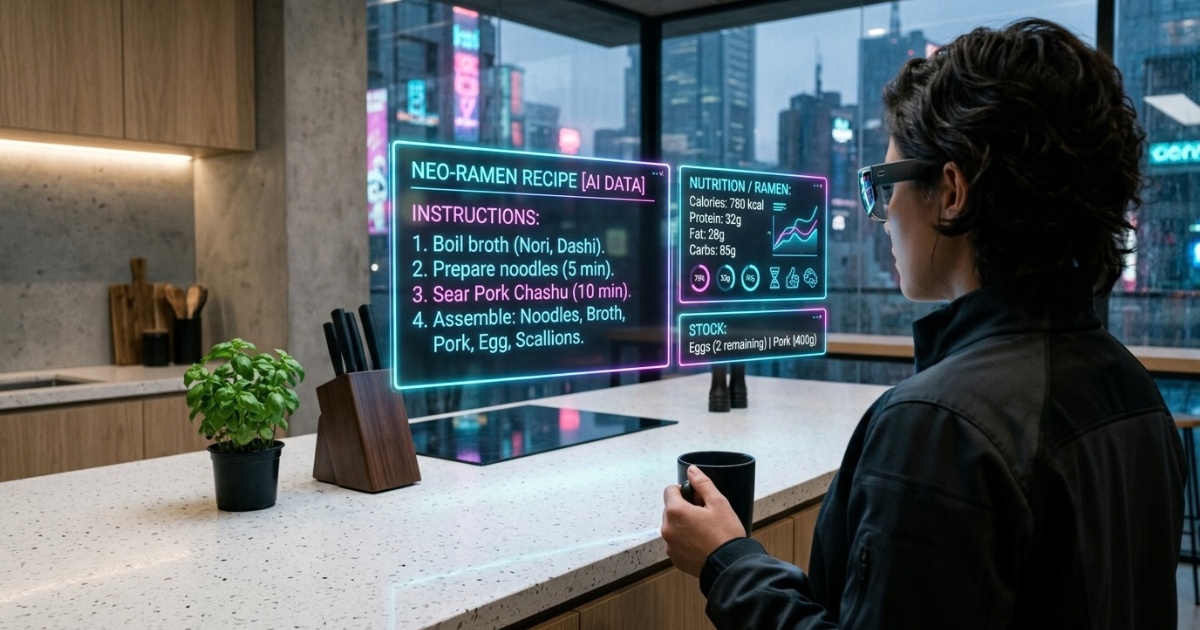
Meta’s Ray-Ban Display glasses are designed to bring visual information closer to the wearer without requiring a traditional smartphone screen.
Imagine walking through a new city.
Instead of constantly looking down at Google Maps, directions could appear within your field of view.
You could receive a notification without pulling your phone from your pocket.
You could potentially read useful information while continuing to look at the person or object in front of you.
That’s the promise of augmented reality.
The digital world doesn’t replace the physical world.
It sits on top of it.
And that distinction is extremely important.
5. Meta VR Glasses Could Change How We Work
Gaming will obviously be a major part of VR.
But productivity may be just as important.
Imagine sitting at a coffee shop in New York with a small keyboard and your glasses.
Instead of carrying two or three physical monitors, you could potentially create several virtual screens around you.
One screen for email.
One for your browser.
One for a spreadsheet.
Another for a video meeting.
Your laptop or phone could provide the computing power while the glasses provide the visual workspace.
Meta is already positioning its new VR glasses around this type of multi-screen productivity experience.
For remote workers, designers, developers and other professionals, that could eventually become a serious use case.
The office would no longer be defined by how many monitors you can physically fit on your desk.
It could be defined by how much virtual workspace your glasses can create.
6. The Real Breakthrough Could Be Hands-Free Computing
There’s something surprisingly annoying about modern technology.
Almost everything requires your hands.
Want directions?
Grab your phone.
Want to take a photo?
Grab your phone.
Want to translate something?
Grab your phone.
Want to ask an AI a question?
Grab your phone.
Wearable AI changes that pattern.
A mechanic working underneath a vehicle could potentially access instructions without touching a screen.
A traveler could ask for a translation while keeping their hands free.
A parent could take a photo without stopping what they’re doing.
A real estate agent could access information while walking through a property.
These aren’t futuristic problems.
They’re ordinary problems.
And that’s why hands-free computing could become more important than flashy VR experiences.
7. Project Orion Shows Where Meta Wants to Go
If the current Meta glasses represent the present, Project Orion represents the longer-term vision.
Meta introduced Orion as a true augmented-reality prototype designed to place digital content into the physical environment.
Unlike conventional VR, you don’t completely disappear into a virtual world.
You continue seeing the people and objects around you while digital information appears alongside them.
Imagine sitting at your kitchen table and seeing a virtual chessboard sitting on the surface.
Or receiving a video call where the other person appears as a digital representation in your environment.
Or asking an AI assistant about an object sitting directly in front of you.
That’s the type of experience Orion was designed to demonstrate.
But there’s an important distinction.
Orion is a prototype, not a mainstream consumer product.
It represents where Meta wants AR glasses to go rather than something most people can simply buy today.
8. There Is a Huge Privacy Problem
There is one issue Meta cannot ignore.
Privacy.
A smartphone camera is obvious.
If someone points a phone at you, you can normally see it happening.
Glasses are different.
Someone could be standing across from you wearing ordinary-looking eyewear that contains cameras and AI.
That creates uncomfortable questions.
Are you being recorded?
Is the AI analyzing what it sees?
Where does that information go?
Could your face or surroundings be analyzed?
Meta has introduced visible recording indicators on its AI glasses to help people understand when the camera is capturing photos or video.
But technology alone cannot solve the social problem.
Society will have to develop new expectations around recording and consent.
If AI glasses become common, simply asking someone to “put your phone away” may eventually not be enough.
9. Why Americans May Actually Care About This
The biggest reason Meta VR Glasses are attracting attention isn’t because everyone suddenly wants another gaming device.
It’s because Americans are increasingly surrounded by screens.
Phone.
Laptop.
Tablet.
TV.
Car display.
Smartwatch.
Another notification.
Another login.
Another app.
Wearable computing offers a different possibility.
Instead of adding another screen, it could eventually reduce how often we look at the screens we already have.
That’s a much more compelling idea.
Imagine going for a walk without constantly checking your phone.
Imagine navigating a new city while actually looking at the buildings around you.
Imagine getting an important message without interrupting a conversation.
Imagine asking an AI question while keeping your hands completely free.
The technology doesn’t have to replace the smartphone overnight.
It simply has to make you reach for it less often.
10. So, Are Meta VR Glasses Replacing the Smartphone?
Not yet.
And it would be misleading to say otherwise.
Today’s Meta glasses come in different forms, with different capabilities. Some focus on AI and audio. Others add displays. The newest VR glasses focus on immersive computing.
Project Orion remains a prototype.
There are still challenges involving battery life, comfort, display technology, price, privacy and social acceptance.
But something important has changed.
The conversation is no longer only about whether people want to enter virtual reality.
It is increasingly about whether people want technology to disappear into everyday life.
That is a much bigger question.
The Future of Meta VR Glasses May Be Bigger Than VR
For years, the smartphone has been the center of our digital lives.
It sits in our pockets from morning until night.
But the next major computing shift may not involve another rectangle.
It may involve something much more familiar.
A pair of glasses.
Meta’s current strategy suggests that the company doesn’t see VR, AR and AI glasses as completely separate worlds. They are pieces of a much larger attempt to change how people interact with computers.
The smartphone probably isn’t disappearing tomorrow.
But our relationship with it could change.
Instead of constantly looking down at a screen, we may eventually look forward and let technology come to us.
That is the bigger promise behind Meta VR Glasses.
The next computer may not sit in your hand.
It may not sit on your desk.
It may be resting on your nose.

I am Bhaktahari Dahal, the founder and writer of Byte and Trail. I passionately research technology, blogging, and diverse fields to deliver clear, simplified, and engaging content for my readers. Welcome aboard!