
What happens before an American customer buys something online?
Maybe they Google it.
Maybe they watch a TikTok or YouTube video. Maybe they check Reddit for honest opinions, visit a company’s website, compare prices, read reviews, and leave without buying anything.
Then, two days later, they see that same brand again.
That entire journey is digital marketing.
And that’s why digital marketing is much bigger than posting on Instagram or running a few Google ads. It is the system businesses use to get discovered, earn attention, build trust, and turn that attention into customers.
For a small business owner, creator, freelancer, startup, or established company, understanding how this system works can make the difference between being easy to find and being practically invisible online.
What Is Digital Marketing?
Digital marketing is the process of promoting a business, product, service, or brand through digital channels such as search engines, websites, social media, email, online advertising, and other internet-based platforms.
The definition sounds simple.
The reality is not.
A customer might discover a business through Google, become familiar with it through Instagram, read an article on its website, receive an email a week later, and finally purchase after seeing a targeted advertisement.
The business isn’t necessarily using one marketing method.
It’s creating several opportunities for the customer to find and trust it.
How Digital Marketing Actually Works
Think about a person searching for a new laptop.
They don’t usually search once and immediately spend $1,500.
They might start with:
“best laptop for college students”
Then:
“MacBook vs Windows laptop for college”
Then:
“best laptop under $1,500”
Finally, they may search for a specific model.
Every one of those searches represents a different stage of the buying journey.
Digital marketing works by providing useful information at those different moments.
That’s why successful businesses don’t only advertise their products. They answer questions, solve problems, demonstrate expertise, and make the buying decision easier.
The Main Parts of Digital Marketing
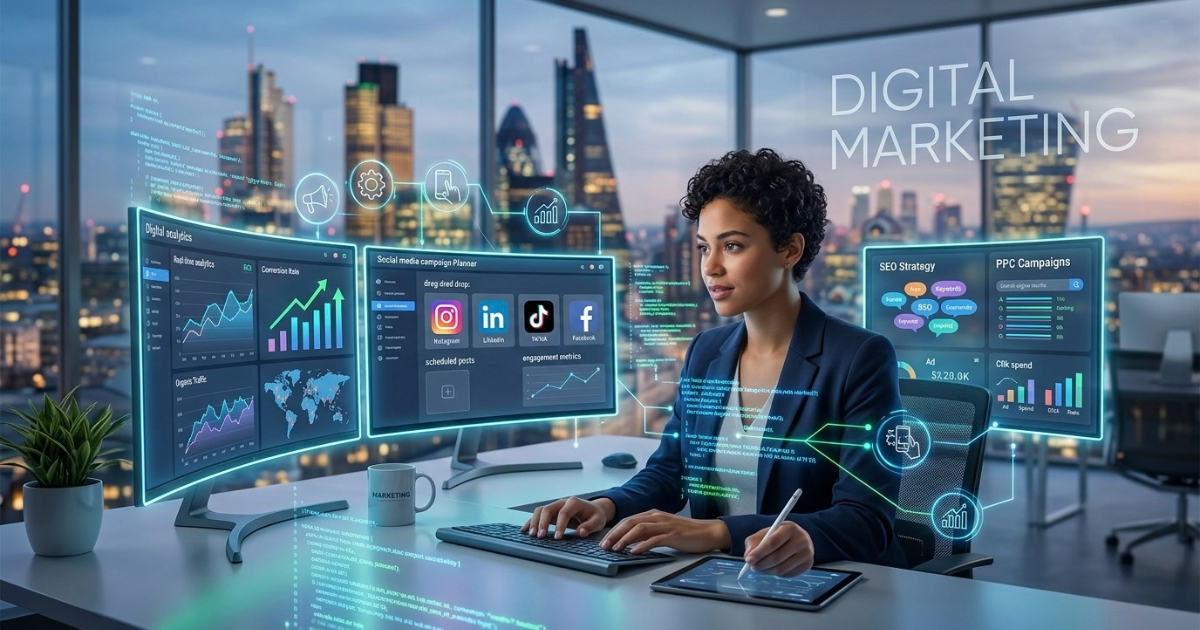
Digital marketing isn’t one channel. It’s an ecosystem.
Search Engine Optimization (SEO)
SEO helps businesses appear in organic search results when people look for information, products, or services.
A local dentist might create content about teeth whitening, dental emergencies, insurance questions, and routine checkups.
A software company might publish tutorials and comparisons.
The goal isn’t simply to put keywords on a page.
The goal is to answer the searcher’s question better than a generic advertisement can.
And search is changing.
People increasingly use conversational queries and AI-powered search tools to find answers. That means businesses need clear, useful, trustworthy information that can be understood by both people and modern search systems.
Content Marketing
Content marketing is about giving people something useful before asking them to buy.
That could be:
- Blog posts
- Tutorials
- Videos
- Guides
- Podcasts
- Case studies
- Original research
- Infographics
Imagine you’re looking for a mortgage.
A company that simply says, “Choose us!” gives you little reason to trust it.
A company that explains mortgage rates, closing costs, down payments, and common mistakes is already helping you.
That creates familiarity.
And familiarity can matter when you’re finally ready to make a decision.
Social Media Marketing
Social media allows businesses to communicate where people already spend time.
Instagram, TikTok, Facebook, LinkedIn, and YouTube can all be useful, but they don’t serve exactly the same purpose.
A restaurant might use Instagram to show food and customers.
A software company might use LinkedIn for professional education.
A creator might use YouTube to build authority.
The mistake is thinking every business needs to post everywhere.
It doesn’t.
A better strategy is to understand where your audience actually pays attention.
Pay-Per-Click Advertising
PPC advertising gives businesses the ability to pay for targeted exposure.
Google Ads can place a business in front of people actively searching for specific products or services.
Social advertising can target audiences based on different characteristics and interests, subject to each platform’s policies and available targeting options.
The major advantage is speed.
The major disadvantage is cost.
If an advertisement sends people to a poor website or weak landing page, increasing the advertising budget won’t magically solve the problem.
Email Marketing
Email remains one of the most direct ways to communicate with people who have voluntarily subscribed to a business.
A clothing company might send new-product announcements.
A software company might send product education.
A nonprofit might send monthly impact updates.
Good email marketing isn’t about filling inboxes.
It’s about sending something the subscriber actually finds useful.
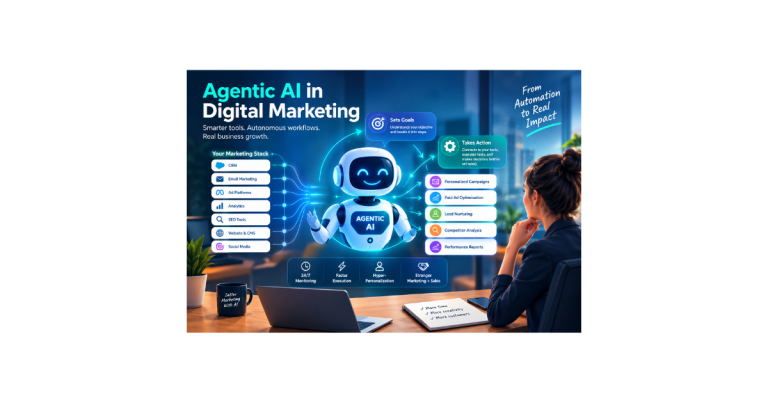
AI in Digital Marketing
AI is changing marketing workflows quickly.
Businesses can use AI to brainstorm content, summarize customer feedback, assist with research, organize campaigns, analyze information, and automate repetitive tasks.
But there’s an important catch.
The internet is becoming crowded with AI-generated material that sounds almost identical.
Publishing generic AI text faster doesn’t automatically give a business an advantage.
Human experience, fact-checking, originality, and brand personality still matter.
AI can help a marketer work faster.
It doesn’t replace knowing the customer.
Why Digital Marketing Is So Important for Small Businesses
A large corporation can spend millions on advertising.
A small business usually can’t.
Digital channels can give smaller businesses opportunities to compete for attention without requiring a national television campaign.
Consider a local roofing company.
It could create a useful website, maintain accurate local information, collect legitimate customer reviews, publish answers to common roofing questions, and run targeted search advertising.
A homeowner searching for a roofer doesn’t necessarily care how big the company is.
They care whether they can find it, trust it, and contact it easily.
That’s where a strong digital presence becomes valuable.
Digital Marketing Is Also About the Customer Experience
Getting someone onto your website is only the beginning.
What happens next matters.
If the site loads slowly, looks confusing on a phone, hides prices, makes contact difficult, or has broken links, the marketing campaign may have done its job only to lose the customer afterward.
That’s why marketing and website experience cannot really be separated.
A successful journey might look like this:
Search → Website → Useful information → Trust → Contact → Purchase
If one part breaks, the entire journey can become harder.
How Businesses Measure Digital Marketing
One advantage of digital marketing is that businesses can measure many parts of the customer journey.
Important metrics can include:
- Website traffic
- Search impressions
- Click-through rate
- Conversion rate
- Cost per lead
- Email engagement
- Advertising return
- Customer acquisition cost
- Repeat purchases
But more data isn’t automatically better.
The useful question is:
What does this number tell us about what customers are doing?
For example, thousands of website visitors sound impressive.
But if almost nobody contacts the business or purchases anything, traffic alone isn’t solving the business problem.
Common Digital Marketing Mistakes
Some businesses make digital marketing harder than it needs to be.
Trying to be everywhere: Focus on channels that actually reach your audience.
Writing only for search engines: People still decide whether content is worth reading.
Chasing viral posts: Attention from the wrong audience may have little business value.
Ignoring reviews: Customers often research a business before contacting it.
Forgetting mobile users: A website that works poorly on smartphones can lose potential customers.
Using AI without human review: Errors and generic content can damage trust.
Running ads without tracking conversions: Clicks aren’t the same as customers.
The Future of Digital Marketing
The technology will continue changing.
Search is becoming more conversational. AI is becoming part of content creation and discovery. Social platforms continue to influence buying decisions. Customers expect faster answers and more personalized experiences.
But the fundamental principle hasn’t changed.
People want businesses that understand their problems and provide useful solutions.
The tools may change.
The platforms may change.
The algorithms may change.
The need for trust doesn’t.
Final Thoughts
Digital marketing isn’t simply about getting more clicks.
It’s about being present when people are looking for answers, products, services, and trustworthy businesses.
SEO helps people discover you. Content helps them understand you. Social media helps them become familiar with you. Email keeps the relationship alive. Paid advertising can put you in front of people at the right moment. AI can make the work more efficient.
When those pieces work together, digital marketing becomes more than online promotion.
It becomes the path between a customer’s problem and your solution.

I am Bhaktahari Dahal, the founder and writer of Byte and Trail. I passionately research technology, blogging, and diverse fields to deliver clear, simplified, and engaging content for my readers. Welcome aboard!