
If your marketing team is still figuring out how to get the most out of ChatGPT, there’s already another shift happening.
It’s called agentic AI.
And this time, the big change isn’t simply about AI writing faster blog posts, creating ad copy, or generating images.
It’s about AI actually doing the work.
Imagine telling an AI system, “Find our highest-value leads from last month, figure out which ones are most likely to buy, create a personalized follow-up campaign, and show me the final plan.”
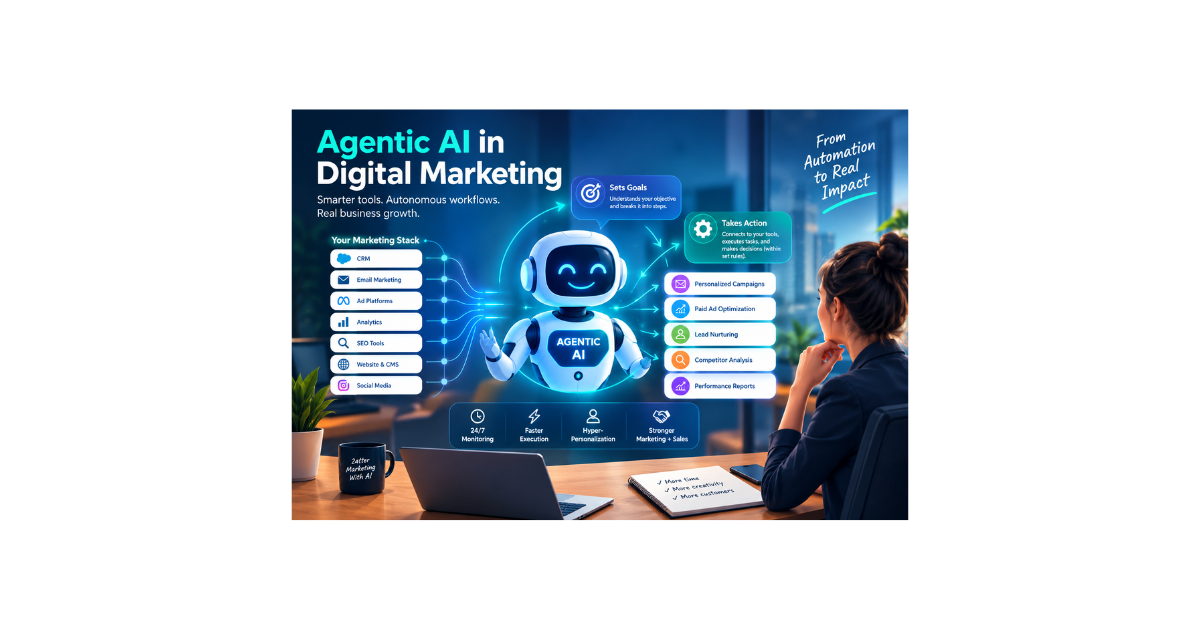
Instead of giving you a paragraph of suggestions and waiting for your next prompt, an agentic AI system can potentially break that goal into smaller tasks, use connected software, analyze information, make decisions within defined rules, and carry out parts of the workflow automatically.
That is a very different idea from the chatbot model most people are familiar with.
And for digital marketing, it could become one of the biggest changes since automation, social media, and search advertising transformed the industry.
1. What Is Agentic AI? A Simple Explanation
The easiest way to understand agentic AI is to compare it with the AI tools marketers already use.
Think about a typical generative AI tool.
You type:
“Write an email promoting our new software.”
The AI writes the email.
You review it.
You make changes.
Then you copy it into your email platform, choose the audience, schedule the campaign, and check the results later.
The AI helped you with one part of the job.
Agentic AI takes a different approach.
Instead of asking an AI system to perform one isolated task, you can give it a broader objective.
For example:
“Find customers who abandoned high-value purchases last month and create a recovery campaign.”
An agentic system could potentially:
- Analyze customer and purchase data
- Identify relevant customers
- Look at previous interactions
- Segment the audience
- Research the customer’s context
- Recommend an offer
- Create personalized messaging
- Connect with an email or CRM platform
- Launch an approved campaign
- Monitor the results
- Adjust the workflow based on performance
The important difference is autonomy.
Generative AI is largely about creating something when you ask.
Agentic AI is about pursuing a goal through multiple steps.
That doesn’t mean an AI agent should have unlimited control over your business. In fact, responsible implementation usually requires permissions, rules, monitoring, and human approval.
But the underlying idea is powerful:
Generative AI helps you produce. Agentic AI helps you execute.
2. Why Agentic AI Is Becoming a Big Deal for Digital Marketing
Marketing has become incredibly complicated.
A typical marketing team may work with Google Analytics, a CRM, an email platform, social media dashboards, advertising platforms, SEO tools, spreadsheets, customer-support software, and dozens of other systems.
Each tool produces useful information.
The problem is getting all of that information to work together.
A marketer might spend the morning checking ad performance, the afternoon researching competitors, and the next few hours building an email campaign.
None of those tasks are necessarily difficult.
They are just time-consuming.
That is where agentic AI becomes interesting.
Instead of having humans constantly move information from one platform to another, AI agents could increasingly act as the connection between different systems.
For example, imagine an ecommerce company notices that sales have dropped.
Today, someone might need to:
- Open the analytics dashboard.
- Check traffic.
- Look at conversion rates.
- Review advertising performance.
- Check the website.
- Compare competitors.
- Look at customer feedback.
- Build a report.
- Decide what to test next.
An agentic workflow could potentially monitor many of these signals continuously and bring the most important changes to the marketing team.
The human still makes the important strategic decisions.
But the machine handles more of the repetitive investigation.
That is the real attraction.
3. How Agentic AI Could Change Traditional Marketing Workflows
The biggest change won’t necessarily come from one amazing AI feature.
It will come from dozens of small marketing tasks becoming connected.
Paid Advertising
Traditional advertising optimization often requires someone to constantly watch campaigns.
A marketer checks cost per acquisition, conversion rates, click-through rates, creative performance, and budget allocation.
If something looks wrong, they investigate and make changes.
An AI agent could eventually monitor these signals continuously.
For example, if a campaign’s performance falls outside a predefined range, an agent could flag the problem, identify possible causes, suggest budget changes, generate new creative variations, and send the recommendation to a marketer for approval.
For businesses running large numbers of campaigns, that could save significant time.
The key word is approval.
Giving an AI unrestricted access to an advertising budget is a completely different risk from allowing it to recommend a change.
Smart businesses will likely use both automation and limits.
Lead Generation and Follow-Up
Lead follow-up is another area where agentic AI could make a noticeable difference.
Consider what happens after someone fills out a B2B contact form.
The lead enters the CRM.
An automated email might be sent.
Then the salesperson has to research the company, check the person’s role, look for recent business developments, and decide what to say next.
An AI agent could potentially handle much of that research.
It could identify the company, summarize relevant information, review the lead’s previous interactions, and prepare a personalized follow-up.
With the right integrations and permissions, it could even help coordinate scheduling.
Instead of salespeople spending hours researching every lead, they could spend more time having actual conversations.
SEO and Competitor Research
SEO is another obvious use case.
A marketer might spend hours comparing competitors, checking rankings, reviewing content gaps, monitoring backlinks, and looking for changes on competing websites.
An agentic system could continuously monitor selected competitors and notify the team when something important changes.
For example:
“Your competitor just launched three pages targeting keywords where your site currently ranks on page two.”
That is much more useful than simply receiving another spreadsheet full of data.
The agent isn’t replacing SEO strategy.
It is reducing the amount of manual work required to find the information that strategy depends on.
4. The Biggest Benefits of Agentic AI for Marketers
The appeal of agentic AI comes down to several practical advantages.
24/7 Monitoring
People don’t spend all day watching dashboards.
AI systems can.
An agent could continuously monitor campaign performance, website behavior, customer signals, inventory information, or other marketing data according to the permissions it has been given.
That means problems can potentially be identified earlier.
Faster Execution
Marketing often moves slowly because every action requires several small steps.
Research.
Analysis.
Writing.
Approval.
Publishing.
Measurement.
Automation can compress that process.
Instead of spending an entire afternoon preparing a campaign, a marketer could potentially review an AI-generated workflow and approve it in minutes.
More Personalized Marketing
Most “personalization” today isn’t particularly personal.
Adding someone’s first name to an email isn’t exactly revolutionary.
Agentic AI could make personalization much more contextual.
With appropriate customer data and privacy controls, an AI system could consider previous purchases, browsing behavior, support interactions, preferences, and other relevant signals when deciding what message or offer makes sense.
That could move marketing from:
“Hey John, check out our latest products.”
to something much closer to:
“You looked at this product twice, bought a similar item six months ago, and recently returned to the category. Here’s why this version may fit what you’re looking for.”
There is a huge difference between the two.
Better Coordination Between Marketing and Sales
Marketing and sales have historically struggled with handoffs.
Marketing generates leads.
Sales receives them.
Then sales decides which leads are worth pursuing.
Agentic AI could help connect these stages.
An AI system could identify promising leads, gather context, score them based on defined criteria, prepare a personalized message, and notify the appropriate salesperson.
The result could be fewer cold handoffs and more informed conversations.
5. Agentic AI Is Powerful, but It Can Also Make Bigger Mistakes
This is where the conversation needs to become more realistic.
AI autonomy sounds exciting until the system makes a mistake with actual business consequences.
If a chatbot writes a bad sentence, a human usually catches it before publishing.
If an autonomous system has access to your advertising account, CRM, email platform, or ecommerce system, the consequences can be much larger.
Imagine an AI agent incorrectly interpreting a promotion.
Instead of offering a 10% discount to a small customer segment, it sends a 90% discount to your entire database.
Or imagine an agent incorrectly identifies a campaign as underperforming and moves thousands of dollars of advertising budget into the wrong audience.
The technology isn’t necessarily the problem.
The problem is giving a system too much authority without enough control.
That’s why guardrails will become one of the most important parts of agentic AI adoption.
6. Human-in-the-Loop Will Still Matter
The idea that AI will completely replace marketers is probably too simplistic.
A more realistic future looks like this:
AI handles more execution. Humans handle more judgment.
For example, an AI agent could research competitors, analyze customer behavior, build a campaign, write the messaging, and prepare everything for launch.
But before the campaign goes live, a human approves it.
This is known as a human-in-the-loop approach.
It creates a useful balance.
The AI gets to work quickly.
The human remains responsible for decisions involving brand reputation, money, customers, privacy, and business strategy.
Businesses can also create different permission levels.
An agent might be allowed to:
- Read analytics data
- Create reports
- Draft emails
- Recommend budget changes
- Prepare campaigns
But it may not be allowed to:
- Spend above a certain amount
- Publish sensitive content
- Change pricing
- Delete customer data
- Send mass campaigns without approval
That’s a much safer way to introduce autonomy.
7. What Agentic AI Means for Marketing Jobs
This is probably the question many marketers are quietly asking:
Will AI replace my marketing job?
Some tasks will almost certainly become less valuable.
Basic reporting.
Manual data entry.
Simple content production.
Routine campaign adjustments.
Repetitive research.
But marketing itself isn’t disappearing.
In many cases, the role is likely to change.
The marketer of the future may spend less time clicking through dashboards and more time deciding:
- What should the AI accomplish?
- What data should it have access to?
- What decisions can it make?
- What decisions require approval?
- How should success be measured?
- Is the output actually good for the customer?
- Does the strategy make sense for the brand?
In other words, marketers may increasingly become managers of AI-powered workflows.
That requires a different skill set.
Understanding customers will still matter.
Strategy will still matter.
Creativity will still matter.
And good judgment may become even more valuable.
8. How Businesses Can Prepare for the Agentic AI Era
You don’t need to build your own AI model to prepare for this shift.
You can start with the infrastructure you already have.
Clean Up Your Data
AI is only as useful as the information it can access.
If your CRM contains duplicate customers, outdated information, missing fields, and inconsistent records, an autonomous system can make bad decisions very quickly.
Before adding more automation, clean up the data.
Make sure customer information is accurate, organized, and properly permissioned.
Choose Tools That Can Connect
Agentic AI depends heavily on integrations.
Your CRM needs to communicate with your marketing platforms.
Your analytics tools need to provide useful data.
Your automation software needs reliable connections.
That makes APIs and integrations increasingly important when choosing business software.
A tool that works well by itself may not be nearly as useful if it cannot communicate with the rest of your technology stack.
Start With Low-Risk Tasks
Don’t give an AI agent control of everything on day one.
Start small.
Let it summarize reports.
Monitor competitors.
Analyze campaign performance.
Draft emails.
Identify potential leads.
Create research briefs.
Once you understand how the system behaves, you can gradually expand its responsibilities.
Set Clear Guardrails
Decide what the AI is allowed to do before you connect it to important systems.
Set spending limits.
Require approvals.
Restrict access to sensitive information.
Create escalation rules.
Keep logs of important actions.
The goal isn’t to eliminate human involvement.
The goal is to make human involvement happen where it matters most.
The Bottom Line: Agentic AI Is More Than Another AI Trend
We’ve already seen several waves of AI enter digital marketing.
First came machine learning.
Then marketing automation became mainstream.
Generative AI changed content creation.
Now agentic AI is pushing the conversation toward something bigger:
What happens when AI doesn’t just generate an answer, but takes action toward a goal?
That question could reshape digital marketing.
The biggest opportunity isn’t simply producing more content.
Most companies already produce too much content.
The opportunity is building marketing systems that can observe what’s happening, understand the situation, recommend what should happen next, and eventually carry out approved actions.
But businesses shouldn’t rush to give AI unlimited control.
The winners are more likely to be the companies that combine AI autonomy with human judgment.
Let AI handle the repetitive work.
Let humans handle the decisions that require context, empathy, creativity, and responsibility.
That’s the real promise of agentic AI.
It isn’t about replacing the marketer sitting behind the computer.
It’s about changing what that marketer spends their time doing.
And if today’s generative AI wave taught businesses anything, it’s that the companies that learn how to adapt early usually have a much easier time when the next wave arrives.

I am Bhaktahari Dahal, the founder and writer of Byte and Trail. I passionately research technology, blogging, and diverse fields to deliver clear, simplified, and engaging content for my readers. Welcome aboard!