
Let’s be honest before we go any further: a lot of the “make money with AI” advice flooding social media makes it sound ridiculously easy.
You’ve probably seen the videos.
Someone generates a few prompts, posts some AI-written content, opens a freelance account, and suddenly claims they’re making thousands of dollars every month.
Sounds great, right?
Then you try the same thing.
You create an AI article. You publish a freelance gig. You send a few pitches.
And… nothing.
No clients. No sales. No magical deposit into your bank account.
Here’s the part that often gets skipped: people don’t pay you simply because you know how to use an AI tool. They pay for the result you create with it.
A business owner can already access many of the same tools you can.
So if your entire offer is, “I can generate text with AI,” there isn’t much reason for that business to hire you.
The better opportunity is to use AI as a productivity layer behind a service, product, or business that solves a real problem.
Think of AI as your digital assistant.
It can help you research, organize, draft, analyze, automate, and repurpose work. You bring the judgment, creativity, strategy, and final quality control.
That’s where things get interesting.
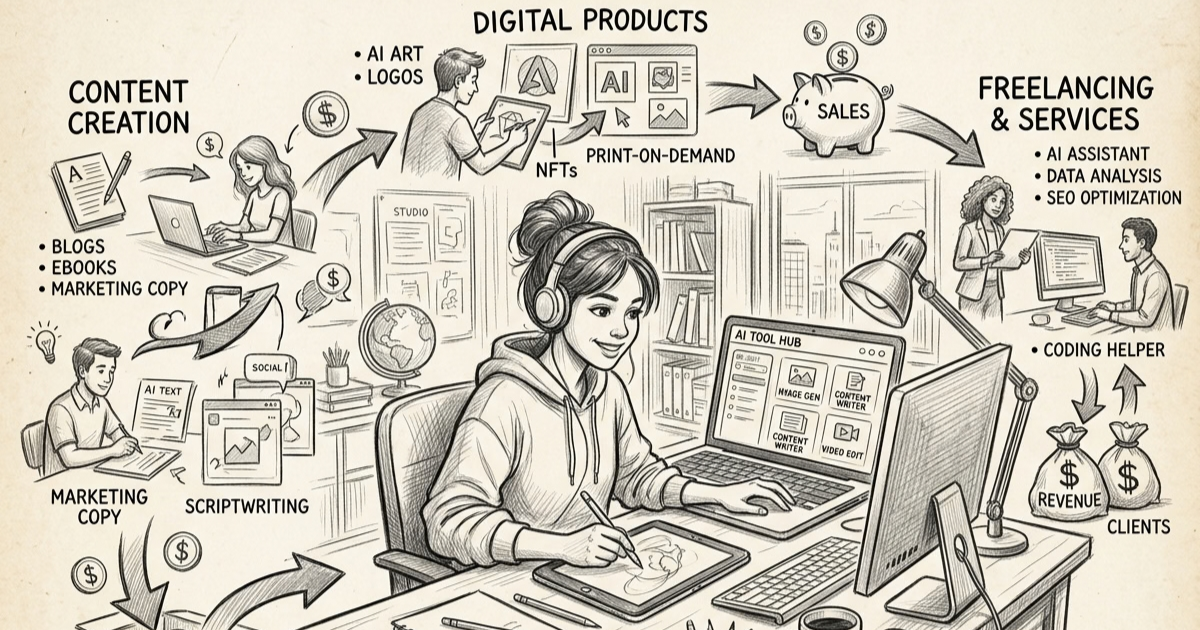
If you want to learn how to make money with ai tools without relying on unrealistic overnight-income promises, here are 10 practical models worth exploring in 2026.
How to Make Money With AI Tools: 10 Proven Ways
Freelancing is still one of the simplest places to start because you don’t necessarily need to build a product first.
You need a useful skill and a clear offer.
AI can make many freelance tasks faster, but the client is paying for the finished work—not the tool sitting behind it.
For example, you could offer:
- Blog writing and editing
- Email marketing
- Product descriptions
- Social media copy
- Video scripts
- SEO content
- Research and summaries
- Presentation design
- Resume and LinkedIn help
- Business documents
The important difference is how you position the service.
Instead of saying:
“I use AI to write blog posts.”
You could say:
“I help small businesses turn complex topics into clear, search-friendly blog content.”
That sounds like a service with an outcome.
A simple workflow might look like this:
Client Brief → AI-Assisted Research → First Draft → Human Editing → Strategic Improvements → Final Delivery
AI handles some of the repetitive work.
You handle the parts that actually require judgment.
That combination can make a basic freelance service much more efficient without turning the final product into generic machine-written content.
2. Creative Ways to Create Content Faster With AI
Content can become a business when you build an audience around a specific topic.
That could be a blog, newsletter, YouTube channel, podcast, or niche social media account.
AI can help with brainstorming, outlining, research organization, repurposing, and editing.
But there’s a catch.
The internet already has plenty of generic content.
If you simply ask an AI tool to write an article, publish it, and repeat the process 100 times, you’re not necessarily building something people want to follow.
The content needs a reason to exist.
Add things that are actually yours:
- Personal experiments
- Original research
- Screenshots
- Interviews
- Real examples
- Comparisons
- First-hand observations
- Useful data
- Clear explanations
Imagine two articles about productivity apps.
One lists 20 tools with basic descriptions.
The other tests five tools for a week, explains what worked, shows the setup, compares the pricing, and tells readers which type of user each tool fits.
The second article gives people something they can’t get from a generic list.
That’s the difference between producing content and building useful content.
3. Simple Ways to Build Valuable Digital Products
Digital products are another interesting way to use AI without selling AI itself.
You could create:
- Templates
- Spreadsheets
- Checklists
- Planners
- Presentation templates
- Productivity systems
- Client onboarding documents
- Research templates
- Industry guides
- Business worksheets
AI can help you brainstorm ideas, organize information, improve instructions, and speed up the creation process.
But specificity matters.
A generic “Ultimate Productivity Planner” is competing with countless similar products.
Something like “30-Day Cold Email System for Commercial Real Estate Brokers” is much more specific.
It tells the buyer exactly who it is for and what problem it addresses.
That’s a useful rule to remember:
Specific beats generic.
Before creating a product, ask yourself:
Who is this for, and what annoying problem does it solve?
If you can answer that clearly, you’re already thinking like a product creator instead of someone simply generating another AI file.
4. Effective Ways to Provide Social Media Services
Small businesses often know they should be active on social media.
The problem is finding the time to actually do it.
That creates an opportunity for people who can combine AI with practical social media skills.
You could create a monthly service that includes:
- Content ideas
- Captions
- Graphic concepts
- Short-form video ideas
- Content calendars
- Platform-specific posts
- Basic performance summaries
But don’t treat every business the same.
A local coffee shop and a software company need completely different content.
Even the same idea may need a different approach on Instagram, LinkedIn, Facebook, or TikTok.
AI can help you produce variations quickly.
You still need to decide whether those variations make sense for the audience.
That human layer is what turns an AI-generated draft into an actual social media service.
5. Practical Ways to Grow With Affiliate Marketing
Affiliate marketing works by recommending products or services through tracked links, with commissions paid when qualifying purchases or actions occur.
It sounds simple.
Getting people to trust your recommendations is the harder part.
Instead of creating endless “best tools” lists, focus on content that helps someone make a decision.
For example:
- Tool A vs. Tool B
- Best software for freelancers
- Alternatives for small businesses
- Best tools for a specific workflow
- What to use if you have a limited budget
- Which option fits a particular type of user
AI can help research topics, organize comparisons, and create content drafts.
But always verify important details yourself, especially pricing, features, limitations, integrations, and policies.
If your only goal is to push the product with the highest commission, readers can eventually notice.
Useful affiliate content should help people choose—not simply convince them to click.
6. Powerful Ways to Start an AI-Assisted Video Business
Video production can take a lot of time.
That’s exactly where AI-assisted workflows can become useful.
For example, imagine a business owner has a 60-minute podcast episode.
You could turn that one recording into:
- Short vertical videos
- YouTube Shorts
- Instagram Reels
- TikTok clips
- Quote graphics
- Captions
- Blog content
The workflow could look something like this:
Long Video → AI-Assisted Clip Selection → Vertical Format → Human Editing → Final Short
AI can help identify interesting moments and speed up repetitive editing tasks.
But you still need to watch the final video.
A clip that looks perfect on paper might be boring in context. A sentence might need more setup. A cut might happen at exactly the wrong moment.
That’s why the service isn’t simply “AI video generation.”
It’s turning existing content into useful video assets without making the client do all the work themselves.
7. Proven Ways to Help Businesses With AI Automation
Automation can become more valuable when you stop selling the technology and start selling the outcome.
Businesses have plenty of repetitive tasks.
For example:
- Lead follow-ups
- Document processing
- Customer support
- Internal reports
- Data organization
- Appointment workflows
- Email sorting
- Repetitive administrative work
Instead of telling a business owner:
“I build AI automations.”
You could explain the result:
“I help your team reduce repetitive administrative work.”
That conversation is much easier to understand.
The technical side might involve several tools working together behind the scenes.
The client doesn’t necessarily care about every technical detail.
They care about whether the workflow works reliably and saves them time.
That’s why understanding the business process can matter just as much as understanding the technology.
8. Exciting Opportunities With AI Voice Agents
AI voice systems are opening another area for specialized services.
Businesses may use voice agents for tasks such as:
- Answering common questions
- Handling appointment requests
- Qualifying leads
- Providing business hours
- Routing calls
- Collecting basic customer information
But this area needs more care than simply connecting a voice system and turning it loose.
Calls can involve misunderstandings, unusual questions, sensitive information, or situations that require a real person.
A useful system should have clear boundaries and a human handoff when necessary.
Testing matters, too.
You want to know what happens when someone asks an unexpected question, changes their request halfway through a call, or becomes frustrated.
The opportunity here is not just building a voice bot.
It’s helping a business create a reliable customer communication workflow.
9. Smart Ways to Build a Niche Micro-SaaS Product
If you have more technical skills—or are willing to learn them—micro-SaaS can be another path.
The idea is relatively simple:
Build a small software product that solves one specific problem for one specific group of users.
That could mean software for:
- Contractors
- Freelancers
- Local businesses
- Agencies
- Recruiters
- Consultants
- Property managers
The mistake is trying to build everything at once.
Look for a boring problem.
Boring can be good.
Maybe a particular group spends hours every week creating the same report. Maybe they repeatedly organize the same information in spreadsheets. Maybe they need a simple tool for a workflow that larger software platforms make unnecessarily complicated.
Start small.
Describe the workflow.
Build a basic version.
Get feedback from real users.
Then improve it.
AI can help with research, coding assistance, documentation, testing ideas, and prototyping. But a useful SaaS product still needs a real customer problem behind it.
10. Rewarding Ways to Build a Premium AI-Enhanced Newsletter
Newsletters can become valuable when readers know exactly why they should open them.
The topic could be narrow enough to create a strong identity, such as:
- AI in healthcare
- Fintech
- Startup funding
- Cybersecurity
- Marketing technology
- Creator businesses
- Emerging software
AI can help monitor information, organize research, summarize large amounts of material, and turn rough notes into a structured draft.
The human editor still has an important job.
You decide what actually matters.
You decide what can be ignored.
And you decide how to explain it in a way your readers will understand.
A newsletter can eventually have several revenue options, including sponsorships, premium subscriptions, affiliate partnerships, and related products or services.
The real asset, though, is the audience.
You’re building a direct relationship with people who have chosen to hear from you regularly.
A Simple Income Framework to Compare Your Options
Not every AI business model requires the same skills, time, or technical ability.
Here’s a simple way to look at the differences:
| Model | Technical Difficulty | Main Advantage |
|---|---|---|
| Freelance Services | Low | Easy to start with an existing skill |
| Content Business | Low-Medium | Builds a long-term audience |
| Digital Products | Low-Medium | Can be sold repeatedly |
| Social Media Services | Low-Medium | Addresses a clear business need |
| Affiliate Marketing | Low-Medium | Can scale with useful content |
| Video Services | Medium | Helps businesses produce more content |
| AI Automation | Medium | Solves operational problems |
| Voice Agents | Medium-High | Specialized service opportunity |
| Micro-SaaS | High | Can support a recurring-revenue model |
| Premium Newsletter | Medium | Builds an owned audience |
The table isn’t a promise of income.
It’s simply a reminder that different models come with different trade-offs.
If you already have a skill, starting there may make more sense than trying to learn an entirely new business model from scratch.
Three AI Money-Making Traps to Avoid in 2026
1. The “Push a Button and Get Rich” Trap
AI can make certain tasks dramatically faster.
That doesn’t mean every AI-generated business automatically becomes profitable.
There’s still a gap between creating something and getting someone to pay for it.
You need an audience, a customer, a useful offer, or some combination of the three.
2. The Generic Content Trap
AI makes it incredibly easy to produce more content.
That’s also the problem.
When everyone can create something quickly, the useful stuff becomes easier to notice.
Don’t compete by publishing more generic pages.
Compete by being more specific, more useful, more original, or more knowledgeable about the problem you’re solving.
3. The Tool-Collector Trap
You don’t need 20 AI subscriptions to get started.
You need a workflow that works.
It’s easy to spend hours comparing tools instead of actually doing the work.
Pick the tools you need.
Learn them properly.
Then focus on the customer problem.
Your 30-Day AI Income Experiment
If you’re serious about testing one of these ideas, don’t spend the next three months endlessly researching.
Run a small experiment.
Days 1–7: Find a Problem
Choose one audience.
Talk to people in that audience if you can.
Look for repetitive tasks, expensive problems, frustrating workflows, or work people consistently complain about.
Don’t start with the AI tool.
Start with the problem.
Days 8–14: Build Your Offer
Turn the problem into a simple offer.
For example:
“I help local businesses turn one long-form video into 10 short-form social clips each month.”
That’s much easier to understand than:
“I provide AI-powered content solutions.”
Be specific about what you deliver.
Days 15–21: Create Your Portfolio
You don’t necessarily need ten clients before showing what you can do.
Create a few realistic samples.
Build a sample before-and-after project.
Show the process.
Explain the result.
Make it easy for someone to understand what they would actually receive.
Days 22–30: Start Selling
This is the part many people avoid.
Send outreach.
Apply for relevant freelance opportunities.
Talk to potential customers.
Post useful examples.
Ask for feedback.
And pay attention to the responses.
If nobody understands your offer, improve the offer.
If people understand it but don’t care, reconsider the problem.
If people keep asking for a slightly different service, that feedback may be useful too.
You don’t need to get everything perfect before you start.
You need enough information to know whether the idea deserves another month of your time.
Final Thoughts
Learning how to make money with ai tools isn’t really about discovering one secret application.
It’s about finding a problem that matters and using technology to solve it more efficiently.
AI can help you research faster.
It can help you create faster.
It can help you automate repetitive work.
It can help you turn one piece of content into several.
It can even help you prototype software that once required a much larger development effort.
But none of that removes the fundamentals.
You still need customers.
You still need quality.
You still need trust.
And you still need to deliver something people consider valuable.
The smartest place to start isn’t with 20 AI subscriptions.
Start with one problem, one audience, and one useful offer.
Build something people actually want.
Then use AI to make the process faster, better, and easier to scale.
That’s a much more realistic approach than chasing the latest “easy money with AI” trend.
And if you stick with it, you may end up with something more valuable than a viral screenshot:
a real business skill you can keep improving.

I am Bhaktahari Dahal, the founder and writer of Byte and Trail. I passionately research technology, blogging, and diverse fields to deliver clear, simplified, and engaging content for my readers. Welcome aboard!