
Introduction
Search engine optimization used to follow a fairly simple formula: find a keyword, create useful content, rank on Google, attract visitors, and turn those visitors into customers.
That formula still matters, but Google Search has become much more complicated.
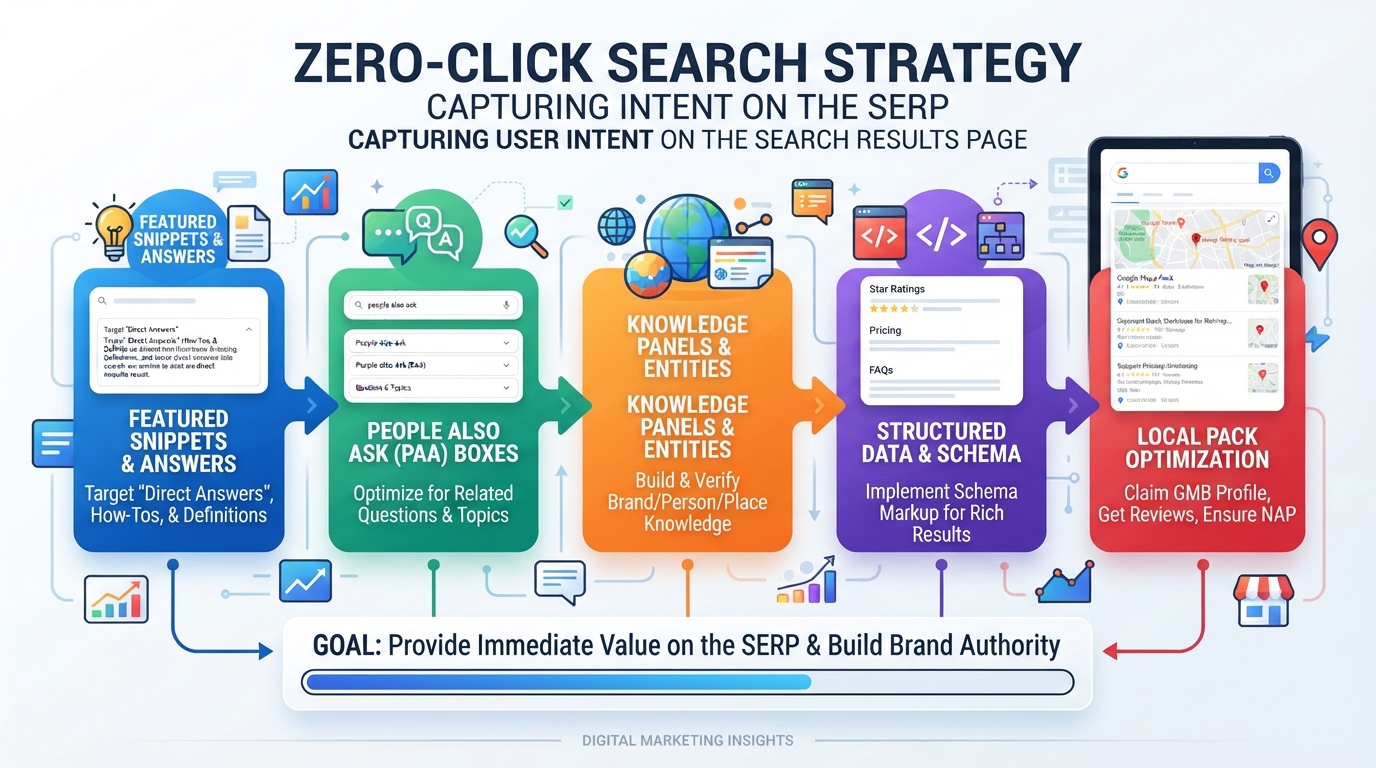
Today, a person can search for a question and receive an answer directly on the search results page. They may see a featured snippet, a People Also Ask box, a local result, a knowledge panel, a calculator, or an AI-generated answer before they ever reach an organic website.
This behavior is known as a zero-click search.
A zero-click search happens when someone completes their search journey without clicking an external website from the results page. For website owners, this can look like a problem. However, it also creates a different SEO opportunity.
Instead of thinking only about getting the click, businesses can work on becoming the source Google uses to answer the search.
That is where a Zero-Click Search Strategy becomes valuable.
The goal is not simply to rank a page. It is to make your brand visible across the search results, provide a useful answer, earn recognition, and create reasons for users to look for your website when they need deeper information.
In this guide, we will explore practical ways to adapt your SEO strategy to the changing search environment.
1. Understand Why Zero-Click Searches Matter
The first step in building a successful Zero-Click Search Strategy is understanding what is actually happening on the search results page.
Google increasingly tries to answer straightforward questions before a user needs to visit another website.
For example, imagine someone searches:
“What is the ROI formula in digital marketing?”
The person may immediately see a formula, explanation, related questions, or an AI-generated summary.
They may get everything they need without clicking a traditional blue link.
That does not automatically mean that SEO has become useless.
It means the definition of SEO success is becoming broader.
Your website can benefit from search visibility in several ways:
- Appearing in featured snippets
- Being included in People Also Ask results
- Becoming a source for search-generated answers
- Increasing brand recognition
- Generating branded searches
- Supporting customer trust
- Attracting clicks for deeper or more actionable information
This creates an important distinction.
A search impression does not always need to become an immediate website visit to have value.
Someone may first discover your brand through a Google result today and search for the brand directly tomorrow.
For example, a user might initially search for:
“best SEO audit checklist”
Later, that same person could search:
“Byte and Trail SEO audit checklist”
The first search creates discovery. The second creates a stronger brand connection.
This is why modern SEO should consider both traffic acquisition and search visibility.
2. Identify the Search Features Taking Your Traffic
Before changing your content, examine the search results for your important keywords.
Not every keyword produces the same type of SERP.
Some searches still generate a traditional list of organic results. Others are filled with additional search features.
Common zero-click or reduced-click environments include:
- Featured snippets
- People Also Ask
- Knowledge panels
- Local packs
- Direct-answer boxes
- Calculators
- Image results
- Video results
- AI-generated search experiences
Consider a simple search such as:
“When was Google founded?”
The user probably does not need to read a 2,000-word article to answer that question.
Google can provide the basic fact almost instantly.
Now compare that with:
“How do I perform a complete technical SEO audit?”
This search involves many steps, tools, examples, technical checks, and possible problems.
A user who wants to actually perform the audit may still need a detailed resource.
This difference is extremely important for content planning.
Some topics naturally have a higher probability of being answered directly on the search page. Others create a stronger reason for users to visit a website.
Your SEO strategy should recognize both types.
3. Choose Keywords With Real Click Potential
One of the smartest ways to respond to zero-click search is to stop treating every keyword equally.
A simple informational query may have limited click potential.
For example:
“What is CTR?”
Google can explain the basic definition very quickly.
But a more specific query such as:
“How to improve CTR for a SaaS landing page”
requires more context.
The user may want examples, testing methods, benchmarks, tools, screenshots, and practical recommendations.
That creates a stronger reason to visit a website.
When researching keywords, ask yourself three questions:
Does Google already answer this query completely?
Does the user need detailed instructions?
Could additional information change the user’s decision?
If the answer to the second or third question is yes, the keyword may offer better opportunities for meaningful traffic.
This does not mean you should completely avoid simple informational keywords.
They can still be useful for building topical authority and increasing brand visibility.
Instead, combine them with deeper topics.
For example:
Basic topic:
What is technical SEO?
Deeper topic:
How to perform a technical SEO audit step by step
Actionable topic:
Technical SEO audit checklist for WordPress websites
Commercial topic:
Best technical SEO tools for WordPress
Together, these topics can create a content ecosystem instead of relying on a single keyword.
4. Use the Inverted Pyramid to Capture Featured Snippets
Featured snippets reward content that makes answers easy to identify.
One effective approach is the inverted pyramid structure.
The idea is simple:
Answer first. Explain second.
Instead of writing several paragraphs before answering the question, give a concise response immediately below the relevant heading.
For example:
What Is a Zero-Click Search Strategy?
A zero-click search strategy is an SEO approach designed to increase visibility when users receive information directly from Google’s search results without visiting a website. It focuses on features such as featured snippets, People Also Ask, structured data, and other search-result elements.
After the direct answer, you can provide additional explanation, examples, and practical steps.
This structure helps several audiences at once.
Humans can understand the answer quickly.
Search engines can identify the main information more easily.
Readers who want more detail can continue into the deeper section.
For list-based queries, use clean formatting.
For example:
How to Improve Organic Search Visibility
- Research the search intent.
- Create a direct answer.
- Structure the page with clear headings.
- Add relevant supporting information.
- Use appropriate structured data.
- Monitor search performance.
Simple formatting can make complicated information easier to process.
5. Build Content Around People Also Ask Questions
People Also Ask, commonly known as PAA, can provide valuable clues about what searchers want to know next.
Suppose your main topic is:
Zero-Click Search Strategy
Google may show related questions such as:
- What is a zero-click search?
- How do zero-click searches affect SEO?
- How do featured snippets work?
- How can I get into Google’s featured snippets?
- Does zero-click search reduce website traffic?
These questions are useful because they reveal related search intent.
Instead of creating completely unrelated content for every question, you can build a comprehensive article that answers several closely connected questions.
The key is to keep the answers natural.
Do not force a keyword into every sentence.
A useful PAA-style section can follow this structure:
Question
Direct answer in one or two sentences.
Additional explanation
Examples, context, statistics, or practical advice.
This creates a better experience for readers while also making the information easier for search engines to understand.
PAA optimization should not become keyword stuffing.
The objective is to answer real questions clearly.
6. Create Clear Answers Before Adding More Detail
Many websites make the same mistake: they try to sound authoritative before actually answering the user’s question.
Long introductions, unnecessary background information, and repeated statements can push the useful information too far down the page.
A better approach is to think like the reader.
If someone asks:
“How does a featured snippet work?”
they probably want the answer first.
You can then explain the details.
This approach also makes long-form content easier to scan.
Use:
- Short paragraphs
- Clear headings
- Bullet points
- Numbered steps
- Tables when comparisons are useful
- Examples
- Relevant statistics
- Practical recommendations
The goal is not to make every sentence short.
The goal is to make every section easy to understand.
A 2,500-word article can still feel simple when the information is organized properly.
7. Turn Search Visibility Into Brand Visibility
Zero-click SEO becomes more interesting when you stop measuring everything through clicks alone.
Imagine your website appears repeatedly in search results.
A user may not click every time.
However, they may remember the company name.
Later, when they need a service, product, or detailed explanation, they may search for that brand directly.
This is where brand visibility becomes an important part of SEO.
Your brand should be recognizable wherever your content appears.
That means maintaining consistent:
- Brand name
- Author information
- Website identity
- Company descriptions
- Logo
- About page
- Author profiles
- Social presence
- Business information
The stronger the connection between your content and your brand, the more valuable a search impression can become.
In other words, the search result does not always have to produce an immediate click to contribute to long-term growth.
8. Use Schema Markup to Strengthen Your Search Presence
Once your content is structured around search intent, the next step is helping search engines understand what your page contains.
This is where schema markup can become useful.
Schema markup is structured information added to a webpage to help search engines interpret specific elements of the content. Depending on the page and its purpose, structured data can describe things such as articles, products, organizations, events, breadcrumbs, or frequently asked questions.
For a Zero-Click Search Strategy, schema should not be treated as a shortcut to guaranteed rankings. Instead, think of it as a way to provide clearer information about your page.
Choose Schema That Matches the Content
One common mistake is adding every possible schema type simply because it is available.
That approach can create unnecessary complexity.
A better strategy is to use structured data that genuinely represents the page.
For example, a blog article may be appropriate for Article schema. A product page may benefit from Product schema when the required information is actually present. Breadcrumb structured data can help communicate the page hierarchy.
The important principle is simple:
Use accurate structured data that matches visible page content.
For example, if an article discusses a digital marketing tool but does not sell that product, adding Product schema simply to obtain product-related search features would not make sense.
Accuracy should always come before search appearance.
Make Your Page Easier to Understand
Think of structured data as additional context.
Your visible content tells the reader what the page is about. Structured data gives search engines machine-readable information about the same content.
A well-organized page might contain:
- A clear article title
- Author information
- Publication details
- Breadcrumbs
- Well-defined sections
- Relevant images
- Appropriate structured data
This creates a stronger technical foundation for search visibility.
Use Rank Math Carefully
For WordPress websites, plugins such as Rank Math can make structured-data configuration easier.
However, the plugin itself does not guarantee that Google will display a rich result.
Search engines decide whether a page qualifies for a particular search feature.
Therefore, do not confuse schema implementation with guaranteed SERP enhancement.
The practical goal should be to provide accurate, complete, and technically understandable information.
Avoid Misleading Structured Data
This is especially important for websites trying to increase visibility quickly.
Do not add ratings, prices, reviews, FAQs, or other information that users cannot actually find on the page.
If the structured data says one thing while the visible page says another, the markup becomes less useful and may create technical or quality problems.
A better approach is to make the page itself accurate first and then represent that information properly through structured data.
That principle works well beyond zero-click optimization.
It is also a good general SEO habit.
Strengthen Your Search Result With Supporting Elements
Schema is only one part of the picture.
Your search appearance can also become clearer when your page has:
- A descriptive title
- A useful meta description
- Logical headings
- Breadcrumb navigation
- Relevant internal links
- Original images
- Helpful lists and tables
These elements work together.
For example, a strong title may encourage a searcher to notice your result, while clear content gives them a reason to trust it after they click.
That leads to an important point:
Zero-click SEO is not only about appearing without a click. It is also about making the click more valuable when it happens.
9. Create High-Intent Content That Earns the Click
Not every search should be optimized simply for an instant answer.
Some searches have a much stronger need for detailed information.
These are the opportunities where your content can give users a compelling reason to leave the search results and visit your website.
Consider the difference between these two queries:
“What is email marketing?”
and:
“How to create an email marketing campaign for a small business”
The first question can be answered in a few sentences.
The second requires a process.
The user may want campaign ideas, email templates, audience segmentation, software recommendations, subject-line examples, testing methods, and performance measurements.
That creates natural click potential.
Understand the Difference Between Answers and Solutions
A useful way to plan content is to distinguish between an answer and a solution.
An answer may satisfy a simple question.
A solution helps someone accomplish something.
For example:
Answer:
What is keyword density?
Solution:
How to optimize keyword usage without keyword stuffing
The second topic requires more explanation and practical guidance.
That is exactly the type of content that can provide a stronger reason to visit a website.
Build Content Around Search Intent
Before writing an article, identify what the searcher is actually trying to accomplish.
Search intent can generally fall into several broad categories:
- Informational
- Navigational
- Commercial investigation
- Transactional
Each type requires a different content approach.
An informational searcher may want an explanation.
A commercial searcher may want comparisons.
A transactional searcher may want to purchase, subscribe, book, or take another action.
If your content does not match the intent, even a strong ranking may produce disappointing results.
For example, someone searching for “best SEO tools for small businesses” probably expects comparisons, features, pricing information, advantages, limitations, and practical recommendations.
A page that only defines SEO tools would not fully satisfy that intent.
Give Readers Something Google Cannot Fully Replace
This is one of the most important ideas in a modern Zero-Click Search Strategy.
If Google can answer your topic completely in two sentences, your page needs additional value.
That value can come from:
- Original research
- First-hand experience
- Detailed examples
- Step-by-step instructions
- Templates
- Calculators
- Case studies
- Screenshots
- Expert commentary
- Unique comparisons
- Downloadable resources
For example, instead of writing another generic article called:
“What Is SEO?”
you could create:
“A Complete SEO Audit Checklist for a New WordPress Website”
The second resource gives the reader something practical to do.
They may need to open the page, follow the checklist, review examples, and return to it later.
That creates a stronger relationship between search visibility and website traffic.
Make Long-Form Content Easy to Use
Longer content does not automatically mean better content.
A 2,500-word article filled with repetition can be less useful than a focused 1,200-word guide.
The real objective is to provide enough information to solve the user’s problem without unnecessary filler.
Break large sections into manageable pieces.
Use descriptive subheadings.
Highlight important ideas.
Add examples where they clarify the subject.
Use tables when several options need to be compared.
Use numbered steps when the reader needs to follow a process.
Most importantly, make the page easy to scan.
A visitor should be able to understand the structure of the article within a few seconds.
Create Content That Encourages the Next Step
A successful page should not always end with the answer.
It should help the reader understand what to do next.
For example, after explaining zero-click searches, you could direct the reader toward:
- A detailed SEO audit
- A keyword research guide
- A featured snippet checklist
- A technical SEO tutorial
- A related case study
- A downloadable template
This creates a natural content journey.
The user may arrive from Google looking for one answer and discover that your website contains a complete set of resources around the same problem.
That is how individual articles can become part of a larger SEO ecosystem.
Balance Visibility With Traffic
The strongest approach is not to fight zero-click searches.
Instead, build content that can benefit from both outcomes.
A concise section may help your page become visible in a search feature.
The deeper information can then give users a reason to visit.
For example:
Direct answer → Explanation → Example → Step-by-step process → Template → Related resource
This structure serves both search engines and people.
It also creates a healthier content strategy because you are not depending entirely on one source of traffic.
The goal is simple:
Win the search impression when possible, but make the website visit valuable when the user wants more.
10. Measure Zero-Click Success Beyond Organic Traffic
One of the biggest mistakes in modern SEO is measuring success only by clicks.
Clicks are important, but they are not the entire picture.
When Google answers a user’s question directly, your website may receive an impression without receiving a visit. If you only look at website sessions, you could assume that the content is underperforming.
A better Zero-Click Search Strategy looks at several signals together.
These signals can help you understand whether your content is becoming more visible, trusted, and recognizable in search.
Track Impressions in Google Search Console
Google Search Console is one of the most useful places to monitor how your pages perform in Google Search.
Pay attention to:
- Impressions
- Clicks
- Click-through rate
- Average position
- Queries
- Pages receiving search visibility
Suppose a page receives significantly more impressions over time while clicks remain relatively stable.
That does not automatically mean the strategy has failed.
It may indicate that the page is appearing for a broader range of searches.
However, impressions should always be interpreted alongside other metrics.
For example, if impressions increase but the average position remains weak and the queries are irrelevant, the visibility may not be particularly valuable.
The quality of the visibility matters.
Watch Your Click-Through Rate
CTR can help you understand whether your search appearance is encouraging users to visit.
Imagine two pages that both receive 10,000 impressions.
Page A receives 200 clicks.
Page B receives 700 clicks.
The second page is attracting a larger proportion of searchers.
This can lead you to review the page title, meta description, search intent, and the relevance of the content.
A strong title should accurately communicate what the page offers.
Avoid exaggerated promises simply to generate clicks.
A user who clicks because of a misleading title and immediately leaves is not a meaningful SEO success.
The better objective is to attract the right click.
Monitor Brand Searches
Brand searches can provide another useful signal.
Suppose your website publishes several useful resources about SEO.
People initially discover those resources through generic searches.
Over time, some users may begin searching for your brand name directly.
That can indicate growing awareness.
You can monitor branded queries in Google Search Console and other analytics platforms.
Look for searches containing:
- Your brand name
- Brand + product
- Brand + service
- Brand + specific topic
- Brand + review
- Brand + comparison
These searches are different from generic keyword searches because the user already has some awareness of your business.
Measure Assisted Conversions
A person does not always discover a company and purchase something during the same session.
The journey may look more like this:
Google search → informational article → brand discovery → return visit → product page → conversion
If you evaluate only the final visit, you may underestimate the role of your informational content.
That is why attribution matters.
Depending on your business, useful measurements can include:
- Leads
- Sign-ups
- Newsletter subscriptions
- Product trials
- Sales
- Contact-form submissions
- Returning visitors
- Branded searches
The right measurement depends on the purpose of your website.
A publisher may care about returning readers and subscriptions.
A SaaS company may focus on trials and qualified leads.
An online store may prioritize revenue and purchases.
There is no single metric that works for every website.
Review Which Search Features Appear for Your Content
Search visibility can change over time.
A page that once appeared as a featured snippet may later lose that placement.
Another page may begin appearing in People Also Ask results.
Search interfaces can also change.
Therefore, periodically search your most important queries and examine the actual SERP.
Look for:
- Featured snippets
- PAA questions
- AI-generated search features
- Local results
- Video results
- Image results
- Organic competitors
- Related searches
Do not assume that your search results look exactly the same for every person or location.
Search results can vary based on factors such as location, language, device, and personalization.
The important thing is to understand the search environment surrounding your target topics.
A Practical Zero-Click SEO Checklist
Before publishing or updating an article, use this checklist to review the page.
Content and Search Intent
- Is the main search intent clearly understood?
- Does the introduction answer the core question quickly?
- Does the article provide information beyond a basic definition?
- Are the examples relevant to the target audience?
- Does the content solve a genuine problem?
- Have unnecessary repetitions been removed?
Featured Snippet Optimization
- Is there a short direct answer beneath important question-based headings?
- Are lists formatted clearly?
- Are important definitions easy to identify?
- Does the content provide concise explanations before deeper details?
- Are paragraphs easy to scan?
People Also Ask Optimization
- Have closely related questions been researched?
- Does the article answer useful follow-up questions?
- Are questions written naturally as headings?
- Does each answer provide genuine value?
- Have keywords been used naturally rather than repeatedly?
On-Page SEO
- Is the focus keyword included naturally?
- Is the keyword used in the SEO title?
- Is the keyword included in the introduction?
- Is the keyword used in at least one relevant heading where natural?
- Is the URL short and descriptive?
- Is the meta description clear and compelling?
- Are internal links relevant?
- Are external links used where they genuinely support the topic?
- Are images optimized with descriptive alt text?
Technical SEO
- Is the page mobile-friendly?
- Does the page load efficiently?
- Is the content indexable?
- Are canonical settings correct?
- Are breadcrumbs implemented appropriately?
- Is the relevant schema configured accurately?
- Does structured data match the visible content?
Brand Visibility
- Is the author clearly identified?
- Is the website’s brand identity consistent?
- Is there a useful About page?
- Are author credentials or relevant experience explained where appropriate?
- Does the content demonstrate genuine expertise or experience?
Measurement
After publication, monitor:
- Search impressions
- Organic clicks
- CTR
- Average position
- Ranking queries
- Branded searches
- Conversions
- Returning visitors
Do not judge the article immediately after publication.
SEO performance can take time to develop, and search visibility can change as Google recrawls, evaluates, and ranks the content.
How to Build a Stronger Zero-Click Search Strategy Over Time
A successful strategy is rarely created by publishing one article and forgetting about it.
Search behavior changes.
Competitors publish new content.
Google changes how search results are presented.
Users also become more specific in the questions they ask.
That means your content should evolve as well.
Start by identifying your most important topics.
Then map the search journey around each topic.
For example:
Broad question → specific problem → practical solution → comparison → commercial decision
This structure can create an entire content cluster.
Imagine a website focused on digital marketing.
A broad article might explain:
What Is SEO?
Supporting articles could cover:
How to Perform an SEO Audit
Best SEO Tools for Small Businesses
How to Fix Common Technical SEO Problems
How to Improve Organic CTR
SEO Checklist for WordPress Websites
Each article can link naturally to the others.
This creates a stronger internal linking structure while helping readers move from basic knowledge toward practical action.
Update Content Based on Real Search Data
One of the easiest ways to improve an existing article is to examine the queries already bringing impressions.
You may discover that Google is showing your page for questions you never specifically targeted.
Those queries can reveal opportunities.
For example, an article about SEO tools might unexpectedly receive impressions for:
“best free SEO tools for beginners”
If that question is relevant to the article, you could add a useful section addressing it directly.
This is much more valuable than blindly adding keywords.
The search data is showing you what people are actually looking for.
Use that information to improve the resource.
Keep the Human Reader at the Center
There is a temptation to optimize every sentence for search engines.
That can create unnatural writing.
Keyword repetition can make an article difficult to read.
Over-optimized headings can also make the page feel mechanical.
The best approach is to write for people first and structure the information so search engines can understand it.
Ask yourself:
Would I genuinely find this useful if I were searching for this information?
If the answer is yes, you have a much stronger foundation.
SEO techniques should support useful content rather than replace it.
Final Thoughts
Zero-click searches are changing the way people interact with Google.
A user does not always need to click a website to find an answer. Search features can provide definitions, explanations, related questions, local information, and other useful details directly on the results page.
For website owners, that creates a new challenge.
But it also creates a new opportunity.
A strong Zero-Click Search Strategy does not focus entirely on preventing Google from answering questions.
Instead, it focuses on making your website useful enough, clear enough, and trustworthy enough to become part of the search experience.
Start by understanding the SERP.
Choose topics that have meaningful search intent.
Give direct answers before adding deeper explanations.
Build around related questions.
Use accurate structured data.
Create high-intent resources that provide reasons to visit your website.
And finally, measure success through more than clicks alone.
The future of SEO is not simply about getting a blue link at the top of Google.
It is about becoming visible wherever people search, building recognition when they see your brand, and providing enough value that they choose to continue their journey with you.
Google may answer the simple question.
Your job is to provide the deeper answer, the practical solution, the original experience, and the trusted resource that comes next.
That is the real opportunity behind zero-click search.

I am Bhaktahari Dahal, the founder and writer of Byte and Trail. I passionately research technology, blogging, and diverse fields to deliver clear, simplified, and engaging content for my readers. Welcome aboard!