
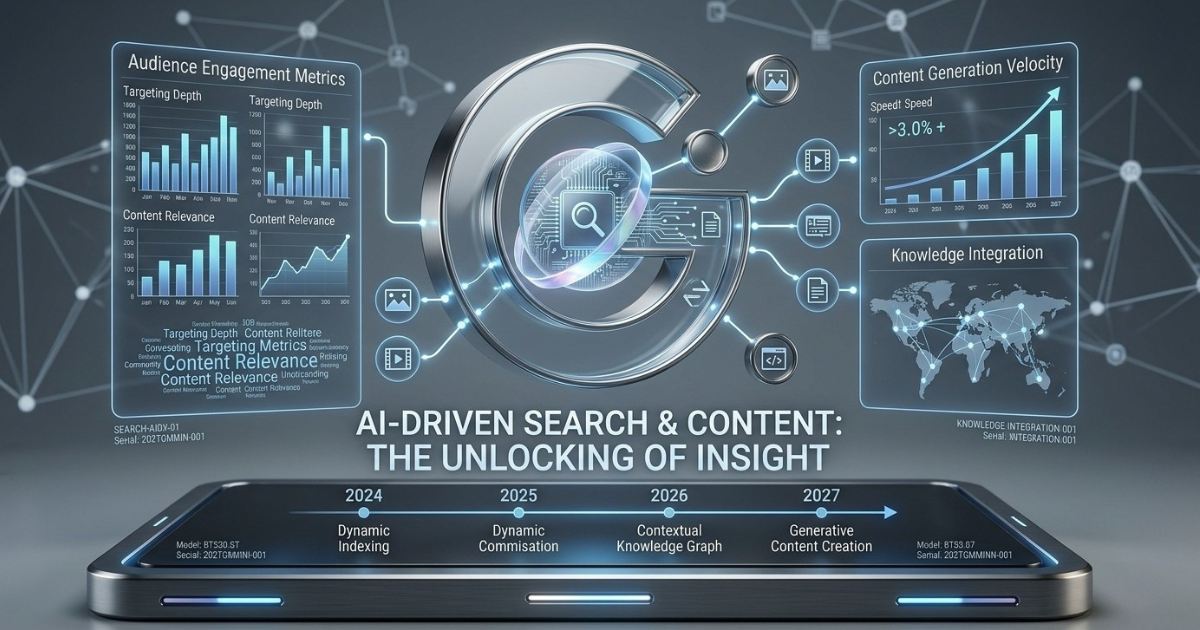
10 Powerful Reasons AI-Driven Search Could Reshape the Future of SEO
For more than two decades, SEO has been one of the most important ways people discovered information on the internet.
Businesses researched keywords. Bloggers optimized articles. Websites built backlinks. Marketers studied Google rankings. Publishers competed for the first page.
The basic formula was simple:
People search → Google shows results → users click websites → websites receive traffic.
But that formula is changing.
Artificial intelligence is creating a new way to discover information. Instead of typing several keywords into a search engine and opening multiple websites, people can increasingly ask an AI system a complete question and receive a synthesized answer.
That change may become even more significant as AI search develops through 2027 and beyond.
Google itself is investing heavily in this direction. In 2026, Google reported that AI Overviews had more than 2.5 billion monthly active users, while AI Mode had surpassed 1 billion monthly users. Google also said AI Mode queries had more than doubled every quarter since its launch and that overall Search queries had reached an all-time high.
These numbers do not mean traditional search has disappeared.
They show something more interesting:
The meaning of “search” itself is changing.
And that could eventually change the role of SEO.
1.1 10 Powerful Signs That Search Is Moving Beyond the Traditional Google Model
The first major sign is that people are no longer limited to short keyword searches.
Instead of searching:
“best laptop for students”
a user can ask:
“I am a university student studying design with a limited budget. Which laptop should I buy for Photoshop, video editing and everyday study, and which features can I safely ignore?”
That is not simply a keyword.
It is a complete information request.
AI systems are designed to understand that context.
Google says AI Mode is allowing people to ask longer and more complex questions and continue conversations through follow-up questions.
This creates an important shift for content creators.
Traditional SEO often asks:
“What keyword should I target?”
AI-driven search increasingly asks:
“What question, problem or decision am I helping someone solve?”
That difference could become one of the biggest changes in digital content.
1.2 7 Amazing Ways AI Is Changing How People Search
Traditional search usually required users to break a problem into several searches.
For example, someone planning a trip might search:
Best hotels in Tokyo
Then:
Best areas to stay in Tokyo
Then:
Tokyo transport cost
Then:
Things to do in Tokyo
Then:
Tokyo itinerary 7 days
AI-driven search can potentially combine much of that research into one conversation.
The user might simply ask:
“Plan a seven-day Tokyo trip for me with a moderate budget, quiet accommodation, good public transport and a mixture of cultural and modern attractions.”
The system can then continue the conversation:
“What is your budget?”
“Do you prefer nightlife or quiet evenings?”
“Are you travelling alone or with family?”
The search process becomes interactive.
Google describes this transition as Search becoming more conversational and capable of handling deeper, more complex questions.
That could reduce the need for users to manually visit ten different pages just to assemble an answer.
For websites, that is a major change.
1.3 5 Eye-Opening Reasons Website Clicks May Become Less Predictable
The biggest concern for publishers is not necessarily that people will stop searching.
It is that people may stop clicking as often.
A June 2026 SparkToro analysis using Similarweb clickstream data reported that 68.01% of Google searches in the first four months of 2026 ended without a click. The research also found that zero-click behavior has grown significantly compared with previous years.
This needs careful interpretation.
It would be misleading to say:
“AI caused 68% of Google searches to become zero-click.”
The research includes many factors, such as AI features, instant answers, search interface elements and changing user behavior.
But the direction is important.
The traditional journey:
Search → Website → Answer
is increasingly being joined by:
Search → AI Answer → User satisfied
And sometimes:
Search → AI Answer → Website only if deeper information is needed
That could make website traffic less predictable.
1.4 8 Powerful Ways AI Could Change the Meaning of SEO Success
For years, SEO success was often measured using:
- Keyword rankings
- Organic traffic
- Click-through rate
- Backlinks
- Page views
- Search impressions
Those measurements will not suddenly become useless.
But AI Search introduces additional questions.
A website may be:
Cited by an AI system.
Mentioned in an AI-generated answer.
Used as a source.
Shown in traditional results.
Discovered after an AI recommendation.
Searched directly by the user later.
Google has already introduced dedicated Search Console reporting for visibility within generative AI features such as AI Overviews and AI Mode. As of August 31, 2026, Google said those insights had been rolled out to websites worldwide.
That is a significant development.
It shows that Google itself recognizes that website visibility inside AI experiences needs to be measured.
So the future SEO question may become less about:
“Am I ranking #1?”
and more about:
“How visible is my brand and content throughout the entire AI-powered discovery journey?”
1.5 6 Strong Reasons “SEO Is Dead” Is Too Simple
It is tempting to say:
“AI has killed SEO.”
But the evidence does not support such a simple conclusion.
Google’s official guidance published in 2026 specifically says that SEO remains relevant for generative AI Search because Google’s AI features are rooted in its existing Search ranking and quality systems.
This creates an important distinction.
SEO may not be disappearing.
The old definition of SEO is changing.
Technical SEO still matters.
Good site structure still matters.
Crawlability still matters.
Useful content still matters.
Page experience still matters.
But content creators increasingly need to think about whether their information is understandable, trustworthy, original and useful enough to be surfaced within AI-generated answers.
Google’s current AI Search guidance emphasizes valuable, non-commodity content and specifically highlights unique viewpoints and firsthand experience.
So instead of:
SEO → dead
a more evidence-based description is:
SEO → evolving into a broader AI-driven search visibility strategy.
1.6 9 Powerful Reasons Generic AI Content Could Become Less Valuable
Here is where the future becomes particularly interesting.
AI makes content creation easier.
But when everyone can create content faster, the amount of similar content can explode.
Imagine searching for:
“What is digital marketing?”
There are already thousands of explanations.
If AI can generate another explanation in seconds, why should a user spend ten minutes reading it?
That creates pressure on generic content.
A simple article that repeats information already available everywhere may become easier for AI to summarize than for a human to value.
Google’s guidance says unique, useful, people-first content is more important for generative AI Search than producing large quantities of commodity content. It specifically recommends bringing a unique point of view and firsthand experience rather than simply recycling information already available elsewhere.
This could create a powerful new content principle:
Don’t compete with AI by producing more ordinary information.
Compete by providing information that is difficult to replace.
That could include:
- Original research
- Personal experience
- Testing
- Case studies
- Expert interviews
- Original data
- Real screenshots
- Unique comparisons
- Demonstrations
- Local knowledge
- Firsthand observations
The easier information becomes to generate, the more valuable genuine differentiation can become.
1.7 10 Exciting Ways Human Experience Could Become a Content Superpower
Consider two articles about a microphone.
The first says:
“This microphone has a cardioid pickup pattern and USB connectivity.”
The second says:
“I used this microphone for 30 days in a normal bedroom while recording YouTube videos. Here are the three problems I discovered and the settings that solved them.”
The second article contains something AI cannot simply invent without a real underlying experience:
firsthand evidence.
The same applies to almost every industry.
A travel creator can document a real journey.
A technology reviewer can test a device.
A fitness creator can document a training experiment.
A software blogger can demonstrate a real workflow.
A business owner can publish a genuine case study.
A marketer can show actual campaign results.
AI can help organize that material.
But the underlying experience still comes from the human.
Google’s own guidance now specifically recommends unique viewpoints and firsthand reviews as examples of content that can provide distinctive value in generative AI search.
That could become one of the strongest opportunities for human creators.
1.8 7 Major Reasons AI Could Become a New Gateway to the Web
The internet traditionally had search engines as gateways.
Google was one of the most important.
But AI assistants are increasingly becoming another gateway.
A user may first ask an AI:
“Which accounting software should I use?”
“Which country is best for a quiet holiday?”
“Which laptop should I buy?”
“How can I learn digital marketing?”
“Which website explains this topic clearly?”
The AI may then introduce the user to particular sources, brands or websites.
Recent Similarweb research reported by SparkToro found that AI brand mentions were associated with increases in direct visits and branded searches in several consumer categories, although the study also notes important unanswered questions about causation and whether the findings generalize to smaller or unknown brands.
This suggests something important.
AI visibility does not necessarily mean:
No traffic.
It may sometimes mean:
Different traffic.
A person may discover a brand through AI first and visit the website later.
That could make brand authority inside AI systems increasingly important.
1.9 5 Positive Opportunities AI Could Create for Smaller Websites
The AI revolution is not only a threat to small websites.
It could also create opportunities.
A small creator can now use AI to help with:
- Research
- Content planning
- Data organization
- Editing
- Translation
- Image creation
- Video scripts
- Content repurposing
- Audience research
- Topic analysis
This means a small team can potentially produce work with capabilities that previously required much larger resources.
But productivity alone will not create authority.
The strongest combination may be:
Human knowledge + original experience + AI-assisted productivity.
A creator who understands a niche deeply and uses AI intelligently could potentially move faster than a large content operation producing generic articles.
That is an important distinction.
The future may not belong simply to:
Human content
or:
AI content.
It may belong to human-led content enhanced by AI.
1.10 10 Powerful Reasons AI Search Could Grow Even Further by 2027
The strongest reason to expect continued AI-search growth is not simply that AI companies are promoting their products.
User behavior is already changing.
Google reported that AI-powered Search features were driving increased Search usage and that Search queries reached an all-time high. It also reported that AI Mode had surpassed one billion monthly users globally.
Google’s Gemini app separately surpassed one billion monthly users in August 2026, showing that conversational AI has expanded beyond experimental use into mainstream consumer behavior.
At the same time, third-party research indicates that users are increasingly completing searches without clicking through to websites.
These trends point toward a broader transformation.
By 2027, people may increasingly expect search to:
Understand context.
Remember the conversation.
Compare options.
Summarize multiple sources.
Handle images and files.
Answer follow-up questions.
Provide recommendations.
Help complete tasks.
Google is already moving Search in that direction, including multimodal inputs and agentic capabilities.
However, one important uncertainty remains.
Nobody can reliably say that AI will completely replace traditional Google-style search by 2027.
People still use traditional search.
Google still sends billions of clicks to websites every week through AI features, according to its own reporting.
And Google explicitly continues to describe SEO as relevant to AI Search.
So the more realistic future may be much more interesting than a simple replacement.
Search is becoming AI-powered.
SEO is becoming AI-aware.
Content is becoming more experience-driven.
And the relationship between websites and search engines is being rewritten.
The real question is no longer whether AI will influence search.
It already does.
The bigger question is:
When millions of people increasingly ask AI instead of searching through traditional results themselves, what will make an AI system trust, select, cite and recommend one piece of content over another?
That is where the next stage of AI-Driven Search & Content becomes even more important.
And that is also where the future of SEO could become completely different from the SEO most bloggers learned over the last decade.
11. 8 Powerful Signals That Could Make Content More Visible in AI Search
As search becomes increasingly AI-driven, simply publishing an article may no longer be enough.
An AI system needs to understand what a piece of content is about, whether it is useful, whether its information can be trusted, and how it relates to the user’s question.
This creates a new challenge for publishers.
A traditional search engine could match words on a page with words in a query.
An AI-powered search system can go much further.
It may need to understand the meaning behind the query, identify relevant information across different pages, compare sources, and construct an answer.
That means content creators need to make their information clear and easy to understand.
Google’s guidance for AI Search emphasizes that there are no special technical requirements that guarantee inclusion in AI features. Instead, fundamental SEO practices, crawlability, indexing, helpful content, and unique value remain important.
This leads to an important principle:
AI optimization is not about tricking AI. It is about making genuinely useful information easier to discover and understand.
Content that is clearly structured, factually supported, relevant, and original has a stronger foundation for the AI-driven search environment.
12. 7 Smart Reasons Originality Could Beat Content Volume
For many years, publishing more content was a common SEO strategy.
More articles meant more keywords.
More keywords meant more opportunities to appear in search.
But AI changes the economics of publishing.
If AI allows one person to produce 20 articles in the time it previously took to produce five, competitors can do exactly the same thing.
The result is an enormous increase in supply.
When supply increases dramatically, simply having more content becomes less impressive.
Originality becomes more important.
Consider two websites covering the same subject.
Website A publishes 100 articles that summarize information already available elsewhere.
Website B publishes 30 articles containing original testing, interviews, data, personal experience, screenshots, and detailed analysis.
The second website may have fewer pages but potentially more distinctive information.
Google’s people-first guidance emphasizes original information, research, analysis, and substantial additional value rather than simply rewriting existing material.
This could create a major change in the content economy:
The future may reward the depth of information rather than simply the quantity of pages.
13. 10 Powerful Content Elements AI Search May Understand More Clearly
AI systems are becoming better at understanding context, but content creators still need to communicate clearly.
Strong content can make its subject and purpose obvious through:
- Clear titles
- Descriptive headings
- Logical sections
- Direct answers
- Relevant examples
- Reliable sources
- Structured information
- Original observations
- Updated facts
- Useful supporting details
This is not about stuffing keywords into every paragraph.
In fact, excessive keyword repetition can make content worse for humans.
A better approach is to cover the topic naturally and comprehensively.
For example, an article about AI-driven search should not simply repeat the phrase “AI-driven search” dozens of times.
It should explain:
What AI search is.
Why it is growing.
How people use it.
How it affects websites.
What happens to clicks.
How content creation changes.
What businesses need to understand.
That creates topical depth rather than artificial keyword density.
14. 6 Exciting Ways AEO and GEO Are Expanding the SEO Conversation
Two terms have become increasingly visible in discussions about AI search:
AEO — Answer Engine Optimization
and
GEO — Generative Engine Optimization
The terminology can sound complicated, but the basic idea is relatively simple.
Traditional SEO focuses heavily on helping webpages become discoverable in search engines.
AEO focuses on becoming useful for systems that provide direct answers.
GEO generally refers to optimizing content so that generative AI systems can discover, understand, and potentially mention or cite it.
However, creators should be careful.
There is no universal GEO formula that guarantees an AI system will recommend a website.
Google’s own guidance says there are no additional requirements or special optimizations required specifically for appearing in AI Overviews or AI Mode. Existing SEO fundamentals remain important.
That means AEO and GEO should not be treated as replacements for SEO.
They are better understood as ways of thinking about a broader search ecosystem.
The goal remains remarkably familiar:
Create useful information that deserves to be discovered.
15. 5 Major Ways Zero-Click Search Could Change the Content Business
A website can receive millions of impressions but still face a difficult business question:
How many people actually visit?
This matters because many online publishers depend on traffic for advertising, affiliate revenue, subscriptions, leads, or product sales.
If AI answers satisfy users directly, some searches may produce fewer website visits.
Independent research from SparkToro found that 68.01% of Google searches in the first four months of 2026 ended without a click, based on Similarweb clickstream data. The analysis attributes zero-click behavior to multiple factors rather than AI alone.
That creates pressure on traditional publishing models.
A website may need to think beyond raw traffic.
For example:
10,000 visitors with no business value may be less useful than 1,000 visitors who trust the brand and become customers.
This could shift attention toward:
- Brand searches
- Leads
- Sales
- Email subscribers
- Returning visitors
- Direct traffic
- Product purchases
- Memberships
- Community growth
The future of SEO may therefore become increasingly connected to broader digital marketing.
16. 9 Powerful Reasons Brand Authority Could Matter More Than Ever
Imagine asking an AI:
“Which camera should I buy?”
The system does not necessarily need to show you ten blue links.
It can compare products and explain the differences.
Now imagine asking:
“Which camera brand is reliable for travel photography?”
The conversation moves from a keyword to a decision.
At this point, brand recognition can become important.
A website that consistently publishes reliable information may become more recognizable over time.
This creates a potentially powerful relationship:
Useful content → visibility → trust → brand recognition → direct searches
Recent Similarweb research discussed by SparkToro found associations between AI brand mentions and increases in direct visits and branded search queries in some categories, while also noting that the research does not establish causation and may not generalize to every brand or industry.
That limitation matters.
But the concept is worth watching.
AI search may not simply send people to websites.
It may also help people remember which brands exist.
17. 7 Important Reasons Publishers May Need a New Definition of Traffic
Traffic has traditionally been treated as one of the clearest signs that SEO is working.
But AI search can create several different stages of discovery.
A person might:
See a brand in an AI answer.
Then:
Search the brand later.
Then:
Visit the website directly.
Then:
Return through another channel.
Traditional analytics may not always make that entire journey obvious.
This means marketers may need to think about the difference between:
Discovery
Engagement
Conversion
and
Retention
rather than treating every website visit as equal.
The first interaction may happen inside an AI answer.
The second may happen through Google.
The third through a website.
The fourth through email or social media.
This creates a much larger digital discovery ecosystem.
18. 10 Strong Reasons AI-Generated Content Alone May Not Be Enough
AI is incredibly useful for content production.
But there is a major difference between:
AI-assisted content
and
content created without meaningful human value.
AI can help a writer:
- Research a topic
- Organize information
- Generate ideas
- Improve grammar
- Create outlines
- Repurpose content
- Translate articles
- Produce drafts
Those are productivity benefits.
The problem begins when the entire publishing process becomes:
Prompt → Generate → Publish → Repeat
without meaningful research, experience, verification, or original insight.
Google’s guidance warns against using generative AI to produce large numbers of pages without adding value, particularly when the purpose is to manipulate search rankings.
That does not mean AI cannot be used to create content.
It means the creator still needs to be responsible for the value and accuracy of the final result.
The smartest use of AI may therefore be:
AI handles more of the repetitive work.
Humans handle judgment, originality, experience, and responsibility.
19. 8 Powerful Content Types That Could Stand Out in an AI-Heavy Web
If generic information becomes easier to generate, what should creators produce?
Several content formats can naturally create differentiation.
19.1 Original Research
Instead of repeating statistics from other websites, conduct your own survey, test, analysis, or experiment.
19.2 Firsthand Reviews
Use a product, service, destination, or software and document what actually happened.
19.3 Case Studies
Show how a real person or business solved a real problem.
19.4 Original Data
Collect and analyze information that other websites do not already have.
19.5 Expert Interviews
Bring perspectives from people with genuine experience.
19.6 Demonstrations
Show the process through screenshots, videos, experiments, or step-by-step examples.
19.7 Comparative Analysis
Instead of listing features, explain meaningful differences and real-world trade-offs.
19.8 Strong Personal Perspective
A knowledgeable creator can explain not only what happened but why it matters.
These formats give content a stronger identity.
They create something that is harder to replace with a generic summary.
20. 5 Positive Ways AI Could Give Small Creators a Bigger Voice
AI-driven search may create challenges for small publishers.
But it can also reduce some barriers.
A solo creator can now perform tasks that once required several specialists.
One person can research a subject, create a draft, produce graphics, edit video, translate content, and prepare social posts with AI assistance.
This could make niche publishing more accessible.
A creator does not necessarily need millions of dollars or a large editorial department to build a useful website.
What may matter increasingly is specialization.
Instead of trying to become everything to everyone, a creator can become extremely useful to a specific audience.
For example:
AI tools for doctors
Budget travel for beginners
Technology for older users
Digital marketing for local businesses
Home fitness for busy professionals
The narrower the problem, the easier it can become to build distinctive knowledge around it.
AI can help scale that knowledge.
But the expertise still needs to come from somewhere.
21. 7 Surprising Ways Search Could Become More Human
At first glance, AI-driven search sounds like a move toward machines.
But there is an interesting possibility that it could actually make human preferences more important.
Users can increasingly explain:
“I want something affordable.”
“I prefer quiet places.”
“I don’t want complicated software.”
“I need something suitable for beginners.”
“I care more about reliability than appearance.”
These are human preferences.
AI can interpret them and potentially filter enormous amounts of information around them.
Traditional search often required users to learn how to search.
AI search increasingly allows people to simply explain what they want.
That could make search more accessible to people who are not experts at constructing keywords.
And that could expand the range of questions people are willing to ask.
22. 10 Big Changes Content Creators Should Prepare For Before 2027
The future is uncertain, but several changes are already visible enough to deserve attention.
1. More conversational searches
Users can ask complete questions rather than isolated keywords.
2. More AI-generated summaries
Search interfaces can provide answers before a website visit.
3. More zero-click behavior
Some users may stop after receiving enough information directly from Search.
4. Greater competition
AI makes content production easier for almost everyone.
5. Higher demand for originality
Generic information becomes easier to reproduce.
6. Greater importance of firsthand experience
Real-world testing can create distinctive value.
7. Broader visibility metrics
Citations and AI mentions may complement traditional rankings.
8. Stronger connection between SEO and brand building
Search visibility may influence recognition as well as traffic.
9. Greater importance of trust
Readers may need stronger signals that information is reliable.
10. More sophisticated content strategies
Creators may need to combine SEO, AI optimization, branding, social media, video, and direct audience relationships.
These changes do not mean every website needs to completely abandon its existing strategy.
They mean creators should avoid assuming that the search environment of 2027 will behave exactly like the search environment of 2017.
23. 6 Powerful Lessons for Bloggers Entering the AI Search Era
The biggest lesson may be surprisingly simple:
Do not try to compete with AI at being AI.
A human creator does not need to write faster than a machine.
Instead, the creator can provide what makes the content valuable.
Experience.
Judgment.
Original research.
Personality.
Testing.
Context.
Trust.
A blogger who simply rewrites information that already exists everywhere may face increasing competition from both AI and other publishers.
A blogger who becomes the original source of useful information has a different position.
That is why the future of blogging may depend less on:
“How many articles can I publish?”
and more on:
“How much unique value can I create?”
The answer to that question could determine whether a website simply survives the AI search transition—or builds a stronger identity within it.
And there is still one major piece missing.
If AI becomes increasingly responsible for discovering, summarizing, and recommending information, what happens to the millions of websites that depend on Google traffic today—and what practical strategy can creators use to build visibility, trust, and income in that new environment?
That is the deeper challenge waiting ahead.
24. 10 Powerful Ways Content Creation Could Evolve by 2027
By 2027, creating content may look very different from the way it did only a few years earlier.
The biggest change may not be that AI writes everything.
It may be that AI becomes part of almost every stage of the content process.
A creator could use AI to discover questions, analyze trends, organize research, create a first draft, generate visuals, prepare videos, translate the material, and repurpose the final content across multiple platforms.
But the creator may still be responsible for the most important part:
deciding what deserves to be published.
That distinction matters.
The future could therefore move toward a human-led, AI-assisted content model.
Instead of replacing the creator, AI becomes a productivity layer around the creator.
This could allow a small website to research and publish more efficiently while spending more time on original information and audience needs.
The strongest creators may not necessarily be those who use the most AI.
They may be those who know where AI helps and where human judgment is essential.
25. 7 Smart Ways Bloggers Can Build Stronger AI-Search Visibility
Bloggers cannot control exactly what an AI system chooses to display.
But they can control the quality of the information they publish.
A strong foundation can include:
- Creating genuinely useful content
- Answering real audience questions
- Adding original information
- Demonstrating firsthand experience
- Supporting important claims with reliable sources
- Keeping information updated
- Maintaining technically accessible websites
Google’s current guidance for AI Search emphasizes many of the same fundamentals that have historically supported good Search performance, including crawlability, indexing, useful content, internal linking, and structured information. Google also says there is no special technical requirement that guarantees inclusion in AI Overviews or AI Mode.
This is important because it removes some of the mystery surrounding AI SEO.
There is no magic button.
There is no guaranteed prompt.
There is no secret “GEO score” that automatically puts a website inside every AI answer.
The foundation remains useful information.
26. 8 Powerful Content Strategies That Could Thrive in an AI-First World
A strong content strategy may increasingly move away from producing endless generic articles.
Instead, creators could build content ecosystems.
For example, one original research project could become:
- A detailed article
- A data visualization
- A YouTube video
- A short video
- An infographic
- A newsletter
- A social media post
- A downloadable guide
One piece of original work can therefore create multiple forms of content.
This is more powerful than simply asking AI to generate eight unrelated articles.
The difference is that all the content originates from something meaningful.
The original research becomes the asset.
AI becomes the multiplier.
That could be a highly effective model for small creators who have limited time.
27. 5 Major Ways AI Could Change the Value of Keywords
Keywords are unlikely to disappear completely.
People still use words to communicate what they want.
But keywords may become less important as isolated targets.
Consider the difference between:
“best camera”
and:
“I travel frequently and need a lightweight camera that performs well at night without costing more than $1,000.”
The second request contains much more information.
It communicates:
- Purpose
- Experience
- Budget
- Preference
- Location-related use
- Technical requirements
AI can interpret these relationships.
This means content creators may increasingly need to cover topics and intent, rather than simply repeating exact keyword phrases.
The focus can shift from:
Keyword density
toward:
Question coverage + topical depth + usefulness.
That is a major conceptual change.
28. 9 Exciting Ways Original Data Could Become a Competitive Advantage
Imagine two websites discussing the same industry.
Both can summarize publicly available information.
But one website conducts its own survey of 2,000 users.
Now it possesses something different.
The website can publish:
“Our 2027 survey found…”
Other websites may then reference that research.
The original publisher becomes the source.
This creates an interesting reversal.
Instead of constantly competing to summarize everyone else’s information, a website can create information that other websites want to summarize.
That is a potentially stronger position.
Original statistics, experiments, surveys, interviews, testing, and case studies can create a content asset that is difficult to duplicate.
AI can help analyze the information.
But someone still has to collect it.
29. 7 Powerful Reasons Personal Brands Could Become More Important
As generic AI-generated content becomes abundant, people may increasingly look for recognizable creators.
A name can become a shortcut for trust.
Think about how people already follow particular:
- Journalists
- YouTubers
- Technology reviewers
- Doctors
- Researchers
- Photographers
- Financial educators
- Travel creators
- Industry experts
The creator becomes part of the product.
This may become even more important in an AI-heavy internet.
When information is abundant, people may ask:
“Who should I listen to?”
rather than simply:
“What information exists?”
A recognizable personal brand can provide continuity.
It can also give audiences a reason to return directly rather than relying entirely on search.
30. 10 Positive Ways Websites Can Reduce Their Dependence on Search Traffic
One of the biggest lessons from the AI Search transition is that relying entirely on one traffic source can be risky.
A strong website can gradually build several discovery channels.
These might include:
- Organic search
- AI search visibility
- Email newsletters
- YouTube
- Social media
- Direct traffic
- Online communities
- Referral traffic
- Returning visitors
- Brand searches
The objective is not to abandon Google.
It is to avoid making Google the only gateway to an audience.
If an algorithm changes, the website still has other relationships.
If AI changes search behavior, the website has direct followers.
If social media changes its algorithm, email subscribers remain accessible.
This creates something much more valuable than traffic:
an owned audience.
31. 6 Smart Ways Businesses Could Adapt to AI-Driven Discovery
Businesses face an additional challenge.
People may increasingly ask AI:
“Which company should I use?”
“Which software is best for my business?”
“Which agency offers this service?”
“Which product is worth buying?”
This means companies may need to think about how they are represented across the broader information ecosystem.
That includes:
- Their official website
- Product information
- Reviews
- Independent coverage
- Industry publications
- Customer experiences
- Expert discussions
- Video content
- Social conversations
A company cannot completely control what an AI system says about it.
But it can control the accuracy, clarity, and usefulness of much of the information it publishes itself.
That makes digital reputation increasingly important.
32. 8 Powerful Reasons Trustworthy Sources Could Win the Long Game
AI systems need information.
But information quality varies dramatically.
Some pages contain carefully researched material.
Others contain outdated information.
Some publish original studies.
Others simply copy competitors.
Some clearly disclose where their data comes from.
Others provide unsupported claims.
As AI systems become more sophisticated, distinguishing among sources becomes increasingly important.
For content creators, this means that trust is not just a branding issue.
It is part of the information itself.
A useful article should make it easier for both humans and information systems to understand:
What is being claimed?
Where did the information come from?
When was it published?
Has it been tested?
Who is responsible for it?
Can the important claims be verified?
This does not guarantee visibility.
But it creates a stronger foundation for it.
33. 5 Important Risks Creators Should Not Ignore
The future of AI-driven content is not entirely positive.
There are real risks.
33.1 Information Overload
The internet may contain far more content than people can reasonably consume.
33.2 Declining Click Opportunities
Some users may receive sufficient information directly from AI search.
33.3 Content Similarity
Large amounts of AI-assisted content may look and sound alike.
33.4 Incorrect AI Answers
AI systems can still make mistakes, misunderstand sources, or produce inaccurate information.
33.5 Platform Dependence
Creators may become dependent on AI platforms in the same way many became dependent on search engines and social media platforms.
These risks are important because technological progress does not automatically create a better information ecosystem.
Human oversight remains necessary.
34. 7 Surprising Ways AI Could Actually Increase the Demand for Quality Content
There is an interesting contradiction in the AI revolution.
If AI answers questions directly, why would more content be necessary?
Because better AI systems need better information.
AI does not create knowledge from nowhere.
It learns from information and interacts with information produced across the wider ecosystem.
When people ask complicated questions, high-quality sources become more useful.
Google’s AI Search guidance emphasizes unique, valuable content and advises creators to focus on people-first information rather than producing content simply to gain search visibility.
Therefore, AI could simultaneously:
reduce the value of generic content
while:
increasing the value of exceptional content.
That is a crucial distinction.
The future may contain more content than ever.
But the best content could become more valuable precisely because there is so much noise surrounding it.
35. 10 Powerful Skills Content Creators Should Develop for the AI Era
The creator of the future may need a broader skill set.
Useful skills can include:
- Research
- Critical thinking
- Fact-checking
- Storytelling
- SEO fundamentals
- AI literacy
- Data interpretation
- Visual communication
- Personal branding
- Audience understanding
Notice what is missing:
“Knowing how to generate 1,000 AI articles.”
That is because content production is becoming easier.
Judgment is becoming more important.
A creator who knows how to ask better questions, verify information, recognize weak evidence, understand an audience, and explain complicated ideas clearly can use AI far more effectively than someone who simply generates text.
36. 5 Powerful Changes That Could Redefine SEO by 2027
SEO may still exist in 2027.
But it may feel very different.
The old SEO mindset often focused on:
Keywords + backlinks + rankings + traffic
The emerging model could increasingly involve:
Search visibility + AI citations + topical authority + original information + brand recognition + audience relationships
This does not mean traditional SEO fundamentals suddenly become irrelevant.
Instead, they become one layer of a much larger system.
A technically broken website still has problems.
Poor content still has problems.
Untrustworthy information still has problems.
But optimizing a page only for a keyword may no longer be enough to build long-term visibility.
The future of SEO could therefore become less about manipulating rankings and more about building discoverable authority.
37. 7 Powerful Lessons for Anyone Building a Website Today
If someone is starting a website today, the AI revolution should not necessarily discourage them.
It should change what they build.
A website should not exist simply to collect search traffic.
It should exist to provide something valuable.
That might be:
Knowledge.
Experience.
Research.
Tools.
Community.
Analysis.
Entertainment.
Education.
Solutions.
The strongest websites can become destinations rather than temporary landing pages.
That distinction could matter enormously as AI increasingly becomes the first step in information discovery.
38. 10 Clear Signs the Future Will Belong to Human-AI Collaboration
The debate is often presented as:
Humans versus AI.
But that may be the wrong question.
A more realistic future is likely to involve collaboration.
Humans can provide:
- Experience
- Creativity
- Judgment
- Values
- Original research
- Accountability
- Emotional understanding
AI can provide:
- Speed
- Organization
- Pattern recognition
- Automation
- Drafting assistance
- Data processing
- Personalization
When these strengths are combined intelligently, a creator can potentially produce better work with less repetitive effort.
The most valuable question may therefore not be:
“Should I use AI?”
It may be:
“Which parts of my creative process should AI improve, and which parts should remain deeply human?”
That is a much more useful question for the future.
39. 6 Powerful Reasons the AI Search Revolution Is Bigger Than SEO
The biggest mistake would be to view AI-driven search as merely another Google algorithm update.
It is much broader.
It changes how people:
Ask questions.
Discover brands.
Research products.
Learn new skills.
Compare choices.
Consume information.
That means the impact goes beyond SEO.
It reaches digital marketing, journalism, publishing, education, ecommerce, advertising, social media, personal branding, and online business.
Search used to be primarily about finding information.
AI-driven search is moving toward understanding information and helping people act on it.
That is a much larger transformation.
40. 10 Final Insights That Reveal Where AI-Driven Search Is Heading
The future cannot be predicted with complete certainty.
Technology moves too quickly.
Google can change its products.
AI companies can introduce new models.
Users can change their habits.
Regulators can introduce new rules.
Business models can evolve.
So nobody can honestly guarantee exactly what search will look like in 2027.
But the direction is becoming clearer.
1. AI is becoming a major information-discovery channel.
2. Search is becoming increasingly conversational.
3. Zero-click behavior is creating pressure on traditional publishers.
4. Generic content is becoming easier to reproduce.
5. Original information is becoming more valuable.
6. Firsthand experience can provide strong differentiation.
7. Brand visibility may extend beyond traditional rankings.
8. SEO is evolving rather than simply disappearing.
9. Human judgment remains essential in an AI-assisted content ecosystem.
10. The future of content may depend more on trust, usefulness, originality, and authority than on publishing volume alone.
Conclusion: AI May Change Search, But It Cannot Replace Human Value
The rise of AI-driven search is one of the biggest changes the internet has experienced since search engines became mainstream.
For years, the internet was built around a simple relationship:
People searched. Websites answered.
Now another layer has appeared:
People ask. AI interprets. AI summarizes. Websites provide the underlying information.
That changes everything.
It changes how people discover content.
It changes how websites receive traffic.
It changes how marketers measure visibility.
It changes how bloggers compete.
It changes how businesses build digital authority.
And it changes what users expect from the internet.
The most important point, however, is that SEO is not simply disappearing overnight.
Google’s own documentation continues to state that established SEO fundamentals remain relevant for AI Search, while its newer guidance emphasizes unique, useful, people-first information.
At the same time, independent research shows that zero-click behavior is already substantial, while Google reports rapidly growing adoption of AI-powered Search experiences.
These developments point toward a more complicated future than either extreme:
“SEO is dead.”
or
“Nothing will change.”
Neither tells the whole story.
The more realistic transformation is that search is becoming an AI-mediated experience.
And when the way people discover information changes, the way content must create value changes too.
The future creator may not be the person who publishes the most articles.
It may be the person who understands people most deeply.
Someone who knows what questions matter.
Someone who can provide firsthand experience.
Someone who can conduct original research.
Someone who can explain difficult subjects clearly.
Someone who verifies information.
Someone who builds trust.
And someone who knows how to use AI without allowing AI to erase the human value behind the content.
That may be the biggest opportunity hidden inside the AI revolution.
AI can generate information at extraordinary speed.
But human beings still decide what is useful, meaningful, trustworthy, interesting, and worth acting upon.
So perhaps the future question is not:
“Will AI replace SEO?”
A better question is:
“How will SEO, content, and human creativity evolve when AI becomes one of the main gateways between people and the internet?”
That transformation has already begun.
And 2027 may be remembered not as the year when SEO suddenly disappeared, but as one of the years when the old definition of search began giving way to something much bigger.
AI-driven search will change how people find information.
AI-assisted content will change how information is produced.
But the creators who continue to provide something genuinely valuable may remain at the heart of the web.
::

I am Bhaktahari Dahal, the founder and writer of Byte and Trail. I passionately research technology, blogging, and diverse fields to deliver clear, simplified, and engaging content for my readers. Welcome aboard!