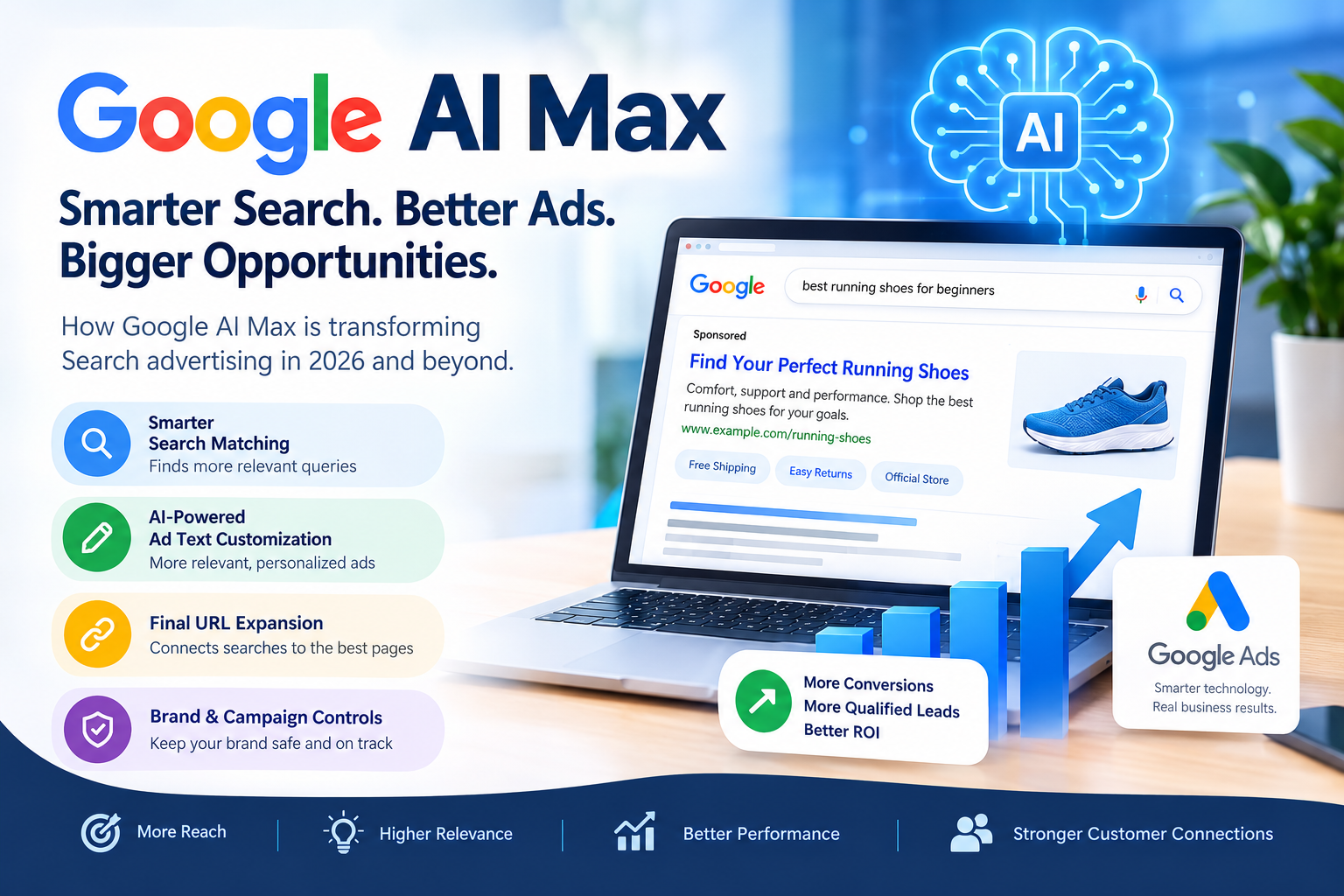
Search advertising is entering a major new era, and Google AI Max is becoming one of the most important developments for businesses, marketers, agencies, and advertisers to understand in 2026.
For years, Google Ads campaigns depended heavily on carefully selected keywords, manually written ad copy, and specific landing pages. Those fundamentals still matter, but modern search behavior is becoming much more conversational and unpredictable. People are asking longer questions, using different wording, and expecting search engines to understand what they actually mean.
Google AI Max is designed to help advertisers respond to that change.
Rather than treating every search as a simple keyword-matching exercise, AI Max uses Google’s AI capabilities to help Search campaigns discover additional relevant queries, customize advertising messages, and connect users with potentially more relevant pages on a website.
For businesses competing for customers across the United States, Canada, the United Kingdom, Europe, and other Western markets, this shift is particularly important. Searchers may use dozens of different phrases to describe the same need, and advertisers increasingly need technology that can recognize intent rather than relying only on exact wording.
But what exactly is Google AI Max, how does it work, and why is Google putting so much attention on it?
Let’s start with the fundamentals.
1. What Is Google AI Max?
Google AI Max is a suite of AI-powered optimization features for Google Search campaigns. Importantly, Google describes AI Max as an optimization layer within existing Search campaigns, rather than a completely new campaign type.
Its purpose is to help advertisers expand their reach while making ads and landing pages more relevant to the searches they are trying to capture.
Google’s current AI Max system combines several capabilities, including improved search-term matching, AI-powered text customization, and Final URL Expansion.
This means advertisers can give Google information about their business, products, services, messaging, and goals while AI helps interpret a much wider range of potential customer searches.
Think about a simple example.
A company sells premium running shoes in the United States. A traditional keyword strategy might target searches such as:
- best running shoes
- running shoes for beginners
- men’s running shoes
- women’s running shoes
- comfortable running shoes
But real customers may search in much more complicated ways:
“What running shoes should I buy if I run three times a week and have sensitive feet?”
That search does not necessarily look like a traditional keyword.
AI-powered search advertising is designed to better understand the intent behind these variations and identify opportunities that conventional keyword structures may not capture as efficiently.
That is one of the central ideas behind Google AI Max.
2. Why Google AI Max Matters in 2026
Search behavior is changing quickly.
People are increasingly comfortable asking Google complete questions instead of typing short keyword combinations. AI-powered search experiences are also making search more conversational, which creates a larger variety of ways for consumers to express the same intent.
For advertisers, this creates both an opportunity and a challenge.
The opportunity is obvious: businesses may be able to reach potential customers through searches they did not specifically anticipate.
The challenge is maintaining control over what the advertising system does with that additional reach.
Google AI Max is built around this balance between automation and advertiser control.
Google has introduced controls intended to help advertisers guide AI according to their business requirements. These include brand controls, location controls, messaging guidelines, and matching guidelines.
That is important because successful advertising is not simply about getting more impressions.
A business needs the right people to see the right message at the right moment.
3. Google AI Max Can Expand Search-Term Matching
One of the most important parts of Google AI Max is its approach to finding relevant searches beyond a narrow list of manually selected keywords.
Traditional search campaigns often require advertisers to spend significant time researching keywords and deciding which variations should be included.
AI Max can use broader signals to identify additional opportunities.
Google explains that AI Max can use broad match, asset-based targeting, and keywordless technology to help expand campaigns toward potentially valuable queries.
For marketers, this can change the workflow significantly.
Instead of trying to predict every possible phrase a customer might type into Google, advertisers can focus more attention on defining their business, creating strong assets, setting appropriate controls, and measuring actual results.
However, broader reach does not automatically mean better performance.
Advertisers still need to monitor search terms, conversion quality, customer value, and return on advertising spend.
A campaign can generate additional traffic without generating additional business.
That is why AI should be treated as a powerful optimization tool rather than a replacement for marketing strategy.
4. AI Max Can Help Advertisers Reach Long-Tail Searches
Long-tail searches are often highly specific.
For example, someone searching for:
“affordable accounting software for a small construction company”
has communicated considerably more information than someone searching for:
“accounting software.”
Specific searches can reveal valuable intent, but they can also be difficult to predict manually because there are countless combinations of words people may use.
Google AI Max is designed to help advertisers identify these types of opportunities.
This matters particularly for businesses with large product catalogs, specialized services, local offerings, or complicated customer journeys.
A software company, for example, might sell different solutions for startups, enterprise businesses, healthcare organizations, retailers, and professional services firms.
Each audience can describe its needs differently.
AI-powered matching gives the advertising system more flexibility to interpret those variations.
For Western-market advertisers, this can be especially useful when customers use natural conversational language rather than conventional marketing terminology.
5. AI Max Can Customize Ad Text
Another major component of Google AI Max is text customization.
Writing effective ad copy has traditionally required marketers to create multiple headlines and descriptions designed around different keywords and customer needs.
AI Max can use AI to adapt advertising text based on the context of the search.
The basic idea is simple:
The ad should feel more connected to what the customer is actually looking for.
Imagine a company offering digital marketing services.
One customer searches:
“SEO agency for a small business.”
Another searches:
“how can I get more Google traffic for my local business?”
A third searches:
“digital marketing agency for startups.”
The underlying business may be the same, but the intent and wording are different.
AI-powered text customization can help advertisers create messages that better align with those different search contexts.
Google has also introduced AI Brief, powered by Gemini, to help advertisers provide more detailed guidance about their business, audience, and preferred messaging.
This gives marketers an additional way to communicate what the AI should emphasize—and what it should avoid.
6. Final URL Expansion Can Connect Searches With Relevant Pages
Getting the click is only part of the advertising journey.
The visitor also needs to reach a page that makes sense.
Imagine someone searches for:
“best accounting software for freelancers.”
If the advertisement sends that person to a generic company homepage, the experience may not be ideal.
A dedicated freelancer accounting page could be much more relevant.
Google AI Max includes Final URL Expansion, which uses AI to identify potentially relevant landing pages on a website based on the user’s search intent.
This can help connect individual searches with pages that advertisers may not have manually selected for every possible query.
For businesses with large websites, this feature can be particularly interesting.
An online retailer might have thousands of products.
A software company might have hundreds of feature, industry, pricing, and solution pages.
A healthcare marketing company might have separate pages for different specialties.
Instead of manually assigning a landing page to every possible search variation, AI can help determine which destination may better match the user’s intent.
Still, website quality matters.
If a website contains outdated, confusing, duplicate, or poorly organized pages, automation cannot magically transform it into a high-converting experience.
AI can help with the connection between search and content, but the content itself still needs to deliver value.
7. Google AI Max Is Moving Search Advertising Toward Smarter Automation
The biggest change may not be a single feature.
It is the broader direction of Google Ads.
Search advertising is moving toward a model where advertisers provide high-quality business information, creative assets, goals, audience signals, and controls while Google’s AI handles more of the complex matching and optimization work.
Google has reported that advertisers activating AI Max in Search campaigns typically see more conversions or conversion value at a similar CPA or ROAS, based on Google’s internal data. Google also reported an average 7% increase in conversions or conversion value at similar CPA/ROAS for non-Retail advertisers using the full AI Max feature suite compared with search-term matching alone. These are Google’s own internal measurements, not an independent industry-wide guarantee.
That distinction is important.
AI Max may create new opportunities, but results will vary depending on the advertiser, industry, campaign structure, website, conversion tracking, budget, competition, and other factors.
For marketers, the most useful approach is therefore not to assume that AI will automatically improve every campaign.
Instead, AI Max should be tested, measured, and guided.
And that leads to an even bigger question:
How does Google AI Max actually change the way businesses should build and manage Search campaigns?
That is where the next part becomes especially important.
Google AI Max: 6 Smart Features Advertisers Need to Understand
In Part 1, we explored what Google AI Max is and why AI-powered Search advertising is becoming increasingly important in 2026. Now it is time to look more closely at how the system works and what its major features can mean for businesses.
Google AI Max is not simply about allowing an advertising system to make more decisions automatically. It brings together several AI-powered capabilities designed to help Search campaigns discover relevant demand, create more contextual advertising messages, and connect users with appropriate landing pages.
For marketers, the important question is not whether AI is becoming part of Google Ads. That transition is already underway.
The more useful question is:
How can advertisers use these capabilities without losing sight of their business goals?
1. AI Max Uses Multiple Signals to Understand Search Intent
One of the biggest differences between traditional keyword-focused advertising and modern AI-powered advertising is the growing importance of search intent.
A person may search for a product without using the exact phrase an advertiser expected.
For example, a travel company might advertise a luxury hotel in New York.
A potential customer could search:
- luxury hotels in New York
- best upscale hotel Manhattan
- five-star hotel near Central Park
- where should I stay in NYC for a business trip?
- premium accommodation near Midtown
These searches use different words, but they can represent related commercial intent.
Google AI Max is designed to use Google’s AI systems to identify relevant opportunities across these variations.
This means advertisers can potentially spend less time trying to predict every possible search phrase and more time creating strong campaigns around their products, services, customers, and business objectives.
However, this does not eliminate the importance of keyword research.
Keywords remain useful for understanding demand, analyzing customer language, creating content, and building campaign strategy.
AI simply gives advertisers another layer of interpretation.
2. Search-Term Matching Can Go Beyond Traditional Keywords
Search-term matching is one of the central capabilities associated with Google AI Max.
Traditional Search campaigns have historically relied on keyword-based targeting. Advertisers select terms they believe potential customers will use, and Google’s systems determine when ads may be eligible to appear.
AI Max expands the possibilities by using AI-powered matching to identify additional searches that may be relevant to the advertiser’s offerings.
This can be particularly valuable when customer language is unpredictable.
Consider a cybersecurity company.
Its website may describe a service as:
“Cloud security monitoring for growing businesses.”
But a customer might search:
“How do I protect my company’s cloud accounts from attacks?”
The wording is completely different.
The customer’s underlying problem, however, may be closely related to the company’s service.
AI-powered matching attempts to understand that relationship.
For advertisers, this can create additional opportunities that a strictly phrase-based approach might overlook.
At the same time, advertisers should review actual search-term performance regularly. Expanded matching can bring valuable traffic, but it can also expose a campaign to searches that do not produce useful business results.
Monitoring remains essential.
3. Text Customization Makes Ads More Contextual
Modern customers expect relevant information quickly.
If someone searches for a specific product or service, an advertisement that directly addresses that need can be more meaningful than a generic message.
Google AI Max includes AI-powered text customization, which can adapt ad messaging to the context of individual searches.
Suppose an online education company offers courses for professionals.
A user searches:
“best online data analytics course for working professionals.”
Another searches:
“learn data analytics online after work.”
The two searches communicate related needs but use different language.
AI-powered text customization can help generate or adapt advertising messages around those contexts using information available from the campaign and website.
This gives advertisers an opportunity to create a wider range of relevant messages without manually writing every possible variation.
But there is an important responsibility here.
Advertisers need to provide accurate information and appropriate messaging guidance.
AI-generated advertising copy should still be reviewed for:
- factual accuracy
- brand consistency
- pricing claims
- promotions
- regulatory requirements
- spelling and grammar
- customer expectations
Automation can increase scale, but human oversight remains important.
4. Final URL Expansion Can Improve Landing-Page Relevance
A highly relevant advertisement can still perform poorly if the customer lands on the wrong page.
This is where Final URL Expansion becomes significant.
Rather than always sending users to one predetermined landing page, AI Max can use the content and structure of a website to identify a potentially more relevant destination based on the search.
Imagine an online retailer selling hundreds of products.
A customer searches:
“lightweight waterproof hiking jacket for women.”
The advertiser may have a general outdoor clothing page, but the website could also contain a dedicated women’s waterproof jackets category.
Final URL Expansion can help connect the search with a more relevant page when Google’s system determines that another destination may better satisfy the query.
This approach can be useful for businesses with large websites.
Examples include:
- e-commerce stores
- software companies
- financial services
- travel companies
- automotive businesses
- healthcare organizations
- education platforms
- professional service companies
The quality of the website therefore becomes increasingly important.
Clear navigation, useful landing pages, descriptive content, and accurate product information can give AI systems better material to work with.
5. Brand Controls Give Advertisers More Guidance
More automation does not necessarily mean advertisers have to surrender every decision.
Google AI Max includes controls designed to help businesses guide where and how their campaigns can expand.
Brand controls are particularly relevant for companies that care about brand-related searches and messaging.
For example, a business may have competitors, product names, trademarks, or brand terms that require careful handling.
Advertisers can use available campaign controls to establish boundaries around brand-related traffic and messaging.
This is an important part of the AI advertising model:
AI works within advertiser-defined objectives and controls rather than operating without direction.
For large brands, these controls can become especially important because a campaign may receive traffic from many different search contexts.
For smaller businesses, they can also help maintain a focused advertising strategy.
The exact controls and availability can change as Google develops AI Max, so advertisers should review the current Google Ads documentation before making major campaign changes.
6. AI Max Can Change How Marketers Think About Campaign Structure
Perhaps the most important impact of Google AI Max is strategic.
For many years, Search advertising required marketers to think heavily about individual keywords.
That approach is not disappearing overnight, but AI is shifting some attention toward broader concepts:
What does the customer want?
What problem are they trying to solve?
What information does the business provide?
Which landing page best answers the customer’s need?
What outcome does the advertiser actually value?
This creates a more holistic approach to Search advertising.
Instead of building a campaign around hundreds or thousands of narrowly defined keyword variations, marketers can increasingly focus on high-quality assets, clear offers, strong landing pages, conversion tracking, and meaningful business goals.
That does not mean campaign structure no longer matters.
It means the role of campaign structure is evolving.
Google AI Max vs. Traditional Search Advertising
The difference becomes easier to understand when we compare the general approaches.
| Traditional Search Approach | Google AI Max Approach |
|---|---|
| Strong focus on selected keywords | Greater use of AI-powered matching |
| Manually planned ad variations | AI-assisted text customization |
| Manually selected landing pages | AI-assisted landing-page selection |
| Heavy keyword expansion work | Greater automation of query discovery |
| More manual optimization | More AI-assisted optimization |
| Keyword-centric planning | Intent and outcome-focused planning |
This does not mean one approach completely replaces the other.
Modern advertisers can still use keywords, audience insights, negative keywords, conversion data, campaign controls, and human strategy alongside AI-powered features.
The strongest campaigns are likely to depend on how well these components work together.
What Google AI Max Means for Small Businesses
Small businesses often face a difficult advertising problem.
They need visibility, but they may not have a large marketing department capable of constantly researching keywords, creating ad variations, analyzing search terms, and optimizing landing pages.
AI-powered advertising can potentially reduce some of that manual workload.
Consider a local home-services company.
It may offer:
- plumbing
- heating
- air conditioning
- emergency repairs
- water heater installation
Customers can describe these services in hundreds of different ways.
Instead of manually building a campaign for every variation, AI-powered matching can help identify additional relevant searches.
However, small businesses should not interpret automation as a reason to stop monitoring campaigns.
Budget control is particularly important when every advertising dollar matters.
Businesses should track actual conversions and revenue rather than judging success based only on impressions or clicks.
What Google AI Max Means for Larger Brands
Large companies face a different challenge.
They may have enormous websites, multiple product categories, thousands of landing pages, several customer segments, and campaigns operating across different markets.
For these advertisers, AI Max can potentially help manage complexity.
A global software company, for example, could have different pages for:
- small businesses
- enterprises
- financial services
- healthcare
- retail
- technology companies
Customers can arrive through highly specific searches.
AI-assisted matching and landing-page selection may help connect those searches with relevant content at a much larger scale.
But larger organizations also need strong governance.
Brand safety, legal review, approved messaging, conversion measurement, and website quality can become increasingly important when automation operates across thousands of potential customer interactions.
The Human Role Is Still Important
It is easy to look at AI advertising and assume that marketers will eventually become unnecessary.
That conclusion is premature.
AI can analyze signals and automate many repetitive processes, but businesses still need humans to determine:
- what they sell
- who they serve
- what makes their offer different
- which customers are valuable
- what claims are acceptable
- how the brand should sound
- what business outcomes matter
A machine can help identify a search opportunity.
A marketing team still needs to decide whether that opportunity makes business sense.
That distinction is critical.
The Biggest Opportunity With Google AI Max
The most interesting opportunity may be the ability to connect three things more effectively:
customer intent + advertising message + website experience.
When those three elements are aligned, the customer journey can become much more relevant.
Someone searches for a specific problem.
The advertisement responds to that problem.
The landing page provides the information or product needed to solve it.
The conversion process then makes the next step clear.
That is the experience AI-powered Search advertising is attempting to improve.
But there are also important questions around control, measurement, privacy, campaign management, and performance.
Google AI Max: 8 Proven Strategies to Prepare for the Future of Search Advertising
The rise of Google AI Max represents a broader transformation in digital advertising.
Search is becoming more conversational, customer journeys are becoming less predictable, and artificial intelligence is taking on more responsibility for matching businesses with potential customers.
For advertisers, this creates significant opportunities—but it also makes strategy more important.
AI can automate many decisions, but automation does not remove the need for good marketing fundamentals.
A successful Google Ads campaign still needs the right audience, a compelling offer, accurate conversion tracking, useful landing pages, and clear business objectives.
So how should businesses prepare?
1. Build a Strong Website Before Increasing Automation
One of the most important steps businesses can take is improving their website.
This may sound unrelated to Google AI Max, but the connection is important.
AI-powered advertising systems can use information from a website to understand products, services, pages, and potential landing destinations.
A website with clear and useful content gives those systems better information to work with.
Businesses should review whether their websites clearly explain:
- What the company offers
- Who the product or service is for
- What problems it solves
- Why customers should consider it
- How much it costs, when appropriate
- How customers can take the next step
- Where different products or services can be found
For example, a software company should not rely only on a generic homepage.
It may benefit from dedicated pages for different industries, features, customer types, and use cases.
Better website organization can help both humans and search technology understand the business.
2. Create High-Quality Advertising Assets
AI Max can help customize advertising messages, but the quality of the information advertisers provide still matters.
Businesses should create strong headlines, descriptions, images where applicable, and other campaign assets.
Good advertising assets should communicate clear benefits rather than simply repeating generic marketing language.
Compare these two approaches:
“We Provide Business Software.”
and:
“Powerful Business Software for Growing Teams.”
The second message communicates more about the intended audience and potential value.
Advertisers should also provide accurate information about:
- Products
- Services
- Features
- Promotions
- Pricing
- Locations
- Customer benefits
AI can work with those inputs, but misleading or outdated information can create poor customer experiences.
3. Focus on Conversions Instead of Clicks
A major mistake in digital advertising is treating clicks as the final objective.
Clicks are useful, but businesses usually want something more valuable.
They may want:
- purchases
- qualified leads
- phone calls
- appointments
- subscriptions
- software trials
- bookings
- quote requests
This is why accurate conversion tracking is essential when using Google AI Max.
If Google receives reliable conversion signals, its automated systems have better information about what outcomes the advertiser considers valuable.
Imagine two campaigns.
Campaign A produces 10,000 clicks but very few customers.
Campaign B produces 4,000 clicks and generates significantly more qualified leads.
The second campaign may be more valuable to the business even though it receives less traffic.
AI-powered advertising should therefore be evaluated against real business outcomes rather than vanity metrics.
4. Keep Monitoring Search-Term Quality
Automation can expand reach, but advertisers should still pay attention to where that reach comes from.
Search-term analysis remains an important part of campaign management.
Businesses should periodically examine whether the queries generating traffic are:
- relevant
- commercially useful
- aligned with the target audience
- consistent with the brand
- generating meaningful conversions
If a campaign starts receiving irrelevant traffic, advertisers should investigate why.
Depending on the campaign and Google’s available controls, marketers may be able to use negative keywords and other settings to reduce unwanted traffic.
This is one of the key principles of modern AI advertising:
Automation should be monitored, not abandoned.
5. Test AI Max Instead of Making Assumptions
No advertising strategy works identically for every business.
An approach that performs well for an e-commerce company may produce different results for a local service provider or B2B software company.
That is why testing matters.
Businesses considering Google AI Max should establish a clear measurement framework before evaluating results.
Useful metrics can include:
- Conversion rate
- Cost per conversion
- Conversion value
- Return on ad spend
- Qualified lead rate
- Customer acquisition cost
- Revenue
- Profitability
The exact metric depends on the business model.
For an online retailer, revenue and return on ad spend may be central.
For a B2B company, qualified leads and pipeline value may matter more.
For a local service business, booked appointments and revenue from customers may be more meaningful than raw traffic.
The goal is to determine whether additional AI-powered reach produces additional business value.
6. Do Not Assume More Automation Means Less Work
One common misunderstanding about AI advertising is that automation makes marketing completely hands-off.
In reality, the marketer’s role changes.
Instead of spending all of their time manually creating keyword variations, marketers may spend more time on:
strategy, creative quality, data analysis, conversion tracking, customer research, landing pages, and business positioning.
This is an important shift.
AI can automate repetitive tasks, but it cannot automatically determine what makes a business genuinely valuable to its customers.
A company still needs a strong value proposition.
If a business has a weak offer, poor customer service, slow website, confusing checkout process, or irrelevant landing page, increasing advertising automation will not solve the underlying problem.
7. Protect Brand Consistency
As AI becomes more involved in advertising creation and matching, brand consistency becomes increasingly important.
A company’s advertising should sound like the company.
For established brands, this may mean maintaining specific terminology, approved claims, product descriptions, and messaging guidelines.
For smaller businesses, it may mean developing a recognizable tone and clear positioning.
Advertisers should carefully review AI-generated or AI-customized messaging when brand reputation is important.
This is particularly relevant in industries where advertising claims require additional care, including finance, healthcare, legal services, education, and other regulated or highly sensitive sectors.
The principle is simple:
Use AI to increase scale without sacrificing accuracy or trust.
8. Prepare for a Search Environment Built Around Intent
Perhaps the biggest lesson from Google AI Max is that advertisers should think beyond individual keywords.
Keywords still matter.
But understanding why someone searches can become even more important.
Consider these three searches:
“CRM software”
“best CRM for a small business”
“CRM that automatically follows up with sales leads”
They are not identical.
The first is broad.
The second communicates audience and purchase consideration.
The third communicates a specific problem and desired capability.
A smart advertising strategy should understand those differences.
AI-powered systems are increasingly designed to interpret this kind of context.
Advertisers therefore have an opportunity to create campaigns around customer problems, needs, products, and outcomes rather than building everything around isolated phrases.
Google AI Max Benefits and Limitations
Like any advertising technology, Google AI Max has both potential advantages and practical considerations.
| Potential Benefits | Important Considerations |
|---|---|
| Broader search reach | More traffic requires monitoring |
| AI-powered matching | Relevance still needs evaluation |
| Customized ad messaging | Generated text needs oversight |
| Automated landing-page selection | Website quality matters |
| Less manual keyword expansion | Strategy remains necessary |
| Greater campaign automation | Results vary by business |
| More opportunities to capture intent | Conversion tracking is essential |
This balance is important.
Google AI Max should not be viewed as a magic button that automatically creates successful advertising campaigns.
It is better understood as another layer of technology that can help advertisers manage the increasing complexity of modern Search.
Is Google AI Max the Future of Google Ads?
Google is clearly investing heavily in AI across its advertising products.
The company has been integrating AI into campaign creation, targeting, creative development, measurement, and optimization.
AI Max fits into that larger direction.
For advertisers, the practical implication is that the skills required for Search marketing are changing.
Keyword research remains useful.
But marketers also need to understand:
- customer intent
- first-party business data
- creative strategy
- landing-page experience
- conversion measurement
- automation controls
- AI-generated content
- campaign experimentation
The future of Search advertising is therefore unlikely to be purely manual or purely automated.
It is more likely to be a combination of intelligent technology and human strategy.
Google AI Max for Western Businesses
Businesses targeting customers in the United States, Canada, the United Kingdom, and European markets should pay particular attention to changes in search behavior.
Consumers increasingly expect fast, relevant, personalized information.
A customer searching for a product may not use the terminology a company’s marketing department expects.
They may describe a problem instead of a product.
They may ask a complete question.
They may compare several solutions.
They may use conversational language.
That creates a larger opportunity for systems capable of understanding intent.
For Western-market advertisers, this means a strong digital presence should increasingly include more than keywords.
A business needs useful website content, clear product information, compelling advertising assets, reliable measurement, and a customer experience that continues smoothly after the click.
5 Practical Steps to Start With Google AI Max
Businesses that want to explore AI-powered Search advertising can begin with a straightforward process.
Step 1: Review Your Website
Make sure your important products and services have clear, useful pages.
Step 2: Check Conversion Tracking
Confirm that Google Ads is accurately recording the actions that matter to your business.
Step 3: Improve Your Ad Assets
Create accurate, persuasive headlines and descriptions that communicate real customer benefits.
Step 4: Define Your Controls
Review brand, location, matching, and other available campaign controls before expanding automation.
Step 5: Measure Business Results
Compare performance using conversions, conversion value, qualified leads, revenue, and other meaningful business metrics.
This process gives businesses a stronger foundation before relying more heavily on automation.
Final Thoughts: Google AI Max Is Changing the Advertising Playbook
Google AI Max represents an important step in the evolution of Search advertising.
Instead of requiring advertisers to predict every search variation manually, AI-powered systems can help discover additional opportunities, adapt advertising messages, and connect users with potentially relevant website pages.
That can make Search campaigns more flexible in an environment where customer behavior is becoming increasingly conversational.
But the technology does not eliminate the fundamentals of marketing.
Businesses still need a strong offer.
They still need a trustworthy website.
They still need accurate conversion tracking.
They still need to understand their customers.
And they still need to measure whether advertising produces meaningful business results.
The most important shift may therefore be a change in mindset.
Rather than asking:
“Which exact keyword should I target?”
modern advertisers increasingly need to ask:
“What does my customer want, what problem are they trying to solve, and how can my business provide the most relevant answer?”
That is the direction in which AI-powered Search is moving.
For marketers and businesses watching Google Ads in 2026, understanding Google AI Max is no longer simply about learning another advertising feature.
It is about understanding how artificial intelligence is changing the relationship between search intent, advertising, and customer experience.
And as Search continues to evolve, businesses that combine AI-powered tools with strong human strategy, useful content, accurate data, and genuine customer value will have a clearer foundation for adapting to whatever comes next.

I am Bhaktahari Dahal, the founder and writer of Byte and Trail. I passionately research technology, blogging, and diverse fields to deliver clear, simplified, and engaging content for my readers. Welcome aboard!