
Search is changing faster than many website owners realize.
For years, the basic formula for getting discovered online seemed simple: choose a keyword, create a page around it, optimize the title and headings, build links, and try to reach the first page of Google.
That approach still matters. But something new is happening alongside traditional search.
People are increasingly asking AI-powered tools questions instead of searching through dozens of individual websites. They want a direct explanation, a comparison, a recommendation, a summary, or a solution. Instead of opening ten blue links and reading everything themselves, they may ask an AI-powered search engine to do the first round of research for them.
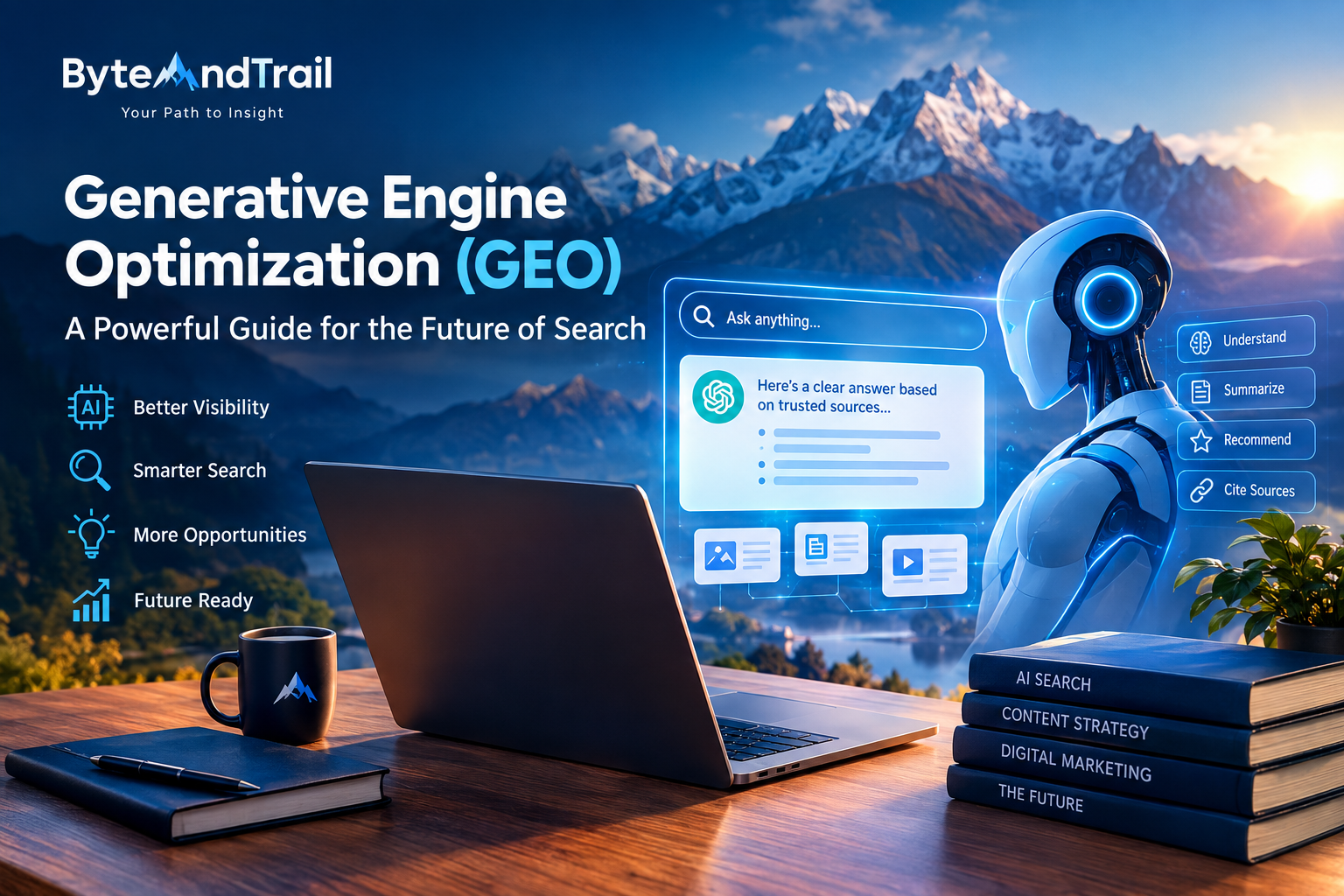
This shift has created a new concept in digital marketing: Generative Engine Optimization, commonly called GEO.
GEO is about preparing your content so that AI-powered search and answer systems can understand it, identify its value, and potentially use it when generating answers for users.
It does not mean abandoning traditional SEO. In fact, the most practical way to think about GEO is as an extension of good SEO and good content creation.
The difference is that the goal is no longer only to help a search engine rank a webpage.
The goal is also to make the information on that webpage easy for intelligent systems to understand, verify, connect, and use.
Why Search Is Becoming More Conversational
Think about how you might search for something five years ago.
You could type:
“best productivity apps for small business”
Then you would receive a collection of websites, articles, advertisements, videos, and product pages. You would open several results, compare them, and eventually make your decision.
Today, someone might ask an AI-powered search tool:
“What are the best productivity tools for a small business with a limited budget, and which one is easiest for beginners?”
That is a very different kind of search.
The second question contains context, intent, preferences, and a desired outcome.
This is one reason the future of search is becoming increasingly conversational.
Users are not always looking for a webpage anymore. They are looking for an answer.
For content creators and website owners, this creates an important challenge.
If an AI system can understand information from many different sources and produce a single response, your website needs to provide information that is clear enough, useful enough, and trustworthy enough to become part of that information ecosystem.
That is where GEO becomes increasingly relevant.
What Is Generative Engine Optimization?
Generative Engine Optimization is the practice of creating and structuring online content so that generative AI and AI-powered search systems can better understand, interpret, and potentially reference that information when answering user questions.
Traditional SEO focuses heavily on visibility in search engine results.
GEO focuses more broadly on visibility within AI-generated answers and conversational search experiences.
The two approaches overlap considerably.
A well-optimized article still needs:
- Useful information
- Clear headings
- Relevant keywords
- Strong topical coverage
- Good readability
- Technical accessibility
- Trustworthy information
- A logical structure
But GEO adds another important consideration.
Your content should make individual facts, explanations, comparisons, and conclusions easy to identify.
Imagine an AI system reading a 3,000-word article.
If the article is vague, repetitive, poorly organized, and filled with unnecessary statements, it becomes harder to determine what the author is actually saying.
Now imagine another article covering the same subject.
It explains the concept clearly, uses descriptive headings, answers common questions, provides examples, separates facts from opinions, and supports important claims with credible sources.
The second article gives both humans and machines a much clearer information structure.
That is the foundation of GEO.
GEO Does Not Replace SEO
One of the biggest misunderstandings about GEO is that it is supposed to replace traditional SEO.
It does not.
Search engines still matter. Websites still need technical SEO. Keywords still have value. Internal linking still matters. Page speed, mobile usability, crawlability, structured data, and backlinks can still influence how content is discovered and understood.
The better approach is to think of SEO and GEO as two connected layers.
SEO helps search engines discover and organize your content.
GEO helps make your content useful and understandable in an environment where AI systems may summarize information and answer questions directly.
A website that ignores SEO may struggle to be discovered.
A website that ignores how people interact with AI-powered search may also miss an important part of the changing search landscape.
The future is therefore less about choosing between SEO and GEO and more about building content that works well for both.
Search Intent Matters More Than Ever
One of the strongest connections between SEO and GEO is search intent.
A keyword by itself does not tell the whole story.
Consider the phrase:
“electric car battery”
A person searching this phrase could be looking for battery lifespan, replacement costs, charging technology, recycling, battery chemistry, common problems, or buying advice.
A useful article does not simply repeat “electric car battery” twenty times.
Instead, it tries to understand what the reader actually wants to know.
This is particularly important for AI-driven search because conversational systems are designed to interpret questions in context.
A strong content strategy therefore begins with a simple question:
What problem is the reader actually trying to solve?
Once you understand that problem, the article becomes easier to structure.
You can answer the primary question first, then cover related questions naturally.
This creates content that feels helpful rather than mechanically optimized.
Write for Questions, Not Just Keywords
Traditional keyword research often encourages publishers to focus on phrases.
GEO encourages a broader approach: think about the questions behind those phrases.
For example, instead of creating a page only around “digital marketing tools,” consider the questions a real reader might ask:
Which digital marketing tools are useful for beginners?
Which tools are free?
Which tools help with social media?
Which tools help with SEO?
Which tools are suitable for a small business?
Which tools are worth paying for?
These questions can become natural sections of an article.
The result is more comprehensive content without forcing keywords into every paragraph.
This is also a better experience for readers.
A person rarely thinks in keywords.
People think in problems, questions, comparisons, frustrations, and goals.
Good content reflects that reality.
Clear Structure Makes Content Easier to Understand
A well-structured article is easier for both people and machines to process.
Instead of writing a huge block of text, divide the subject into meaningful sections.
Use descriptive headings that tell the reader what they are about to learn.
For example, a weak heading might be:
“More Information”
A stronger heading would be:
“How GEO Changes the Way Businesses Approach Search”
The second heading immediately communicates the subject of the section.
Within each section, keep the discussion focused.
If you are explaining three different ideas, give each idea enough space to be understood.
This does not mean every article needs dozens of headings.
It means every heading should have a purpose.
A logical information hierarchy helps readers scan the page, understand the relationship between ideas, and find the answer they need.
The Importance of Direct Answers
AI-generated search experiences often need to identify concise pieces of information from larger documents.
That makes direct answers particularly useful.
Suppose your article discusses:
“What is GEO?”
Do not spend six paragraphs building suspense before answering it.
Answer the question clearly near the beginning, then explain the concept in greater depth.
This creates a useful pattern:
Answer first. Explain second.
For example, you can define a concept in one or two clear sentences and then provide examples, context, limitations, and practical applications.
This approach also improves the human reading experience.
Readers appreciate clarity.
They do not want to fight through unnecessary introduction just to discover what an article is actually about.
Build Topical Depth Instead of Keyword Stuffing
Keyword stuffing has never been a good long-term content strategy.
Repeating the same phrase again and again can make an article uncomfortable to read and does not automatically make it more authoritative.
A stronger approach is topical depth.
If you are writing about GEO, naturally discuss related concepts such as AI search, conversational queries, content structure, search intent, entity understanding, citations, authority, factual accuracy, structured data, internal linking, and user experience.
This creates a semantic relationship between concepts.
Instead of telling a search system repeatedly that your page is about GEO, you demonstrate that you understand the broader subject.
That distinction is important.
Expertise is shown through useful information, not repetition.
Original Experience Can Make Content More Valuable
There is another factor that becomes increasingly important as AI-generated content becomes common: original value.
The internet already contains enormous amounts of information.
If hundreds of websites repeat the same generic explanation, publishing another nearly identical article does not add much.
Original observations, examples, experiments, case studies, screenshots, personal experiences, interviews, original research, and practical lessons can make content more useful.
For example, instead of simply saying that a particular digital marketing technique can help small businesses, a publisher could document how the technique was implemented, what happened, what worked, what failed, and what was changed.
That creates information that cannot be easily replaced by another generic article.
For a growing website, this is a powerful opportunity.
You do not necessarily need to compete with giant publishers by producing more content.
You can compete by producing content with a distinct point of view and useful first-hand value.
Trust Becomes Even More Important
When AI systems summarize information, accuracy becomes critical.
An unclear or unsupported claim can potentially travel much further when it becomes part of an AI-generated response.
This is why trustworthy content matters.
When discussing statistics, research findings, laws, medical information, financial information, technology specifications, or rapidly changing developments, use reliable sources and make the date or context clear when necessary.
Do not present an old statistic as if it were current.
Do not turn a company’s marketing claim into an established fact.
Do not make a prediction sound like a confirmed outcome.
Good content distinguishes between:
- Established facts
- Expert analysis
- Company claims
- Research findings
- Personal experience
- Opinion
- Prediction
This distinction is valuable for human readers and increasingly relevant in an AI-mediated information environment.
Citations and Sources Add Context
Sources are not merely decoration at the bottom of an article.
They can help readers understand where important information comes from.
If you mention a major technology development, link to an authoritative source.
If you discuss research, identify the research or organization behind it.
If you describe a product specification, use the manufacturer’s documentation when appropriate.
If you discuss a rapidly changing industry trend, provide enough context for the reader to understand when the information was accurate.
This creates a stronger information trail.
It also helps readers verify important claims themselves.
A trustworthy website should not ask readers to blindly accept everything it says.
It should make verification easier.
Structured Data Can Help Search Engines Understand Pages
Technical SEO also has a role in GEO.
Structured data allows publishers to provide machine-readable information about certain types of content.
Depending on the page, this may include information about articles, products, organizations, events, authors, recipes, and other entities.
Structured data does not magically make an article appear in an AI answer.
However, accurate technical implementation can help search systems understand the content and context of a webpage.
The important word here is accurate.
Do not add structured data that does not match the visible content.
Technical optimization should support the actual information on the page rather than attempting to manipulate search systems.
Internal Links Create Context
Internal linking is another simple but powerful part of a strong GEO-friendly content strategy.
Imagine publishing an article about electric vehicle batteries.
You may already have separate articles about:
EV charging
Battery degradation
Home charging
EV buying guides
Fast charging
Electric vehicle maintenance
Instead of treating every article as an isolated page, connect them logically.
A reader interested in battery technology may naturally want to learn about charging.
An article about charging may naturally lead to an EV buying guide.
These connections create a network of related information.
For search systems, internal links can also provide useful contextual signals about the relationships between pages on your website.
This is one reason a website should be planned as a knowledge network rather than a collection of unrelated posts.
Author Expertise Still Matters
As the internet fills with automatically generated material, readers increasingly want to know who created the information.
A clear author identity can help establish context.
An author bio can explain relevant experience, areas of knowledge, professional background, or the purpose behind the publication.
For specialist topics, expert review can also be useful.
For example, a technical article may benefit from review by someone with relevant professional experience.
This does not mean every article needs a famous author.
It means websites should make a reasonable effort to establish who is responsible for the information.
People trust information more easily when they can understand its origin.
User Experience Is Part of the Equation
It is easy to become obsessed with algorithms and forget the person sitting behind the screen.
A GEO strategy that produces technically optimized but frustrating pages is missing the point.
Readers want websites that load quickly, work well on mobile devices, use readable typography, and make information easy to find.
They also want advertisements and pop-ups to remain reasonable.
If someone arrives at an article and immediately encounters multiple interruptions, they may leave before reading the content.
A clean design does not simply make a website look professional.
It allows information to do its job.
This is particularly important for publishers trying to build long-term audiences rather than collecting short-term clicks.
GEO and Featured Information
AI-powered search can change how users interact with websites.
Instead of clicking a result immediately, a user may first receive a generated summary.
That creates a new challenge for publishers.
If the user gets the complete answer without visiting the original website, the publisher may receive less direct traffic.
At the same time, appearing as a cited or referenced source can potentially increase brand visibility and establish authority.
This creates an interesting tension.
Publishers need to provide enough useful information to become valuable sources while also giving readers reasons to explore the original website.
That is why original research, detailed examples, tools, calculators, visual resources, expert commentary, and unique experiences can become increasingly important.
Information that is easily summarized may not always be enough to generate a strong reason for a reader to visit the source.
Think Beyond the Click
Traditional content marketing often focuses heavily on clicks.
But digital visibility can take many forms.
A person may discover your brand through a search result.
Another person may encounter your name in an AI-generated answer.
Someone else may see your article shared on social media.
Another visitor may return directly because they remember your website.
This means brand recognition can become an important part of search strategy.
If people repeatedly encounter useful information associated with the same publication, the website can become more memorable.
For emerging websites, this is especially valuable.
You are not simply trying to rank an article.
You are building an information brand.
GEO for Small Websites
You might assume GEO is only useful for large technology companies and major publishers.
That is not necessarily the case.
Small websites can also benefit from the principles behind it.
In fact, smaller publishers sometimes have an advantage when they focus on narrow subjects.
Instead of trying to write about everything, a website can develop strong topical coverage in selected areas.
For example, a technology publication might focus heavily on AI tools, digital marketing, future mobility, and online business.
Over time, its collection of connected articles can demonstrate a deeper understanding of those subjects.
The goal is not to publish hundreds of shallow articles.
It is to build a useful library.
That library can serve readers today and potentially become part of the information landscape used by search and AI systems tomorrow.
How to Start With GEO Today
You do not need to redesign your entire website overnight.
Start with the content you are already creating.
Before writing an article, identify the primary question.
Then list the related questions a reader is likely to have.
Create a logical outline.
Answer the main question clearly.
Use descriptive headings.
Add relevant examples.
Support important claims with trustworthy sources.
Link to related pages on your own website.
Include original insights whenever possible.
Review the article before publishing and remove unnecessary repetition.
Then ask yourself one simple question:
If someone had never heard about this topic before, would this article genuinely help them understand it?
If the answer is yes, you are moving in the right direction.
Common GEO Mistakes to Avoid
One mistake is treating GEO as a secret formula.
There is no magic sentence that guarantees inclusion in an AI-generated answer.
Another mistake is stuffing keywords into every paragraph.
A third is publishing large amounts of generic AI-generated material without adding meaningful value.
Another problem is making unsupported claims.
Some publishers also focus so heavily on optimization that the article stops sounding human.
That can be just as damaging to the reader experience.
The best content feels like someone knowledgeable is genuinely trying to help another person understand a subject.
Technology should support that process, not replace it.
What the Future of GEO May Look Like
The field is still developing.
AI-powered search continues to evolve, and different systems may use different methods to discover, interpret, retrieve, and cite information.
That means publishers should avoid building their entire strategy around one platform or one current feature.
Instead, focus on principles that are likely to remain useful:
Create accurate information.
Explain complicated subjects clearly.
Understand user intent.
Build topical depth.
Develop original material.
Maintain technical accessibility.
Make authorship and sources clear.
Create a good user experience.
Build a recognizable publication.
These principles remain valuable regardless of how a particular search interface changes.
GEO Is Ultimately About Becoming a Useful Source
Generative Engine Optimization may sound like another technical marketing acronym.
But underneath the terminology is a relatively simple idea.
When people ask questions, they need reliable information.
AI systems are increasingly becoming part of the way people discover that information.
Websites therefore need to become easier for both humans and intelligent systems to understand.
That does not mean writing for robots.
It means writing so clearly that a person can understand the answer quickly, while the structure and context of the information are also clear enough for machines to interpret.
The websites that adapt successfully will not necessarily be the ones that publish the most words.
They may be the ones that consistently provide the most useful information.
For content creators, marketers, bloggers, and technology publishers, this creates a significant opportunity.
Instead of chasing every new algorithm update, build something more durable: a website people can trust, return to, and recommend.
SEO can help people discover it.
GEO can help prepare its information for the emerging world of AI-powered search.
But the foundation remains the same.
Create something genuinely worth finding.

I am Bhaktahari Dahal, the founder and writer of Byte and Trail. I passionately research technology, blogging, and diverse fields to deliver clear, simplified, and engaging content for my readers. Welcome aboard!