
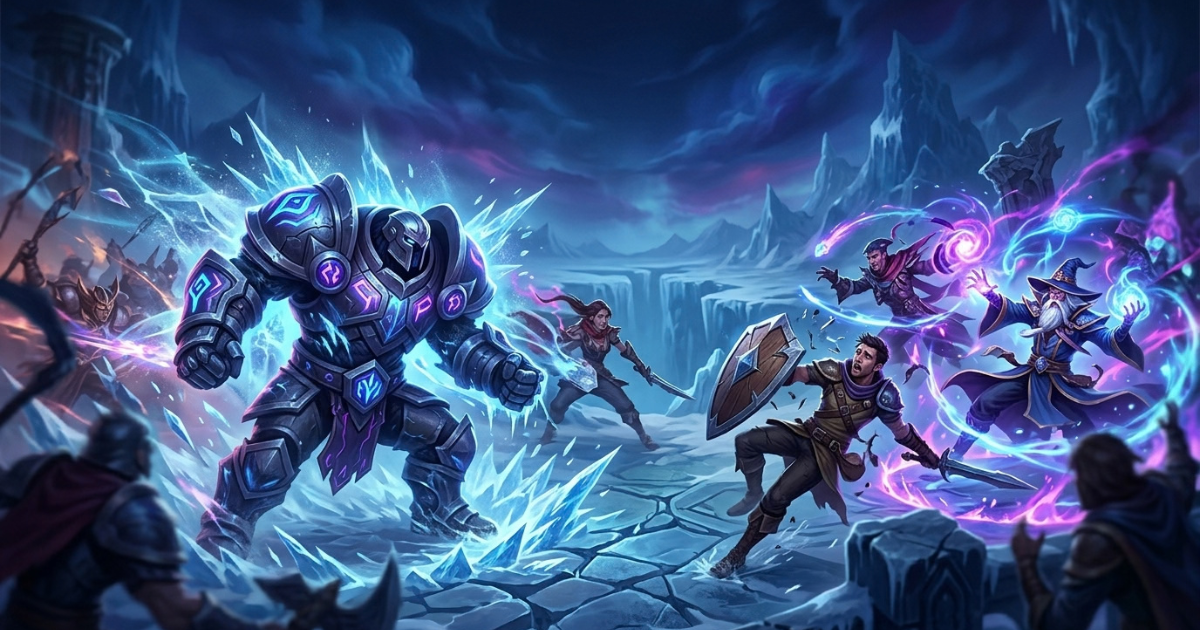

If you came to ARAM Mayhem looking for a quick, stupidly fun League of Legends game, you probably expected chaos.
You probably did not expect to spend the next 20 minutes wondering why the game feels more frustrating than fun.
That is the biggest problem with ARAM Mayhem right now.
The mode has some genuinely entertaining ideas. Random builds, ridiculous power spikes, unusual champion combinations, and matches that can completely fall apart in seconds should make ARAM Mayhem feel like a refreshing break from normal League.
Instead, the randomness often creates something much less enjoyable.
A lucky augment can matter more than good decision-making. Certain champions can become incredibly difficult to deal with. Players can turn a casual match into a serious competition. And when a game should clearly be over, some teams simply refuse to end it.
The result is a mode that can be hilarious one game and absolutely exhausting the next.
Here are 6 of the biggest problems with ARAM Mayhem that make the mode harder to enjoy than it should be.
1. ARAM Mayhem Has Too Much Unfair RNG
Randomness is supposed to be part of the fun.
The problem starts when randomness becomes the main reason one team wins.
ARAM has always included random champion selection, so players already understand that they will not get their favorite champion every game. ARAM Mayhem adds another layer of uncertainty through its additional power systems and augments.
That can create some ridiculous moments.
But it can also create completely one-sided situations.
Imagine spending several minutes building a strategy around your champion, only for another player to receive a combination that dramatically increases their effectiveness. Suddenly, the difference between the two teams is not necessarily mechanical skill or better teamwork.
It is simply luck.
That can feel terrible when you are on the wrong side of it.
The biggest issue with heavy RNG is that losing does not always feel like something you could have prevented. You can make good plays, position carefully, and choose sensible items, but an extremely favorable combination on the other side can still make the game feel decided.
A little randomness creates excitement.
Too much randomness creates frustration.
And ARAM Mayhem sometimes crosses that line.
2. Overpowered Builds Can Make Tanks Miserable to Fight
There is nothing wrong with tanks being difficult to kill.
That is literally their job.
The problem appears when a tank becomes difficult to kill and starts dealing enough damage to erase the enemy backline.
That is when ARAM Mayhem becomes frustrating.
Because the map is basically one long lane, there is not much room to avoid a strong frontline. A tank that can constantly walk forward, absorb huge amounts of damage, and still threaten carries can completely change how the opposing team is allowed to play.
You cannot simply walk around them.
You cannot always split the map.
You cannot safely farm somewhere else.
You have one lane, limited space, and five enemy players standing behind that frontline.
That makes certain tank-heavy situations especially annoying.
The worst part is the feeling of hitting a champion over and over again without making meaningful progress. You spend your abilities, use your cooldowns, and watch their health bar disappear only to see it come back through healing, shields, defensive items, or other effects.
At that point, the match stops feeling like a fight and starts feeling like a wall.
And when that same tank can suddenly delete a squishy champion, the frustration gets even worse.
3. Broken Augment Interactions Can Ruin the Entire Match
The most exciting part of ARAM Mayhem can also become one of its biggest weaknesses.
Augments and unusual combinations are supposed to create moments that would never happen in a normal League game.
That sounds great on paper.
In practice, however, complicated systems create complicated interactions.
When multiple effects, items, abilities, and champion mechanics interact at the same time, strange results can happen. Some combinations can become far more effective than intended, while others can feel almost useless.
This creates another problem: players quickly learn which combinations are worth chasing.
Once that happens, experimentation starts disappearing.
Instead of thinking, “What ridiculous build can I try this game?” players start thinking, “Which combination gives me the biggest advantage?”
That difference matters.
A chaotic game mode should encourage experimentation. If the strongest strategy becomes obvious, players naturally begin copying it.
Then the same powerful combinations start appearing again and again.
The mode may still look chaotic on the surface, but underneath all that visual madness, players are slowly being pushed toward the same few strategies.
That is not healthy variety.
It is repetitive chaos.
4. Players Can Drag Out Games That Should Already Be Over
This is one of the most annoying problems in any casual game mode.
You finally win a huge fight.
The enemy team is dead.
Their base is exposed.
The Nexus is right there.
And somebody decides it is time to farm a few more kills.
You have probably seen this happen.
One player starts chasing someone toward the fountain. Another starts spamming emotes. Someone else wants to test a new ability interaction.
Suddenly, a game that could have ended in seconds becomes another five or ten minutes of unnecessary fighting.
Sometimes the enemy team gets another chance.
Sometimes your own team gets wiped.
And sometimes the entire situation completely reverses.
The problem is not simply wasting time.
It changes the experience for everyone in the match.
If four players want to finish and one or two players want to keep playing with their food, the rest of the team is stuck.
That is especially frustrating for players who only have a short amount of time to play.
ARAM Mayhem is supposed to be a fast and chaotic alternative. Turning a clearly won game into an extended fountain-farming session works against that idea.
A funny moment is fine.
Holding an entire lobby hostage is not.
5. The Casual Atmosphere Can Quickly Turn Toxic
ARAM has traditionally had a more relaxed reputation than ranked League.
That does not mean ARAM is always friendly.
Anyone who has played enough League knows that toxicity can appear anywhere.
But ARAM Mayhem has another problem: the mode looks casual while some players treat it extremely seriously.
That creates a strange combination.
You might enter the game expecting everyone to experiment and have fun. Instead, you can end up with teammates criticizing your build, complaining about every missed ability, or spamming pings after a single mistake.
Suddenly, the “casual” game feels like a ranked match without the ranked rewards.
Build experimentation becomes harder when players are constantly judging every decision.
Pick an unusual item?
Someone complains.
Try a funny ability combination?
Someone complains.
Miss an engage?
Prepare for the question-mark ping.
Die twice?
Apparently, you have committed a crime against the entire team.
That atmosphere can push away exactly the players who should be enjoying a mode like this.
Not every League match needs to be treated like an esports final.
Sometimes players simply want to experiment.
Sometimes they want to build something ridiculous.
And sometimes they want to lose while laughing about it.
ARAM Mayhem works best when players remember that it is supposed to be chaotic.
6. ARAM Mayhem Can Become Repetitive Very Quickly
At first, ARAM Mayhem can feel incredibly fresh.
Every match seems capable of producing something completely ridiculous.
Then you play more games.
And you start noticing patterns.
You see similar champions.
You see similar builds.
You see players chasing similar augment combinations.
You recognize the same powerful interactions.
Eventually, the chaos starts feeling predictable.
That is a serious problem for a game mode that depends so heavily on replayability.
Randomness can create variety, but randomness alone cannot guarantee long-term variety.
If the same combinations remain significantly stronger than everything else, players will naturally gravitate toward them.
The result is a strange contradiction.
The mode looks random, but the optimal way to play it becomes increasingly predictable.
That can make ARAM Mayhem lose some of its original charm.
The first few games can feel like discovering a new playground.
After dozens of games, it can start feeling like you are walking around the same playground and using the same equipment every time.
Can ARAM Mayhem Actually Be Fixed?
Absolutely—but the biggest improvements would need to address the systems that create frustration rather than simply adding more chaos.
The mode needs meaningful balance between randomness and player agency.
Powerful combinations should still feel exciting without making the rest of the match irrelevant.
Tanks should be durable without becoming nearly impossible to punish.
Augments should create interesting choices instead of obvious “take this or lose” situations.
And games that are clearly finished should not be unnecessarily dragged out.
Most importantly, ARAM Mayhem needs to protect the reason people play it in the first place.
Fun.
League of Legends already has competitive modes for players who want intense optimization and serious decision-making.
A mode built around mayhem should feel different.
It should allow players to make weird choices.
It should reward creativity.
It should create ridiculous moments that players remember after the match.
Right now, the biggest weakness of ARAM Mayhem is that the chaos can sometimes work against those goals.
The randomness becomes frustrating.
The strongest builds become repetitive.
The tanks become exhausting.
The games can drag on.
And the casual atmosphere can disappear surprisingly fast.
That does not mean ARAM Mayhem is a bad idea.
In fact, the opposite may be true.
The concept is interesting enough that these problems stand out precisely because the mode has so much potential.
But until the balance between chaos, fairness, and fun improves, ARAM Mayhem risks becoming the kind of game mode players love for a few matches—and then quietly stop playing.
And honestly, that might be the biggest problem of all.

I am Bhaktahari Dahal, the founder and writer of Byte and Trail. I passionately research technology, blogging, and diverse fields to deliver clear, simplified, and engaging content for my readers. Welcome aboard!