

Eric Schmidt AI programmers
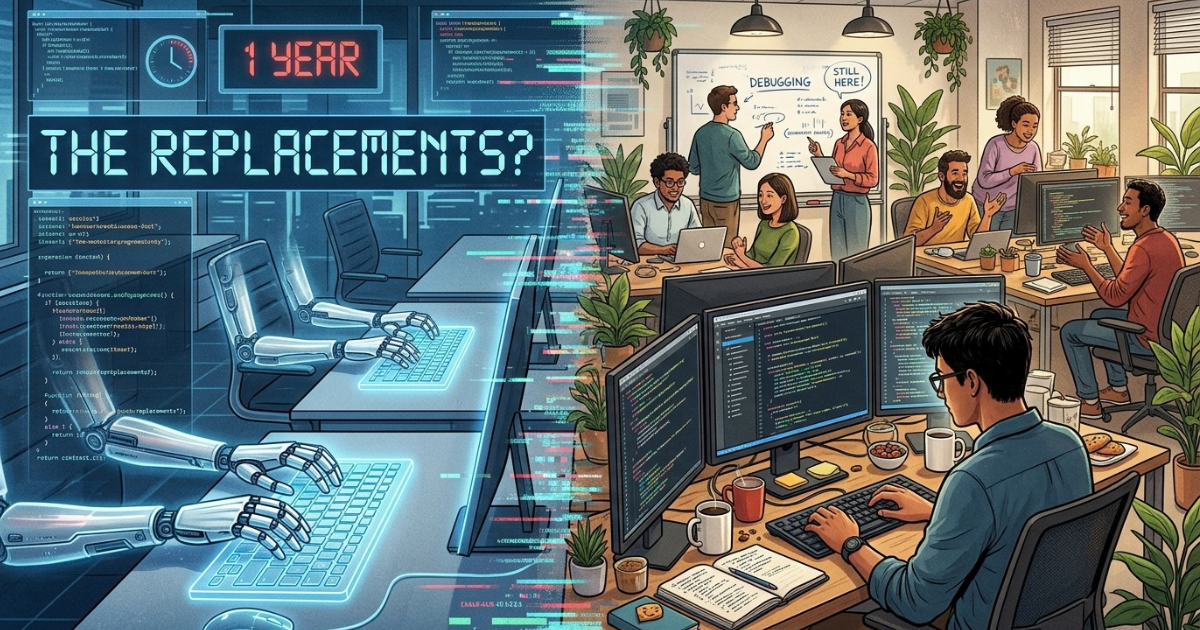
In April 2025, at an AI and biotechnology summit in Washington, D.C., former Google CEO Eric Schmidt said something that made a lot of programmers stop mid-sip. He said the industry believes that within one year, the vast majority of programmers will be replaced by AI programmers.
That’s a hell of a sentence if you write code for a living. It’s an even bigger one if you’re nineteen and just picked computer science as a major.
Well, it’s now October 2026. More than a year has passed. So let’s do something people rarely do with big predictions: go back and check.
First, what did he actually say?
Context matters here, because short clips travel faster than full talks.
Schmidt’s argument at that summit was that AI systems are moving from answering questions to carrying out multi-step work on their own. He described how modern systems already work by exploring a tree of choices: try one approach, check it, try another, keep going until something works. And then he added that this is basically how humans think too.
From there, he drew the line to programming. His claim was that autonomous AI programmers would arrive fast enough that, in about a year, most human programmers would be replaced by them. He also said he thinks AI is underhyped, not overhyped, which is a spicy position in a world where plenty of people are tired of the hype.
Schmidt isn’t a random commentator, either. He ran Google for a decade, has advised on national AI policy, and has put money into AI companies, including coding-focused startups. When someone with that résumé makes a prediction, people pay attention. That’s also worth noticing from the other direction: he’s deeply involved in the industry whose future he’s forecasting. That doesn’t make him wrong. It just means you should read his words the way you’d read a restaurant owner’s opinion about the neighborhood’s food scene.
So what actually happened?
Let’s look at the evidence we have, with the caveat that I’m not going to pretend I can see every hiring database in the country.
The first clue is Stack Overflow’s 2025 Developer Survey, which covered more than 49,000 developers. AI usage is enormous: about 84% said they use or plan to use AI tools, and just over half of professionals use them daily. So AI is absolutely changing how code gets written.
But the same survey reports something that cuts against the “replaced” story. Only a tiny slice of developers, around 3%, say they highly trust AI output. About 46% distrust it. The biggest frustration, at 66%, is code that’s almost right but not quite. Three quarters said they’d still ask a human when they don’t trust an AI answer. Those are not the numbers you’d expect from a profession that’s about to hand over the keys.
The second clue is what Schmidt himself said later. In a March 2026 talk at Harvard, as reported in the press, he shifted the framing. The best programmers, he said, have already stopped writing most code by hand. They direct AI systems that write it. He also noted that at leading AI labs, AI is already producing something like 10% to 20% of the code. And he argued those top engineers would become far more valuable, not less.
Read those two statements side by side and you notice something. “The vast majority of programmers will be replaced” and “the best programmers will be ten times more valuable” are not the same prediction. One is about disappearance. The other is about transformation.
“Replaced” is doing a lot of work in that sentence
Eric Schmidt AI programmers
Here’s where I think the confusion comes from. When people hear “replaced,” they picture a company laying off every developer and flipping a switch. That’s not what the evidence shows so far.
What looks much more likely is a gradual shift in what the job is. Developers are spending less time typing out routine code and more time describing, reviewing, testing, and steering. The title “programmer” might stay the same while the daily work changes underneath it.
We’ve seen this before. Spreadsheets didn’t eliminate accountants. They changed what accountants spent their time on. Accountants who refused to learn spreadsheets did struggle, though. Digital cameras didn’t kill photography. They killed a certain kind of darkroom job and created a lot of new ones.
I’m not saying AI will follow the exact same pattern. This technology is different in important ways, and anyone who tells you with total confidence what happens next is guessing. But the “replacement” framing might be too crude to describe what’s actually going on.
Where the prediction has some truth in it
Let me be fair to Schmidt, because dismissing him entirely would be lazy.
Some parts of programming really are shrinking. Boilerplate. Simple CRUD apps. Quick scripts. Translating a clear spec into a standard implementation. A task that took a developer a day can now sometimes take an hour. Schmidt himself has said that work that would have taken him six months and ten programmers at Google can now be done far more cheaply with these tools.
And the pressure is real, especially at the entry level. If a company can get a decent first draft from an AI tool, the old “hire a junior to write the easy stuff” model gets harder to justify. Headlines about tech layoffs in 2026, including big names like Meta and Amazon, add to the anxiety, though layoffs happen for a lot of reasons and it’s tough to pin them on one cause.
Commencement season tells its own story. Reports from this spring describe graduates booing speakers who talked up AI. You don’t get that reaction unless people are genuinely scared about their futures. That fear is real even where the data doesn’t back up the worst-case version.
So the honest summary is: the tools are changing the work faster than most people expected, and the pain is landing first on people trying to get their foot in the door.
Where the prediction runs into reality
Now the other side.
Writing code was never the whole job. Developers spend huge amounts of time figuring out what to build, talking to people, reading old code, debugging weird problems, and making tradeoffs. AI helps with parts of that. It doesn’t fully own it.
Trust and accountability are hard to automate. If something breaks at 3 a.m., a company needs a person who understands the system and can be responsible for it. An AI agent can assist, but organizations are slow to hand over accountability to something that can’t be fired, sued, or woken up.
Real codebases are messy. Benchmarks and demos use clean problems. Real software has fifteen years of weird decisions, half-documented systems, and customers who depend on bugs. AI tools struggle most in exactly that environment.
Adoption is slower than capability. Even if a tool could do something, companies take time to trust it, integrate it, and deal with security and legal questions. The Stack Overflow survey shows that agent adoption is still cautious, with a big chunk of developers not using agents at all.
Verification is the bottleneck. The more code AI produces, the more code a human has to check. That’s not a job going away. That’s a job growing.
The pattern with big tech predictions
Here’s something worth saying out loud: timeline predictions in tech are almost always too fast on the “when” and too slow on the “how much.”
Self-driving cars were supposed to be everywhere by now. They’re real, and they’re in a handful of cities, and they’re still not what the 2015 predictions promised. But nobody serious says the technology is fake either.
Schmidt’s one-year timeline looks the same. The direction may well be right. The speed and the word “replaced” look overcooked. That doesn’t make the prediction worthless, but it should make you cautious about turning any single forecast into a life decision.
I’d also point out that other leaders have made similar claims about AI writing most code soon. When several people in the same industry say the same thing, it can feel like confirmation. Sometimes it is. Sometimes it’s just a group of people who read the same internal dashboards and share the same incentives.
So should you be worried?
My honest take: be alert, not panicked.
If you’re a working developer, the job is changing. The people who treat AI as a tool to master will likely do fine, possibly better than before. The people who ignore it completely are taking a bigger risk than the ones who learn it.
If you’re a student, your path is harder than it was five years ago, but it isn’t closed. Employers still need people who can think clearly, communicate, and understand systems. What they’re less excited about is someone who can only do the thing AI already does well. Build the skills around the code.
If you’re a parent or a career changer wondering whether programming is still worth learning, I’d say yes, with an asterisk. Learn it as a way of thinking and building, not as a trick for typing syntax. That version of the skill isn’t going out of style.
What to watch next
A few things will tell us more than any one prediction.
Watch entry-level hiring numbers over the next year or two. That’s the clearest signal of whether the bottom rung of the ladder is really disappearing.
Watch the Stack Overflow 2026 survey when it lands. It’ll show whether trust is rising, whether agent use is climbing, and whether developers are feeling more or less secure in their jobs.
Watch how companies talk about AI-written code. Are they bragging about percentages, or about reliability and results? The second kind of talk usually means a technology is maturing.
And watch what Schmidt says next. He’s changed his framing before, and he probably will again. That’s not a flaw. It’s how people update when reality pushes back.
The bottom line
Did most programmers get replaced within a year? No. Is programming changing, fast, in ways that are uncomfortable for a lot of people? Absolutely.
The headline version of Eric Schmidt’s prediction was too dramatic. The quieter version, that the job is shifting from writing every line to directing, checking, and designing, looks a lot closer to what’s happening.
So if you’ve been losing sleep over that one sentence from April 2025, here’s my advice. Take a breath. Then go get better at the parts of the job a machine can’t do for you.
What’s your read on it? Do you think the “replacement” prediction was off, or just early?

I am Bhaktahari Dahal, the founder and writer of Byte and Trail. I passionately research technology, blogging, and diverse fields to deliver clear, simplified, and engaging content for my readers. Welcome aboard!