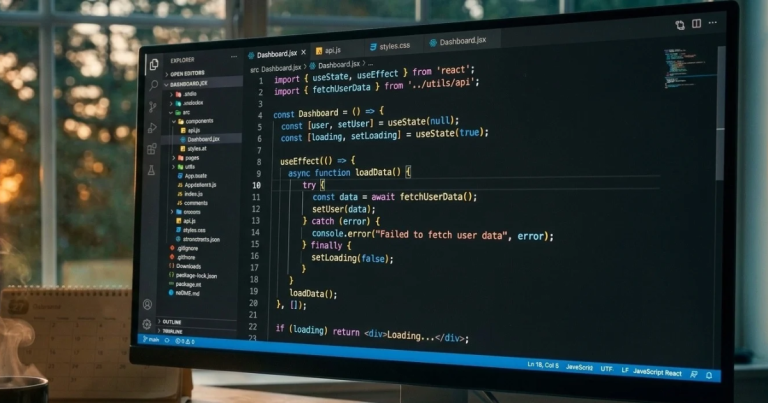



The global software engineering community is currently experiencing a massive, collective existential crisis. If you open X (formerly Twitter), browse through technical subreddits, or attend any tech meetup in Silicon Valley, the sentiment is overwhelmingly anxious. The question isn’t just lingering in computer science classrooms anymore; it is being actively debated by tech executives and corporate boardrooms across the United States. Is coding dead because of AI? The short answer is a definitive no, but the traditional manner in which we have defined a “coder” or a “programmer” for the past three decades is undergoing an absolute, permanent demolition.
For nearly thirty years, learning to code was marketed across the globe as the ultimate golden ticket to economic mobility and middle-class stability. “Learn to code” became the default piece of career advice given to anyone wanting to future-proof their income. Students were told to memorize syntax, master algorithmic data structures, build a portfolio of simple web applications, and land a high-paying corporate job. Today, autonomous AI platforms can spin up production-ready, beautifully optimized code in mere fractions of a second based on a simple plain-English prompt. This rapid acceleration forces the industry to confront a brutal, unavoidable truth: the era of the pure syntax writer is officially over, and it is never coming back.
🔍 The Big Question: Is Coding Dead Because of AI?
To fully comprehend why this industry-wide panic is completely valid, we have to look closely at the terrifyingly rapid evolution of developer-focused artificial intelligence systems. We have transitioned far beyond the initial phase of simple auto-complete coding features, such as the early iterations of GitHub Copilot. The industry has shifted toward entirely autonomous, agentic software platforms. As engineers watch these tools evolve, everyone is asking: is coding dead because of ai? Tools like Anthropic’s Claude Code and advanced LLM agent frameworks are no longer just suggesting the next line of generic code; they are actively operating within massive, multi-layered enterprise codebases entirely on their own.
These modern autonomous systems can independently diagnose bugs across dozens of interconnected files, write comprehensive automated test suites, refactor heavily outdated legacy systems, and securely deploy updates straight to production clouds. They don’t get tired, they don’t suffer from context-switching fatigue, they don’t require stock options, and they operate at the pure speed of computer processing power. When a junior engineer watches an AI agent seamlessly solve a complex backend architecture issue in less than three minutes—a task that would typically require a senior human engineer an entire afternoon of intense mental labor—the career anxiety becomes incredibly rational. The tactical execution of manually writing code has become completely commoditized, reducing its economic value to almost zero.
🧠 Why the Answer to “Is Coding Dead Because of AI” is Syntax vs. Systems Architecture
If a machine can write flawless syntax in the blink of an eye, what is genuinely left for the human developer to do? When analyzing whether is coding dead because of ai, the profound distinction between a basic “coder” and a true “software engineer” becomes critically important for your survival. Writing syntax is merely the mechanical translation of human logic into a structural language that a machine can execute. Systems architecture, on the other hand, is about understanding complex human business requirements, implementing elite security paradigms, ensuring long-term product scalability, and crafting an intuitive user experience.
Artificial intelligence excels remarkably at solving deterministic problems—give it a specific error code, and it will find the patch instantly. However, AI struggles immensely with the ambiguous, messy, and constantly changing reality of human operations. In the real world, corporate clients and stakeholders rarely know what they actually want. Translating vague, contradictory business desires into precise technical specifications requires deep empathy, intuition, and institutional knowledge. The future of tech belongs not to those who can type lines of Python, C++, or JavaScript the fastest, but to those who can orchestrate these powerful AI systems to build robust, secure, and compliant software ecosystems.
💻 The Impact on Your Career: Is Coding Dead Because of AI for New Developers?
The financial and technical barrier to entry for creating custom software is plummeting straight to zero. Historically, if an ambitious entrepreneur wanted to launch a tech startup, they required hundreds of thousands of dollars in venture capital funding just to hire a foundational engineering team to build a simple Minimum Viable Product (MVP). Today, a single technical founder equipped with advanced AI agents can achieve that exact same operational engineering output over a single weekend from their living room.
This radical democratization means the market is about to see an absolute explosion of niche, hyper-customized software applications tailored to specific localized industries. The premium economic value is shifting rapidly away from the execution of the software to the ingenuity of the core idea and the efficiency of its distribution channels. The modern developer’s technical stack is no longer just about frontend frameworks and SQL databases; it now includes prompt engineering pipelines, agent orchestration layers, and continuous evaluation models.
[ Traditional Development Stack ] : HTML/CSS ➔ JavaScript ➔ Backend DB ➔ Server Hosting
[ Modern AI Orchestration Stack ] : Product Spec ➔ AI Agent Prompting ➔ Human Code Review ➔ Automated CI/CD
The Roadmap for the Next Generation of Engineers
If you are a computer science student or a junior developer entering the job market today, the worst thing you can possibly do is panic and abandon the tech field entirely. You shouldn’t blindly believe that is coding dead because of ai means there are no jobs left. The second worst thing you can do is pretend that absolutely nothing has changed and continue studying legacy programming methods. The roadmap to a successful, high-paying tech career in this new era requires an immediate, aggressive pivot toward systems engineering, product design, cybersecurity, and deep domain expertise.
You must stop viewing artificial intelligence as an external competitor and start mastering it as your primary operational leverage. A single developer who intimately understands how to guide an AI agent, debug its subtle logic hallucinations, and securely integrate its outputs will easily outperform a traditional engineering team of five manual coders. Coding isn’t dead; it is simply evolving from a manual typing labor into a high-level creative, architectural, and managerial discipline. The computer keyboard is no longer a tool for manual entry—it has permanently transformed into a steering wheel for automated intelligence.

I am Bhaktahari Dahal, the founder and writer of Byte and Trail. I passionately research technology, blogging, and diverse fields to deliver clear, simplified, and engaging content for my readers. Welcome aboard!