
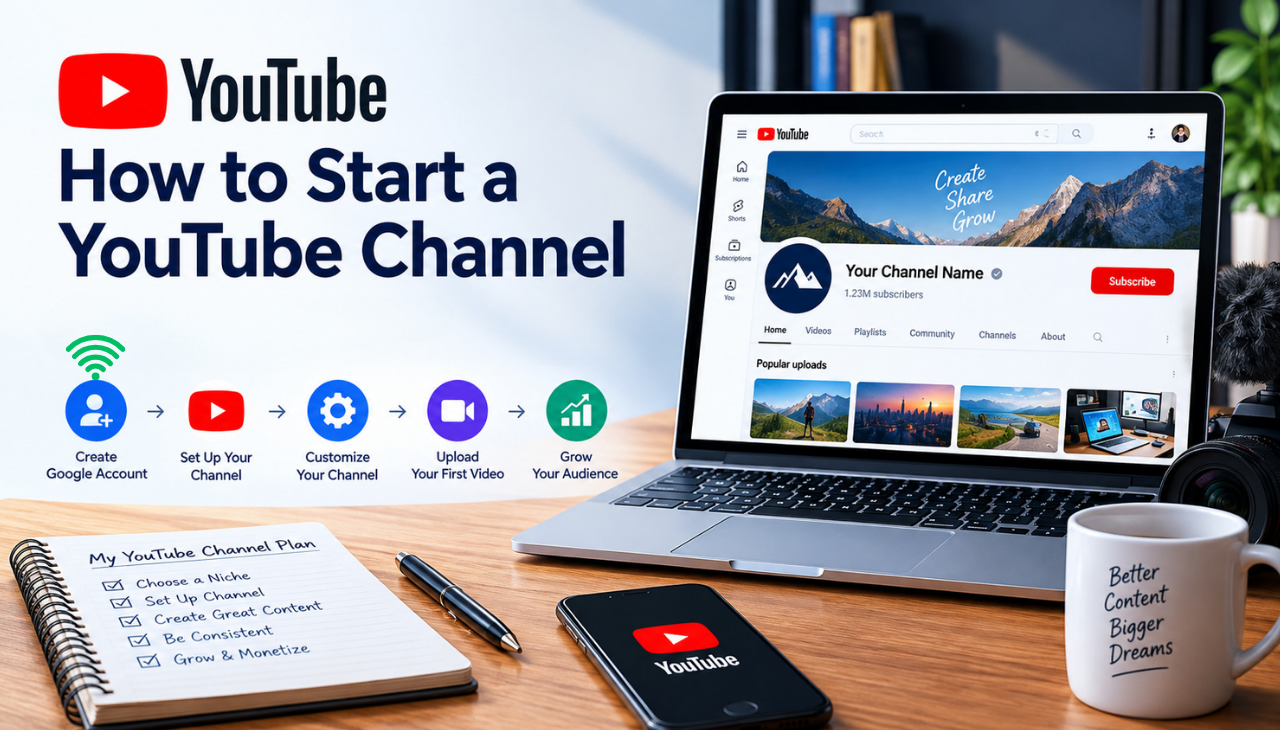
How to Start a YouTube channel can feel overwhelming when you see creators with professional cameras, huge audiences, and millions of views. But the truth is, you don’t need expensive equipment or thousands of subscribers to get started.
What you really need is a clear idea, a Google account, a little creativity, and the willingness to publish your first few videos.
Whether you want to build a personal brand, share your knowledge, promote a business, or eventually earn money online, YouTube can be a powerful platform. The hardest part is often simply getting started.
In this guide, we’ll walk through the essential steps to start a YouTube channel from scratch.
1. Decide What Your Channel Will Be About
Before creating your channel, take some time to decide what you want to talk about.
Your topic, often called a niche, doesn’t have to be extremely specific. However, having a clear direction makes it easier for viewers to understand why they should subscribe.
For example, you could create content around:
- Technology and gadgets
- Travel and destination guides
- Fitness and healthy living
- Personal finance
- Cooking and recipes
- Gaming
- Tutorials and how-to videos
- Digital marketing
- Education and career advice
- Product reviews
A good starting point is to choose something you genuinely enjoy or know reasonably well. You don’t need to be the world’s biggest expert. You simply need to be able to help, entertain, educate, or inform your audience.
Think About Your Audience
Don’t just ask, “What videos do I want to make?”
Also ask:
“Who would want to watch these videos?”
For example, instead of creating a general technology channel, you might focus on helping beginners understand useful apps, AI tools, websites, and everyday technology.
That simple shift can make your content much easier to plan.
2. Choose a Channel Name
Your channel name is important, but don’t spend weeks trying to find the perfect one.
A good name should be:
- Easy to remember
- Easy to spell
- Relevant to your content
- Simple enough to say out loud
- Flexible enough to grow with your channel
If you’re building a personal brand, naturally using your own name can be a smart option. If you’re creating an information-based channel, a brand name may work better.
Most importantly, avoid making your name too complicated. You want viewers to remember it after watching one of your videos.
3. Create Your YouTube Channel naturally
Once you’ve chosen your topic and name, you can create your channel using your Google account.
The basic process is straightforward:
- Sign in to YouTube with your Google account.
- Select your profile picture.
- Choose the option to create a channel.
- Add your channel name and profile picture.
- Complete your basic channel information.
You don’t need a professionally designed logo on day one. You can always improve your branding later.
What matters most at this stage is getting your channel ready so you can start publishing.
4. Plan Your First Few Videos
Don’t create your channel and then wonder what to upload.
Before publishing your first video, write down at least 5–10 video ideas.
Look for questions people are already asking. Search YouTube and Google for your topic and pay attention to the types of videos that appear repeatedly.
For example, if your channel is about YouTube, possible beginner topics could include:
- How to Start a YouTube Channel
- How to Create Your First YouTube Video
- YouTube Mistakes Beginners Should Avoid
- How YouTube Recommendations Work
- How to Get Your First 100 Subscribers
Having several ideas ready reduces the pressure of constantly thinking about what to make next.
And remember: your first video doesn’t need to be perfect. It just needs to be published.
Creating Your First Videos
Creating a YouTube channel is only the beginning. The next step is turning your idea into videos that people actually want to watch.
The good news is that you don’t need a studio or expensive equipment. Many successful creators started with simple setups and upgraded their equipment as their channels grew.
5. Start With the Equipment You Already Have
One of the biggest mistakes beginners make is waiting until they can afford a professional camera, microphone, lighting, and computer.
You don’t need all of that to start.
A modern smartphone can record perfectly usable video. If you’re making screen tutorials, your computer and screen-recording software may be enough.
For better audio, consider investing in a reasonably priced microphone when your budget allows. Good sound can make a bigger difference than buying an expensive camera.
If you’re filming yourself, basic lighting also helps. A window with natural light can work surprisingly well.
Don’t let equipment become an excuse for not publishing.
Start with naturally what you have and improve your setup as your channel develops.
6. Make Your First Video Simple
Your first video doesn’t need a complicated script.
A simple structure can make the process much easier:
Hook → Introduction → Main Content → Takeaway → Call to Action
The first few seconds are especially important. Give viewers a reason to continue watching.
Instead of starting with a long introduction, get straight to the point.
For example:
“Want to start a YouTube channel but don’t know where to begin? Here are the five steps you need to follow.”
Then explain the topic clearly and naturally.
Try to speak as though you’re talking to one person rather than presenting to a huge crowd. This can make your videos feel more personal and less robotic.
7. Create Better Titles and Thumbnails
A great video can struggle if nobody clicks on it.
That’s why your title and thumbnail deserve attention.
Your title should tell viewers what they’ll get from the video while creating enough curiosity to encourage a click.
For example:
Weak:
“My YouTube Tips”
Better:
“How to Start a YouTube Channel in 2026: Beginner’s Guide”
Your thumbnail should be easy to understand at a glance. Avoid filling it with too much text.
Use a clear image, strong visual contrast, and only a few important words when necessary.
The goal isn’t to trick people into clicking. Your title and thumbnail should accurately represent what the video delivers.
8. Learn the Basics of YouTube SEO
YouTube is both a video platform and a search engine.
People search for answers, tutorials, reviews, entertainment, and solutions every day. Understanding what your audience searches for can help your videos reach the right viewers.
Start by researching keywords related to your topic.
For example, if your channel is about photography, people might search for:
- How to use a DSLR camera
- Best camera settings for beginners
- How to take better photos
- Photography tips for beginners
Use the main keyword naturally in your video title and description. Avoid stuffing keywords everywhere.
Most importantly, create the video because it genuinely answers the viewer’s question—not simply because a keyword has search volume.
9. Focus on Watch Time and Viewer Retention
Getting someone to click your video is only half the battle.
You also want them to keep watching.
Avoid unnecessary introductions, long pauses, repetitive information, and unrelated sections.
Break longer videos into logical sections and keep the pace comfortable.
Ask yourself:
“If I were watching this video, where would I get bored and leave?”
That question can help you improve your videos dramatically.
You won’t master this immediately. Your first videos are partly a learning process.
10. Be Consistent, Not Perfect
You don’t necessarily need to upload every day.
For many beginners, one quality video per week is a much more realistic target than trying to upload daily and burning out.
Choose a schedule you can actually maintain.
As you publish more videos, you’ll learn what your audience enjoys, which topics perform well, and where viewers stop watching.
Your first 10 or 20 videos may not get many views. That’s normal.
Instead of judging your channel too early, use those videos as practice.
Every upload gives you another opportunity to improve your topic selection, storytelling, editing, thumbnails, and presentation.
Your first goal shouldn’t be to go viral. Your first goal should be to get better.
Grow Your Audience and Make Money
Once you’ve published your first few videos, the next challenge is getting people to discover your channel and giving them a reason to come back.
You don’t need millions of views to build a successful YouTube channel. A small audience that genuinely cares about your content can be more valuable than a large audience that never returns.
11. Give Viewers a Reason to Subscribe
People don’t subscribe simply because you ask them to.
They subscribe when they believe your future videos will continue to be useful, entertaining, or interesting.
Instead of repeatedly saying, “Please subscribe,” give viewers a reason.
For example:
“If you want more simple YouTube tutorials like this, subscribe because I post a new guide every week.”
That feels more natural because you’re explaining the benefit.
You can also create related videos and playlists so viewers have an easy way to continue watching your content.
12. Use YouTube Analytics to Improve
One of the best things about YouTube is that you can learn from your own data.
YouTube Analytics can show you information such as views, watch time, audience retention, traffic sources, and which videos are attracting viewers.
Don’t become obsessed with numbers, especially when your channel is new.
Instead, look for patterns.
If one topic performs significantly better than your other videos, consider creating another video around that subject.
If viewers consistently leave during your introduction, experiment with getting to the main point faster.
Think of analytics as feedback rather than a judgment of your ability.
13. Understand YouTube Monetization
Many beginners start a channel because they want to make money online.
YouTube can provide several potential income streams, including advertising revenue, memberships, sponsorships, affiliate marketing, and selling your own products or services.
However, monetization shouldn’t be your only goal at the beginning.
Focus first on creating useful content and building an audience.
YouTube also has eligibility requirements for its Partner Program, and these requirements can change over time. Check YouTube’s official requirements before planning your income strategy around a specific subscriber or watch-time target.
Remember that making money from YouTube usually takes time. A channel can take months—or sometimes much longer—to build meaningful income.
14. Avoid Common Beginner Mistakes
A few mistakes can make the journey harder than it needs to be.
One common mistake is copying another creator too closely. Study successful channels for ideas, but develop your own voice and approach.
Another mistake is quitting because the first videos get very few views.
Your first videos are unlikely to represent your long-term potential.
You may also hurt your channel by changing topics constantly. Experimentation is good, but repeatedly jumping from gaming to cooking to finance to travel can make it difficult to build a clear audience.
Finally, don’t spend all your time worrying about algorithms.
Make videos for people first.
If viewers find your content useful and continue watching, you’re moving in the right direction.
15. Keep Improving One Video at a Time
You don’t have to become an expert YouTuber overnight.
With every video, try to improve one thing.
Maybe your next video will have better audio. The one after that might have a stronger thumbnail. Later, you might improve your storytelling or editing.
Small improvements add up.
Your first video may feel awkward. That’s okay.
Almost every creator has an old video they wouldn’t make the same way today. Those early mistakes are part of the process.
Conclusion
Starting a YouTube channel in 2026 is easier than ever, but building a successful one still requires patience and consistency.
You don’t need expensive equipment, a perfect voice, or thousands of subscribers to begin. Start with a topic you understand, create videos that solve real problems or entertain people, and learn from every upload.
Choose a realistic publishing schedule, improve your titles and thumbnails, study your analytics, and keep experimenting with content your audience actually wants.
Most importantly, don’t wait for everything to be perfect before you start.
Your first video won’t be your best video—and it doesn’t need to be.
The best way to learn YouTube is to start creating, publish your work, listen to your audience, and keep getting better.
Start small. Stay consistent. Keep improving. Your channel can grow from there.

I am Bhaktahari Dahal, the founder and writer of Byte and Trail. I passionately research technology, blogging, and diverse fields to deliver clear, simplified, and engaging content for my readers. Welcome aboard!