
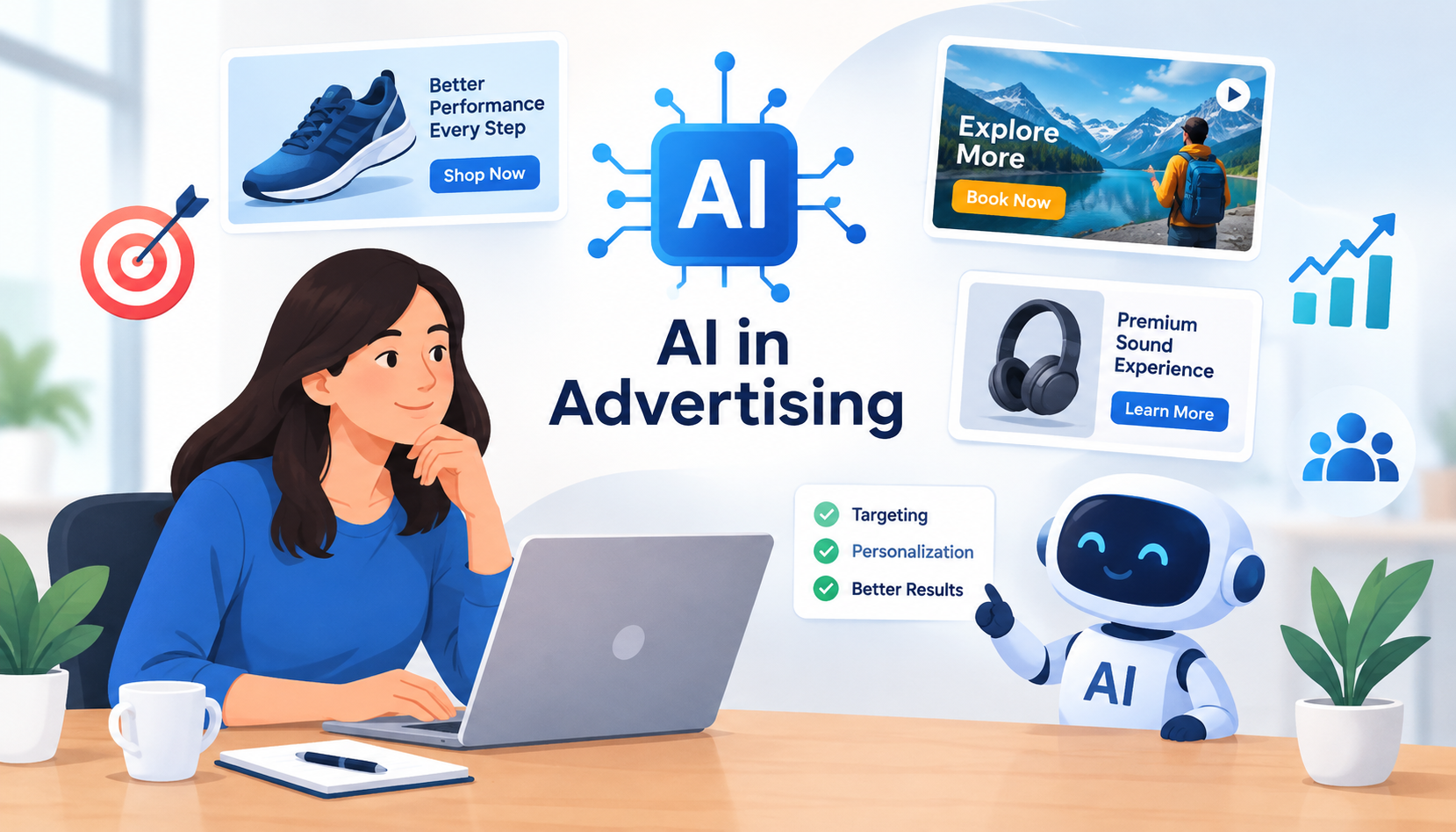
Advertising has always been about understanding people. Brands want to know what customers need, what catches their attention, and what makes them choose one product over another. Today, technology is changing how businesses answer those questions.
One of the biggest changes is AI in advertising. Artificial intelligence is helping marketers analyze customer behavior, create content, improve ad targeting, and make faster decisions. What once required hours of manual research can now happen in minutes.
But AI is not simply about replacing traditional advertising. In many cases, it is helping marketers work smarter while giving them more time to focus on ideas, creativity, and strategy.
What Is AI in Advertising?
AI in advertising means using artificial intelligence technologies to plan, create, target, analyze, and improve advertising campaigns.
Instead of relying only on historical data or manual decisions, AI systems can process huge amounts of information and identify patterns. They can help advertisers understand which audiences may be interested in a product, which type of message could perform better, and when an advertisement may have a stronger chance of getting attention.
For example, an online store selling running shoes might use AI to identify different customer groups. One group may be interested in marathon shoes, while another may be looking for affordable shoes for everyday workouts. AI can help advertisers create and deliver more relevant messages to each audience.
This is one reason AI in advertising has become an important part of modern digital marketing.
10 Powerful Ways AI Is Changing Advertising
1. Smarter Audience Targeting
Finding the right audience has always been one of the biggest challenges in advertising.
Traditional advertising often depended on broad demographic information such as age, location, or gender. AI can go much deeper by analyzing patterns in browsing behavior, interests, interactions, and previous campaign responses.
This allows advertisers to build more specific audience segments.
For example, a travel company may discover that some users are interested in luxury vacations while others regularly search for budget-friendly destinations. Instead of showing everyone the same advertisement, marketers can create different messages for different groups.
The result can be a more relevant advertising experience.
2. Faster Ad Creation
Creating advertising content can take a significant amount of time. Marketers may need headlines, descriptions, social media captions, product images, video concepts, and multiple versions of the same advertisement.
Generative AI is changing this process.
AI tools can help create initial versions of ad copy, suggest headlines, develop creative concepts, and generate variations for different audiences. Human marketers can then review, edit, and improve those ideas before publishing them.
This does not mean every AI-generated advertisement is automatically good. A machine can produce words quickly, but understanding a brand’s personality and customers still requires human judgment.
The strongest approach is often a combination of AI speed and human creativity.
3. Better Ad Personalization
People are more likely to notice advertising that feels relevant to them.
AI can help advertisers personalize messages based on customer interests and behavior. A customer who frequently looks at fitness products may receive a different advertisement from someone interested in home technology.
This creates an opportunity for brands to move away from one-size-fits-all advertising.
However, personalization needs to be handled carefully. If an advertisement feels too personal or intrusive, customers may become uncomfortable. Successful AI in advertising therefore requires a balance between relevance and respect for privacy.
4. Improved Campaign Optimization
Advertising campaigns rarely perform perfectly from the first day.
Marketers normally test different headlines, images, audiences, placements, and budgets. AI can help analyze campaign results and identify which combinations are producing stronger engagement.
Instead of waiting until the end of a campaign to study the results, marketers can use AI-powered systems to identify patterns while campaigns are running.
This can help businesses make faster adjustments and potentially reduce wasted advertising spend.
AI Is Becoming a Marketing Assistant, Not Just a Tool
The most interesting part of AI in advertising may not be automation itself. It is the way AI can become an assistant for marketers.
A marketer can use AI to analyze campaign data, brainstorm creative ideas, summarize customer feedback, generate variations of an advertisement, or identify patterns that might be difficult to notice manually.
The final decision can still remain with the human team.
That combination matters because advertising is not only about data. It is also about emotion, culture, storytelling, trust, and creativity.
AI can process information at incredible speed, but humans still understand the deeper context behind a brand and its audience.
As AI technology continues to develop, advertising is likely to become faster, more personalized, and more data-driven. The brands that understand how to use these tools responsibly may have new opportunities to connect with customers in meaningful ways.
In the next part, we will look at how AI is changing ad performance, predictive analytics, creative testing, and customer behavior, along with the challenges marketers need to consider.
How AI Makes Advertising More Effective
The biggest advantage of modern advertising is not simply reaching more people. It is reaching the right people with the right message at the right moment. This is where artificial intelligence can make a major difference.
As businesses collect more digital data, AI can help turn that information into useful insights. Marketers can use those insights to understand campaign performance, discover customer patterns, and make better advertising decisions.
5. Predictive Analytics Helps Marketers Plan Ahead
Advertising has traditionally relied heavily on past performance. Marketers look at previous campaigns and use those results to decide what to do next.
AI adds another layer to this process through predictive analytics.
By examining large amounts of historical and real-time data, AI systems can identify patterns that may help marketers estimate future customer behavior. For example, an online retailer may notice that certain customers are more likely to purchase after seeing several product advertisements.
These insights can help marketers plan campaigns more strategically.
Predictive analytics does not guarantee what a customer will do. People can change their minds, markets can shift, and unexpected events can influence buying decisions. However, AI can give marketers additional information to support their decisions.
6. AI Makes Creative Testing Faster
A single advertisement can have many different versions.
A company might test one headline against another, use different images, change the call to action, or create separate versions for different audiences. Doing all of this manually can take a lot of time.
AI can make creative testing much faster.
Marketing teams can use AI to generate multiple variations and analyze how different versions perform. If one message receives stronger engagement than another, marketers can study the result and adjust the campaign.
This approach can be especially useful for digital advertising, where campaigns can be tested and modified relatively quickly.
However, performance data should not be the only consideration. An advertisement may receive clicks but still fail to communicate the brand’s values. Human review remains important when deciding which creative ideas should represent a business.
7. AI Can Help Reduce Advertising Waste
Advertising budgets are rarely unlimited.
Small businesses especially need to think carefully about where every advertising dollar goes. Showing an advertisement to people who have little interest in the product can quickly consume a budget without producing meaningful results.
AI-powered advertising systems can analyze campaign signals and help identify audiences, placements, and creative combinations that appear more promising.
This can help marketers make better use of their budgets.
For example, if a campaign performs strongly with one audience segment but poorly with another, the marketing team can examine the difference and decide whether to change the targeting or advertising message.
The goal is not simply to spend less. It is to make each advertising decision more informed.
How AI Understands Customer Behavior
Customer behavior is complicated.
Someone may see an advertisement today, visit a website tomorrow, compare products later, and finally make a purchase several days afterward. There may be many interactions between the first advertisement and the final decision.
AI can help marketers analyze these complicated customer journeys.
Instead of looking at individual clicks separately, businesses can examine broader patterns across multiple interactions. This can help answer questions such as:
- Which advertising channels bring interested visitors?
- Which messages generate stronger engagement?
- When do customers usually interact with an advertisement?
- Which content encourages people to continue exploring a product?
- Where are potential customers leaving the buying journey?
These insights can help advertisers improve their overall strategy rather than focusing on a single metric.
The Human Side of AI-Powered Advertising
Even with advanced technology, advertising remains a human activity.
People do not purchase products only because an algorithm predicts that they might. They respond to emotions, stories, trust, reputation, design, social influence, and personal experiences.
This is why successful AI in advertising should not remove human creativity from the process.
A marketer still needs to understand the brand’s identity and decide what the company should communicate. AI can provide ideas and insights, but humans need to determine whether those ideas are appropriate.
For example, an AI system might suggest a highly attention-grabbing headline. That headline could generate clicks, but it might also create the wrong impression about the product. A human editor can recognize that problem before the advertisement reaches customers.
Privacy and Trust Matter More Than Ever
The growing use of AI also creates important questions about customer privacy.
Advertising systems can work with large amounts of information, but businesses need to be careful about how customer data is collected, stored, and used.
Customers want relevant advertising, but they also want to know that their personal information is being treated responsibly.
For brands, transparency can therefore become an important part of the advertising experience. Businesses that use AI should consider privacy, security, accuracy, and responsible data practices rather than focusing only on campaign performance.
AI can make advertising more powerful, but trust remains one of the foundations of a successful brand.
The future of advertising will likely involve a close partnership between technology and human decision-making. AI can analyze information, automate repetitive work, and identify opportunities, while marketers bring creativity, context, and judgment to the final campaign.
The Future of AI in Advertising
Artificial intelligence is changing advertising faster than many businesses expected. What started as a technology used mainly for data analysis is now becoming part of content creation, campaign planning, customer research, and performance measurement.
The next stage will likely bring even more automation, but that does not mean human marketers will become unnecessary. Instead, the role of marketers may continue to shift toward strategy, creativity, brand building, and responsible decision-making.
8. AI Will Make Advertising More Conversational
Traditional advertisements usually deliver a message in one direction. A company creates an advertisement, shows it to an audience, and waits for a response.
AI can make this interaction more conversational.
AI-powered chat systems can answer customer questions, explain products, recommend options, and help people move through different stages of the buying journey.
For example, someone looking for a laptop may ask questions about battery life, storage, performance, and price. An AI assistant can provide immediate responses instead of forcing the customer to search through several pages.
This creates a different type of advertising experience—one where customers can interact with a brand rather than simply view an advertisement.
9. AI Will Change Video and Visual Advertising
Video has become one of the most important formats in digital marketing, but producing high-quality video can be expensive and time-consuming.
AI tools are making parts of the production process faster.
Marketers can use AI to develop video ideas, write scripts, create voiceovers, generate visual concepts, edit footage, and produce different versions of the same campaign.
This could be particularly useful for small businesses that do not have large creative teams.
However, faster production does not automatically mean better advertising. Strong visual storytelling still requires creativity and an understanding of the audience.
The brands that combine AI-generated production with genuine creative direction may be able to produce more content without losing their identity.
10. Small Businesses Can Compete With Larger Brands
One important benefit of AI is accessibility.
Large companies have traditionally had advantages because they could afford bigger advertising teams, expensive research, professional designers, and extensive marketing campaigns.
AI can reduce some of those barriers.
A small business owner can use AI to brainstorm campaign ideas, research customer questions, create advertising variations, analyze performance, and prepare content for different platforms.
This does not guarantee success. Larger companies will continue to have significant resources. But AI can give smaller businesses access to tools that were previously more difficult or expensive to use.
For entrepreneurs, this could make digital advertising more manageable.
What Are the Biggest Risks of AI Advertising?
The growth of AI also comes with challenges.
One concern is that advertisements may become too similar. If many companies use the same AI systems and follow the same recommendations, online advertising could become repetitive.
Another issue is inaccurate or misleading content. AI can produce information that sounds convincing but is not necessarily correct. Businesses therefore need human review before publishing important claims.
There is also the issue of privacy. Customers may become uncomfortable if businesses use personal data in ways they do not understand or expect.
Finally, excessive automation can remove personality from a brand. People may notice when every advertisement feels mechanically generated.
These challenges do not mean businesses should avoid AI. They show why responsible use matters.
How Businesses Can Use AI Without Losing the Human Touch
The most practical approach is to treat AI as an assistant rather than a complete replacement for the marketing team.
Businesses can use AI for repetitive and time-consuming tasks while keeping important creative and strategic decisions with people.
A simple workflow could look like this:
Research → AI assistance → Human review → Testing → Optimization
AI can help collect ideas and identify patterns. Human marketers can then check the information, add brand personality, remove inaccurate claims, and decide which message should reach customers.
This approach allows technology to improve efficiency without allowing automation to control every part of the customer experience.
Final Thoughts
AI in advertising is no longer just a future concept. It is becoming part of how modern businesses create campaigns, understand customers, test creative ideas, and improve marketing performance.
The biggest opportunity may not be replacing traditional advertising with artificial intelligence. Instead, it may be combining the speed of AI with the creativity and judgment of people.
Businesses that learn to use AI thoughtfully can potentially create more relevant campaigns, work more efficiently, and respond faster to changing customer behavior.
At the same time, advertising will continue to depend on something technology cannot easily replace: human connection.
Customers still want brands they can understand and trust. They still respond to authentic stories, useful information, and creative ideas. AI can help businesses reach those customers, but the message still needs a human purpose behind it.
The future of advertising may therefore belong not to AI alone, but to businesses that know how to use AI while keeping people at the center of the experience.

I am Bhaktahari Dahal, the founder and writer of Byte and Trail. I passionately research technology, blogging, and diverse fields to deliver clear, simplified, and engaging content for my readers. Welcome aboard!