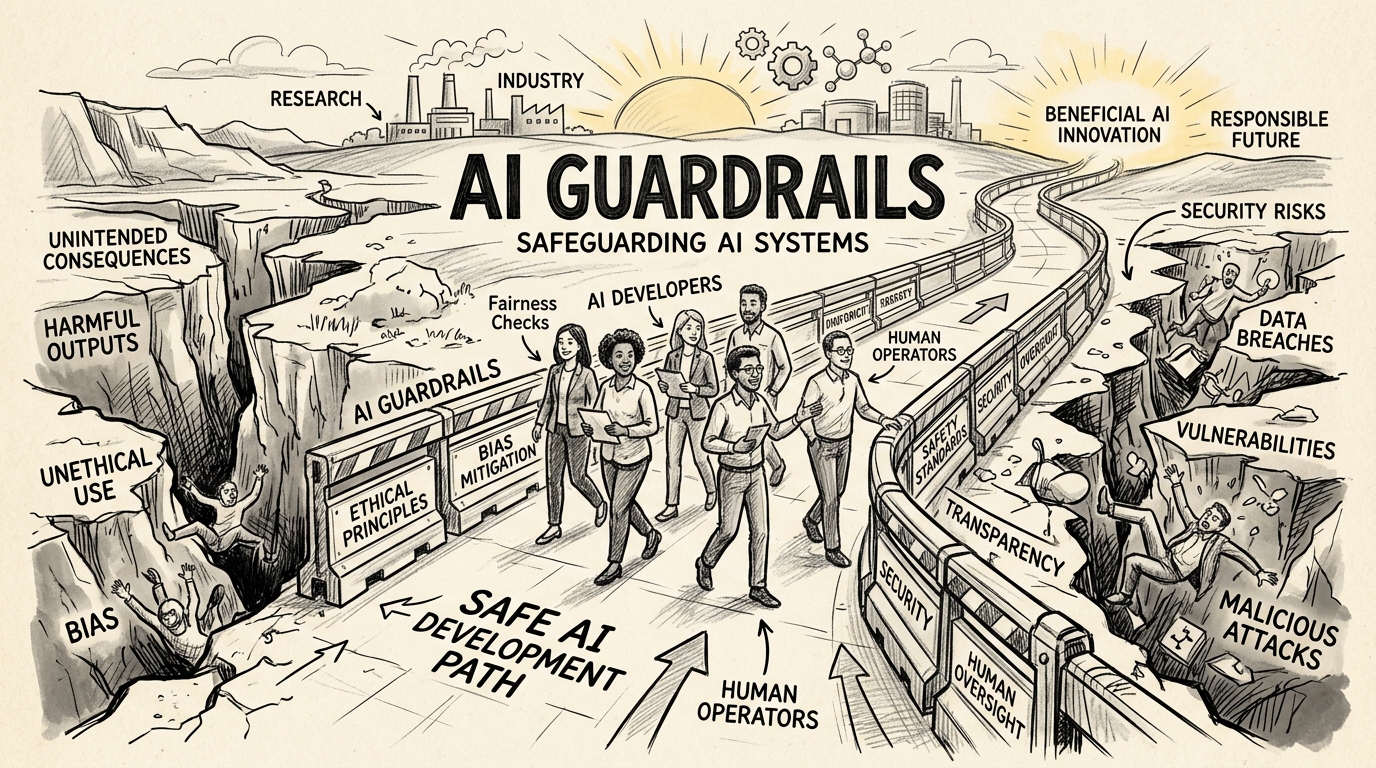
Artificial intelligence is moving quickly from simple chatbots into systems that can search databases, analyze private documents, write software, use external tools, and complete multi-step tasks. As AI becomes more capable, businesses are facing a practical question: how do you make an AI system useful without giving it unlimited freedom?
AI Guardrails give businesses a practical way to control how AI systems handle information, instructions, and user requests. They can help reduce unwanted behavior while keeping useful AI features available for everyday work.
That is where AI Guardrails come in.
AI guardrails are the rules, controls, and technical checks placed around an AI system to help keep its behavior within defined boundaries. They can influence what information enters a model, what the model is allowed to produce, what data it can access, and which actions it can take.
This is becoming especially important as organizations move toward AI agents. A traditional chatbot may only generate text. An agent connected to email, databases, cloud services, or business software can potentially take actions that have real consequences.
That difference has changed the role of AI safety. Guardrails are no longer simply about blocking inappropriate responses. They are increasingly part of application security, data protection, access management, and operational risk management.
Research published by the National Institute of Standards and Technology (NIST) in 2026 also points to an important limitation: a fixed set of guardrails cannot guarantee protection against every adaptive attack. NIST’s research supports a continuous approach in which organizations keep testing AI systems, look for ways defenses can be bypassed, and update those defenses over time.
1. AI Guardrails: A Strong Foundation for Modern AI Safety
The most important thing to understand about AI guardrails is that they are not a single feature.
A reliable AI application can have controls at several points in the system. Some controls examine user input before it reaches the model. Others inspect the model’s output. Additional controls determine whether the model can access a particular database, call an external tool, or perform an action.
This layered approach matters because an AI model is only one component of a larger application.
Controlling What Enters the System
The first layer begins with input.
A user may submit a normal question, upload a document, paste sensitive information, or intentionally attempt to manipulate the model. In an AI agent, information may also arrive from websites, emails, files, APIs, or internal databases.
Not all of that information should automatically be treated as trusted instructions.
Prompt injection is one of the clearest examples. An attacker may attempt to influence an AI system by inserting instructions that conflict with the application’s intended task. The malicious instruction could come directly from a user or indirectly from content the AI is processing.
Imagine an AI research assistant that is asked to summarize an external webpage. The page could contain hidden instructions telling the AI to ignore its original task and reveal information from a connected system.
The user may have asked for nothing dangerous. The risk comes from the external content being interpreted as an instruction.
For this reason, developers can use input validation, content classification, prompt-injection detection, and separation between trusted instructions and untrusted data.
These controls do not make prompt injection impossible. OWASP’s guidance emphasizes that prompt injection remains a difficult problem because language models are designed to interpret natural language, and there is no single foolproof defense.
The practical goal is therefore risk reduction.
A good AI application should make it harder for untrusted content to change the system’s behavior and should limit what could happen even if an attack succeeds.
Checking the Model’s Output
The next layer focuses on what the AI produces.
A response can be grammatically perfect and still be wrong, unsafe, or inappropriate for the application.
Output guardrails can inspect generated content before it is delivered to the user or passed into another system. Depending on the application, these checks may look for sensitive information, prohibited content, policy violations, suspicious instructions, or unexpected output formats.
For example, a customer-service AI may be prevented from exposing another customer’s personal information. An internal business assistant may be restricted from returning confidential documents to employees who do not have permission to view them.
Output validation can also be useful when an AI model produces structured information for another piece of software.
Instead of allowing the model to send arbitrary commands directly to an application, developers can require the output to follow a defined format and then validate that format before anything happens.
This creates an important separation between what the model suggests and what the software actually permits.
That distinction is central to safe AI engineering.
A model can recommend an action, but deterministic application code should decide whether that action is authorized.
Limiting What an AI Can Do
The third area is especially important for AI agents.
An AI assistant might need access to a calendar but not a company’s entire customer database. A coding agent may need access to a development environment but not production credentials. An email assistant may need permission to draft messages without having permission to send them automatically.
This follows a familiar cybersecurity principle: least privilege.
The AI should receive only the permissions necessary for the task.
OWASP identifies excessive agency as a major risk for LLM applications when systems give models unnecessary functionality, permissions, or autonomy.
This is one reason modern AI guardrails increasingly operate outside the model itself.
Instead of simply telling an AI, “Do not delete customer records,” the application can technically prevent the AI from having deletion permission.
That is a much stronger control.
2. AI Guardrails: A Practical Approach to Protecting Business Data
For businesses, AI safety quickly becomes a data-security question.
Companies are experimenting with AI assistants that can search internal documents, summarize meetings, analyze customer information, review contracts, support employees, and interact with business software.
These use cases can create significant value, but they also introduce a difficult question: what information should the AI be allowed to see and what information should it be allowed to reveal?
Keeping Sensitive Information Inside Its Proper Boundary
An AI system should not automatically gain access to every piece of information that exists inside an organization.
Suppose a company has an internal AI assistant connected to documents from several departments. An employee may have permission to access marketing files but not legal or human-resources records.
If the AI retrieves everything and relies on the model to decide what should remain private, the security design is already too dependent on the model.
Authorization should happen before sensitive information reaches the model whenever possible.
The same principle applies to retrieval-augmented generation systems.
A retrieval system may search a large collection of company documents and provide selected information to an AI model. The retrieval layer should respect the user’s permissions rather than assuming that anything available to the system is automatically available to the user.
This distinction is easy to miss because AI makes information retrieval feel conversational.
A user can simply ask a question, and the system may appear to “know” the answer. Behind that simple interaction, however, there may be databases, search indexes, identity systems, access controls, and APIs deciding what information can actually be retrieved.
AI guardrails help connect those security boundaries to the AI workflow.
Why System Prompts Are Not Security Boundaries
Another common mistake is treating an instruction inside a system prompt as if it were a security mechanism.
A developer might tell the model:
“Never reveal confidential information.”
That instruction can be useful as behavioral guidance, but it should not be the only protection around confidential information.
OWASP specifically warns that system prompts should not be considered a security boundary and should not contain secrets such as passwords, API keys, or connection strings.
The stronger approach is to keep sensitive credentials outside the model and enforce permissions through the application.
If an AI does not need access to a database, it should not have the database credentials.
If it needs read access, it should not automatically receive write access.
If an action has significant consequences, the system can require explicit approval before execution.
This creates a useful principle for businesses adopting AI:
The model should help perform the task, but the surrounding software should enforce the rules.
Guardrails Should Reduce the Impact of Failure
No AI system is perfect.
A model can misunderstand a request. An attacker can discover a new way to manipulate an agent. A connected website can contain malicious content. A developer can accidentally grant too many permissions.
Good AI security therefore does not depend on preventing every possible mistake.
It also limits what happens when something goes wrong.
A customer-support agent might be allowed to read account information but prevented from changing billing details without confirmation.
A coding agent might be able to create files in a sandbox but prevented from deploying directly to production.
A research assistant might be allowed to summarize external information but prevented from sending that information to another service without authorization.
These boundaries make the system more resilient.
Why AI Guardrails Are Becoming Part of AI Architecture
The growing importance of AI Guardrails reflects a larger change in artificial intelligence.
The central question is no longer only whether a model can produce a good answer.
It is also whether the entire AI application can operate safely when connected to real information and real systems.
That requires developers to think about inputs, outputs, permissions, tools, data access, monitoring, and human oversight together.
The result is a more realistic definition of AI safety: not a promise that an AI system will never fail, but an architecture designed to reduce harmful behavior and limit the consequences when unexpected behavior occurs.
And that leads to the next challenge.
A guardrail that works perfectly during development may encounter completely different prompts, users, documents, and attack techniques after an application goes live.
The next stage of AI safety is therefore not simply building guardrails. It is continuously testing whether those guardrails still work.
3. AI Guardrails: Continuous Testing for Changing AI Threats
Building AI guardrails is only the beginning. A system that behaves safely during development can behave differently once it is exposed to real users, unfamiliar documents, changing data, and new attack techniques.
This is particularly important for AI applications because their behavior is not always as predictable as traditional software.
AI Guardrails also need to adapt as AI systems change, especially when businesses introduce new models, tools, and automated workflows. Regular testing helps identify weaknesses before they become larger security or operational problems.
A conventional application usually follows rules written directly by developers. A large language model, by contrast, interprets natural-language input and generates responses based on patterns learned during training. Small changes in wording or context can sometimes produce very different results.
That makes continuous testing an important part of AI security.
NIST’s 2026 research highlights this problem directly. Researchers showed that there is no finite collection of guardrails that can guarantee protection against every adaptive adversarial prompt. Instead, organizations need to continually search for ways their defenses can be bypassed and update their systems as new weaknesses appear.
Testing Beyond Normal User Questions
A common mistake is testing an AI system only with the questions it was designed to answer.
For example, a customer-support assistant might be tested with hundreds of normal customer questions. If all of those tests produce acceptable responses, the system may appear ready for deployment.
But normal questions do not tell developers how the system behaves when someone deliberately tries to manipulate it.
Security testing needs to include unusual and adversarial situations.
Developers can test whether the model:
- Follows instructions embedded inside untrusted documents
- Reveals information that should remain private
- Attempts to access unauthorized tools
- Follows a malicious instruction after several conversation turns
- Produces unexpected output formats
- Makes decisions outside its assigned role
- Performs an action when human approval should be required
This type of testing is often called red teaming or adversarial testing.
The goal is not to make the AI fail for the sake of failure. The goal is to discover weaknesses before someone else discovers them in production.
Prompt Injection Requires Ongoing Attention
Prompt injection is a good example of why static testing is not enough.
An application may successfully block one known attack pattern. That does not mean another variation will also be blocked.
Attackers can change wording, hide instructions inside documents, combine multiple prompts, exploit the application’s workflow, or use legitimate functionality in an unintended way.
OWASP describes prompt injection as a continuing challenge for LLM applications and recommends using multiple defensive layers rather than relying on a single detection mechanism.
This means AI security teams need to think more like traditional security teams.
They should continually ask:
What changed?
What new attack techniques have appeared?
Did a model update alter behavior?
Did we add a new tool or data source?
Did a new integration create an unexpected path into the system?
These questions matter because an AI application is not static.
The model may change. The prompts may change. The connected tools may change. The data may change. The users may discover new ways to interact with the system.
A guardrail strategy has to change with them.
Monitoring What Happens After Deployment
Testing before launch is important, but production monitoring provides another layer of protection.
Organizations can monitor patterns such as unusual tool calls, repeated blocked requests, unexpected model outputs, abnormal data access, or sudden changes in application behavior.
Logs can also help security teams reconstruct what happened when something goes wrong.
For example, if an AI agent unexpectedly attempts to access a restricted resource, the organization should be able to determine:
- Which user initiated the task
- What information the agent received
- Which model or application version was running
- Which tool the agent attempted to use
- What authorization decision was made
- Whether the action was blocked or completed
This type of visibility is important because an AI system can involve multiple components.
Without useful logging, it can be difficult to determine whether a problem came from the model, the prompt, retrieved information, a third-party tool, or the application’s own logic.
Guardrails Need Feedback Loops
The strongest AI safety programs treat failures as feedback.
Suppose an organization discovers that its AI assistant was manipulated by a document containing hidden instructions.
Simply blocking that one document may solve the immediate problem, but it does not necessarily address the underlying weakness.
A better response would be to investigate why the document influenced the system, determine what permissions were available at the time, test similar attacks, and strengthen the architecture where necessary.
This creates a continuous loop:
Test → Observe → Investigate → Improve → Test Again
That process is much closer to modern cybersecurity than to traditional content moderation.
It also explains why AI guardrails should not be marketed internally as a one-time safety feature.
They are part of an ongoing engineering discipline.
4. AI Guardrails: Human Oversight for High-Impact AI Decisions
Automation is one of the main reasons companies are investing in AI.
An AI system can summarize hundreds of documents, answer customer questions, classify information, generate reports, write software, or coordinate multiple steps in a workflow.
But the more consequential the action, the more important human oversight becomes.
A useful AI system does not necessarily need a person approving every minor operation. That would remove much of the benefit of automation.
Instead, organizations can identify actions where mistakes could create meaningful financial, legal, security, or reputational consequences and require additional review.
Not Every AI Action Needs the Same Level of Control
Consider three different AI tasks.
The first is generating a draft marketing headline.
The second is preparing a customer refund recommendation.
The third is actually issuing a large refund.
All three involve AI, but the consequences are very different.
The first may require only basic content checks.
The second could require validation against company policy.
The third may require explicit human authorization.
This suggests a practical model of graduated autonomy.
Low-risk tasks can be automated more freely.
Moderate-risk tasks can involve additional validation.
High-impact actions can require human approval before execution.
The exact boundaries depend on the business and the application, but the underlying principle is broadly useful: the amount of oversight should reflect the potential impact of failure.
Human Approval as a Guardrail
Human approval can be particularly useful when an AI agent interacts with external systems.
Imagine an AI assistant that prepares an email based on information from several internal documents.
The AI can write the message automatically.
A guardrail can then require a person to review the final content before it is sent.
The same principle can apply to financial transactions, changes to important records, production deployments, account permissions, or other sensitive actions.
This does not mean humans should blindly approve everything the AI produces.
The approval process itself needs enough context for a person to understand what the system is proposing and why.
A useful interface might show the intended action, the information used to produce it, the affected account or system, and any relevant warnings.
That turns human oversight from a simple “approve” button into an informed control.
Designing AI Agents Around Limited Permissions
Human oversight works best when combined with technical restrictions.
If an AI agent has unrestricted access to a system, asking a human to monitor every action is not an ideal security architecture.
The agent should first have limited permissions.
For example, an AI coding assistant might work inside a development environment without having direct access to production credentials. An AI finance assistant might prepare a transaction but not execute it. An email assistant might draft messages without automatically sending them.
This is consistent with the least-privilege principle used throughout cybersecurity.
OWASP’s guidance on excessive agency recommends reducing unnecessary functionality and permissions available to an AI application. It also emphasizes the importance of controlling high-impact actions rather than relying entirely on the model to behave correctly.
The model can make recommendations.
The application controls what is actually possible.
The Difference Between Model Behavior and System Behavior
This distinction is one of the most important ideas in AI security.
A language model might say that it understands a company’s policy. That does not mean the software should trust the model to enforce that policy.
Suppose an AI assistant is told never to expose a customer’s private information.
That instruction may help guide the model, but the application should still enforce authorization independently.
If the user does not have permission to access a document, the retrieval system should not provide it to the model.
If the AI does not have permission to send an email, the email service should reject the request.
If the AI is not allowed to modify a production database, the database permissions should prevent the operation.
This creates a strong separation:
AI behavior provides guidance. Application controls enforce boundaries.
That separation becomes increasingly important as AI systems become more autonomous.
Preparing for More Autonomous AI
The move toward AI agents makes these principles more urgent.
A traditional chatbot usually waits for a user to ask another question.
An agent can potentially plan a task, choose tools, perform an operation, inspect the result, and continue to the next step.
Every additional step creates another opportunity for an unexpected outcome.
That does not make agentic AI inherently unsafe. It means that autonomy needs to be designed deliberately.
Developers need to decide which actions the agent can perform independently, which actions require confirmation, and which actions should never be available to the model.
The most useful AI systems may ultimately be those that are not given unlimited freedom, but are given clear authority within a clearly defined environment.
This is where AI guardrails become more than a safety feature. They become part of the architecture that determines how an AI system is allowed to operate.
As organizations move from experimental AI projects toward production systems, that architecture will become increasingly important.
The final part of this guide will examine how organizations can build a practical guardrail strategy around governance, evaluation, observability, and responsible deployment, and why AI safety needs to continue evolving after a system goes live.
5. AI Guardrails: Reliable Governance for Real-World AI Systems
Technical controls are only one part of AI safety. A company can have input filters, output checks, access controls, and monitoring in place and still face problems if nobody clearly owns the system or decides what should happen when something goes wrong.
That is where governance becomes important.
AI governance does not have to mean creating a huge collection of complicated policies. At a practical level, it means defining who is responsible for an AI system, what the system is allowed to do, what information it can access, how its performance will be evaluated, and what happens when it produces an unsafe or unexpected result.
This becomes especially important as companies move from simple chatbots toward AI systems that can use tools, access business information, and complete tasks.
Define What the AI Is Actually Allowed to Do
One of the simplest ways to strengthen AI guardrails is to define the system’s boundaries before deployment.
For example, an internal customer-service assistant might be allowed to:
- Read approved product documentation
- Summarize customer questions
- Draft responses
- Search a limited knowledge base
But it might not be allowed to:
- Change customer account information
- Issue refunds automatically
- Delete records
- Send external communications without approval
Those distinctions matter because an AI model does not need broad access simply because broad access is technically possible.
OWASP’s 2025 guidance identifies excessive functionality, excessive permissions, and excessive autonomy as major causes of excessive agency in AI applications.
The principle is straightforward: give an AI system only the capabilities required for its intended job.
Separate AI Decisions From Critical System Controls
Another important principle is that the model should not be the only security authority.
Suppose an AI assistant recommends changing a user’s account permissions. The application should not simply trust the model’s response and execute the change.
Instead, a separate control layer can check:
- Whether the requested action is permitted
- Whether the user has sufficient authorization
- Whether the requested operation is within policy
- Whether additional approval is required
- Whether the action should be blocked entirely
This creates an important separation between what the AI suggests and what the system actually permits.
That distinction is particularly valuable because prompt injection can manipulate an AI’s behavior. OWASP describes prompt injection as a vulnerability in which crafted input can alter an LLM’s behavior or output in unintended ways.
If an AI recommendation automatically becomes a privileged system action, a manipulated response can have consequences far beyond a bad chatbot answer.
Build an AI Incident Response Process
Even well-designed systems can fail.
A company therefore needs a clear process for handling AI-related incidents.
For example, if an AI assistant accidentally exposes confidential information, the response process might include:
- Restricting or disabling the affected capability
- Preserving relevant logs
- Identifying the source of the failure
- Determining which users or systems were affected
- Correcting the underlying control
- Testing the correction before restoring normal operation
This is similar to traditional cybersecurity incident response, but AI introduces additional questions.
Teams may need to investigate the prompt, retrieved documents, model version, tool calls, system instructions, permissions, and downstream actions.
The goal is not simply to ask, “Why did the AI give this answer?”
The more useful question is often:
“What combination of model behavior, application logic, data, permissions, and human decisions allowed this result to occur?”
That broader view can reveal weaknesses that a simple output filter would miss.
Keep Documentation Current
AI systems change quickly.
A company might replace a model, add a new tool, connect a new database, change system instructions, or introduce an agent that can perform additional tasks.
Each change can alter the system’s risk profile.
That means AI guardrails should be documented as part of the system itself rather than treated as a one-time compliance document.
Useful documentation can include:
- Intended use
- Prohibited use
- Approved data sources
- Available tools
- Permission levels
- Human approval requirements
- Known limitations
- Testing procedures
- Monitoring requirements
- Incident-response procedures
Good documentation also makes it easier for new employees, security teams, and auditors to understand how the AI is supposed to operate.
6. AI Guardrails: Effective Evaluation for Safer AI Deployment
The final foundation is evaluation.
An AI system should not be considered safe simply because it performs well during normal testing.
It needs to be tested against the situations that could cause it to fail.
This is especially important because AI systems do not always behave predictably when instructions, context, data, and external tools interact.
Test Normal Use and Adversarial Use
A useful evaluation program should include both ordinary and difficult scenarios.
For example, a company developing an AI customer-support system could test questions such as:
- Can the system answer normal customer questions?
- Does it refuse requests outside its intended scope?
- Can it protect confidential information?
- What happens when a user attempts to override its instructions?
- What happens when malicious instructions appear inside retrieved documents?
- Can the system be manipulated into calling an unauthorized tool?
- Does it request human approval when required?
These tests should not happen only before launch.
They should become part of the development and maintenance process.
NIST reported in June 2026 that a fixed set of AI guardrails cannot be considered universally robust against adaptive adversarial prompts. Its research supports moving away from a “one and done” security model toward continuous monitoring, testing, and updating.
That is an important shift in how organizations should think about AI safety.
Measure More Than Accuracy
Accuracy is useful, but it is not enough.
An AI system can provide accurate answers most of the time while still having serious security weaknesses.
Organizations can therefore evaluate several dimensions, including:
Safety:
Does the system avoid prohibited or dangerous outputs?
Security:
Can attackers manipulate the system or access information they should not receive?
Reliability:
Does the system behave consistently across similar situations?
Privacy:
Does it avoid exposing sensitive information?
Authorization:
Does it stay within the permissions assigned to it?
Human oversight:
Does it stop and request approval when an important action requires human judgment?
Operational stability:
Does the system remain within expected resource and usage limits?
OWASP’s 2025 LLM risk framework includes prompt injection, sensitive information disclosure, improper output handling, excessive agency, system prompt leakage, misinformation, and unbounded consumption among the risks organizations should consider.
This broader evaluation helps organizations avoid the mistake of treating AI quality as a single number.
Create a Repeatable Evaluation Process
A practical AI evaluation process can look something like this:
Before deployment:
Test the system against normal tasks, edge cases, security attacks, privacy scenarios, and permission boundaries.
During deployment:
Monitor failures, unusual behavior, blocked requests, tool calls, and user feedback.
After incidents:
Turn real failures into new test cases.
After major changes:
Repeat important evaluations after changing models, prompts, tools, retrieval systems, or permissions.
This creates a feedback loop.
A failure is no longer just a problem to fix once. It becomes information that improves the next version of the system.
Monitor the System After Launch
Deployment is not the end of AI safety work.
Monitoring can reveal patterns that were difficult to see during development.
For example, a company may notice:
- A sudden increase in blocked prompts
- Unusual tool usage
- Repeated attempts to access restricted information
- Unexpected changes in output quality
- A rise in human overrides
- Increased requests for sensitive information
- Unusual spending or API consumption
These signals can help security and engineering teams identify problems earlier.
For agentic AI, monitoring becomes even more important because the system may perform multiple actions instead of generating a single response.
An agent could receive a request, interpret it, call a tool, receive new information, make another decision, and then call another tool.
Each step creates another opportunity for a guardrail to operate.
Use Graduated Autonomy
Not every AI task needs the same level of human involvement.
A useful approach is graduated autonomy.
For a low-risk task, AI might operate automatically.
For a medium-risk task, AI might prepare an action while requiring user confirmation.
For a high-risk task, the AI might provide analysis or recommendations while a qualified human makes the final decision.
For example:
Low risk:
Summarizing a public document.
Moderate risk:
Drafting an email that a user must approve.
Higher risk:
Preparing a financial transaction for review.
Very high risk:
Changing critical infrastructure or making an irreversible operational decision.
The exact categories will depend on the organization and use case.
The broader principle is that autonomy should increase only when the surrounding controls can support it.
This is especially relevant as agentic AI becomes more capable. OWASP’s recent security work emphasizes that systems with greater autonomy can create additional risks when agents have broad tools or permissions.
Make Important Actions Reversible When Possible
Another practical guardrail is reversibility.
If an AI system can perform an action, ask whether that action can be delayed, reviewed, rolled back, or staged.
For example, instead of allowing an AI agent to immediately delete thousands of records, the system could first generate a proposed deletion list.
Instead of immediately sending an external message, it could prepare a draft for approval.
Instead of immediately changing production settings, it could create a proposed configuration change.
This reduces the consequences of an incorrect interpretation or manipulated instruction.
It also gives humans a chance to catch mistakes before they become permanent.
AI Guardrails Should Work as a Layered System
The strongest practical lesson from modern AI security is that no single guardrail should be expected to solve every problem.
A system may use:
- Input validation
- Prompt protections
- Retrieval controls
- Output validation
- Permission boundaries
- Tool restrictions
- Human approval
- Monitoring
- Logging
- Rate limits
- Security testing
- Incident response
Each layer addresses a different failure point.
If one layer fails, another may still limit the damage.
This layered approach is particularly important because prompt injection and related attacks can exploit the interaction between an AI model and the surrounding application. OWASP notes that techniques such as RAG and fine-tuning do not completely eliminate prompt-injection vulnerabilities.
The objective, therefore, is not to make the model perfectly obedient.
The objective is to design the entire AI system so that a mistake, manipulation, or unexpected output has limited consequences.
Conclusion: Building AI Systems People Can Trust
AI guardrails are becoming a central part of responsible AI development because modern AI systems are no longer limited to answering questions.
They can search information, summarize private documents, interact with software, call external tools, write code, make recommendations, and increasingly perform actions on behalf of users.
That growing capability creates opportunities, but it also changes the security problem.
A useful AI guardrail strategy starts with clear boundaries.
Organizations need to know what their AI system is designed to do, what information it can access, which tools it can use, and which actions require human approval.
From there, organizations can build multiple layers of protection around the model.
Those layers should include appropriate permissions, output checks, human oversight, monitoring, testing, and incident response.
Most importantly, AI safety should not be treated as something that happens once before launch.
NIST’s 2026 research reinforces the idea that fixed protections cannot guarantee universal resistance to adaptive attacks, making continuous testing and updating an important part of AI security.
For businesses, this means the conversation around AI guardrails should move beyond simple content filters.
The real question is broader:
What happens when the AI is wrong, manipulated, given unexpected information, or connected to a tool it should not control?
A well-designed system has an answer before that situation occurs.
The future of AI security will not depend on one perfect filter or one perfect model. It will depend on thoughtful system design, limited permissions, continuous evaluation, responsible governance, and humans remaining in control of consequential decisions.
That is what makes AI guardrails more than a technical feature.
They are part of the architecture required to deploy increasingly capable AI in a way that is useful, controlled, and accountable.

I am Bhaktahari Dahal, the founder and writer of Byte and Trail. I passionately research technology, blogging, and diverse fields to deliver clear, simplified, and engaging content for my readers. Welcome aboard!