
Just Google it: the strange, brilliant story of the company that became a verb.
It’s 2:14 in the morning, and your toddler’s forehead feels like a warm stovetop. You’re standing in the dark hallway in one sock, phone in hand, and you do what roughly every parent in America does next. You type a few panicked words into the Google search engine and hold your breath.
Or maybe it’s a Sunday afternoon, and your brother-in-law is insisting, with total confidence, that Canada is farther south than Detroit. (Part of it is, actually. Look it up.) Somebody pulls out a phone. Argument over. Nobody even says the name of the thing they just used. They just say, “Hang on, let me Google it.”
Think about how strange that is. We don’t “Yahoo” things. We don’t “Bing” our way out of a bar bet. A private company’s name has become the everyday verb for finding out what’s true, and most of us have said it thousands of times without once stopping to wonder how that happened.
So let’s stop and wonder. This is the story of the Google search engine and the company behind it: where it came from, how it nearly didn’t happen, how it makes its money, why it makes plenty of people nervous, and what it might mean now that a machine can answer your question before you’ve finished typing it. It’s a better story than you’d expect. It has garages, a misspelled word, a $100,000 check made out to a company that didn’t exist yet, and a handful of very smart people who spent years being told they were wrong.
Two Grad Students and a Bad Idea (That Wasn’t)
In the mid-1990s, the internet was exciting and also kind of a mess. Millions of pages were going up every month, and finding anything useful felt like digging through a garage sale in the dark. The search engines of the day, names like AltaVista, Excite, and Lycos, mostly worked by counting how many times a word appeared on a page. If you searched for “pizza,” you’d get whatever page said “pizza” the most. Which, as you can imagine, made it very easy to game. Spammers just stuffed the word in over and over, invisible, at the bottom of the screen.
Larry Page was a grad student at Stanford, interested in how web pages linked to each other. His thinking went something like this: every link from one page to another is a tiny vote. And a vote from an important page should count for more than a vote from a random one. A link from a major university’s website means something. A link from a page nobody has visited since 1997 means very little.
He teamed up with another Stanford student, Sergey Brin, a math whiz who had a knack for making big ideas actually work. Together they turned that notion into an algorithm they called PageRank. (Yes, named partly after Larry. Engineers are not always subtle.) Their first prototype was called BackRub, because it analyzed the web’s “back links.” Not exactly a name that sells.
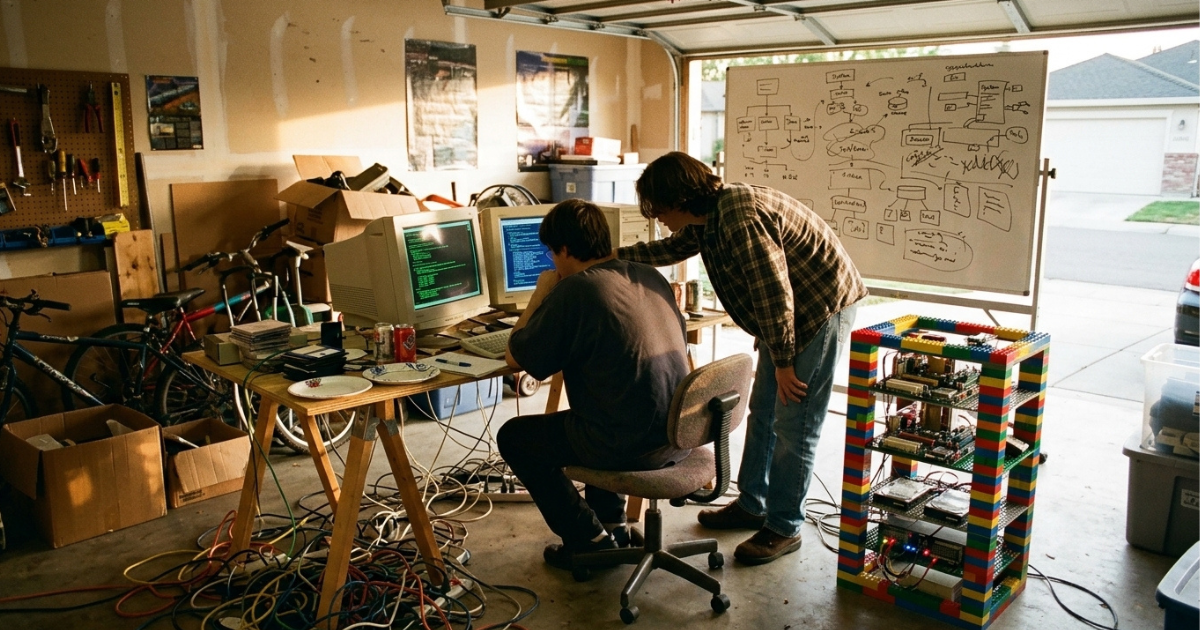
The results were better. Noticeably, almost embarrassingly better. Students around Stanford started using BackRub, the early version of the Google search engine, because it simply found things the others didn’t. The two founders kept running it on borrowed computers and, famously, a homemade server case built out of Lego bricks, because they were broke grad students and Lego was what they had.
Eventually the project needed a real name. The story, as it’s usually told, goes like this: a fellow student suggested “googolplex,” a number with an almost incomprehensible number of zeros. Page liked the shorter “googol,” which is a 1 followed by 100 zeros, and which fit their ambition to organize an enormous amount of information. Then, when someone went to check whether the domain was available, it got typed as “google.” Whether it was a spelling slip or a happy accident, the domain was free, and Page registered it in September 1997. A mistake became one of the most valuable names on Earth.
The Check That Came Before the Company
Here’s the part I love. By the summer of 1998, Page and Brin had a search engine that worked and no company to put it in. They tried selling the technology to the big portals of the era. The offers were not what you’d hope. One widely repeated version of the story says that they were willing to sell the whole thing for around a million dollars and the buyer passed. Nobody wanted to be the one who bought the better search engine, because the major portals wanted you to stay on their pages, not leave quickly with an answer. Giving people a fast exit seemed like a terrible business plan.
Then came a meeting on a porch. Andy Bechtolsheim, a co-founder of Sun Microsystems and one of the early heavyweights of Silicon Valley, got a quick demo. He saw it, understood it, and, according to legend, wrote a check for $100,000 right then. The check was made out to “Google Inc.”
There was one small problem. Google Inc. did not exist. The founders had to sit on that check for a couple of weeks until they could incorporate and open a bank account under the right name.
Google officially incorporated in September 1998. The first “office” was a garage in Menlo Park, California, that belonged to a friend named Susan Wojcicki, who would later become the CEO of YouTube. Sit with that for a second. The woman whose garage launched Google ended up running a company Google would buy a few years later. Silicon Valley is a small place wearing a very large reputation.
The Ugliest Homepage That Ever Made Billions
If you want to understand why people fell for Google, look at what it looked like. Compare it to its rivals. Most search sites back then were what we’d call “portals,” crowded pages stuffed with news headlines, weather widgets, horoscopes, stock tickers, shopping links, and ads blinking at you from every corner. They wanted you to hang around. They wanted you to click everything.
Google’s homepage was a white page, a logo, one search box, and two buttons. That was it. Part of that was philosophy. Part of it, honestly, was that Brin and Page weren’t web designers and didn’t know how to make anything fancier. Either way, the effect was the same. It loaded fast on slow dial-up connections, and it felt calm. You typed, you got an answer, you left.
That last bit is the real genius. In a world that measured success by how long people stayed on your site, Google bet on the opposite. Get people what they want faster than anyone else, and they’ll keep coming back. It sounds obvious now. It was heresy then.
And the little touches mattered. In 1998, the founders put a stick figure behind the logo to signal they’d gone off to the Burning Man festival in Nevada. That was the first-ever “Google Doodle,” a tradition that has since grown into thousands of playful logos celebrating everything from holidays to jazz legends. It told people something important without saying it: there are humans here, and they have a sense of humor.
But How Does It Actually Make Money?
This is the question that makes a lot of Americans pause when I ask it. Google is free. Nobody has ever pulled out a credit card to run a search. So where does the money come from?
For the first couple of years, the honest answer was: barely anywhere. Google was wildly popular and not making real money. Investors were getting a little nervous. The founders had been publicly lukewarm on advertising, because ads, to them, were part of what made rival sites so annoying.
Then, around 2000, they launched AdWords, and later refined it in 2002 into something much smarter. The idea was elegant. Instead of splashy banner ads that had nothing to do with what you wanted, Google would show small, plain text ads that matched what you were searching for. Looking up “running shoes”? A local shoe store’s ad might appear next to your results. Advertisers paid only when someone actually clicked. And ads were ranked not just by how much money an advertiser bid but by how relevant and useful people found them.
It turned out to be one of the great business models of the modern era. Every search is a tiny declaration of intent. Someone typing “emergency plumber near me” is about as ready to buy as a customer can be. Advertisers will happily pay for that moment, and Google sits right at the doorway of it, thousands of times a second.
In August 2004, Google went public, and it did it in typically stubborn Google fashion. Instead of the usual Wall Street routine, where big banks hand out shares to favored clients, it used an auction format that gave ordinary investors a shot. The shares priced at $85. In the letter that went with the offering, the founders laid out an unofficial motto for the company: “Don’t be evil.” You could roll your eyes at that, and plenty of people did, then and since. But it also said something about how they wanted to be judged.
The Everything Company
Here’s where the story gets fun, and a little chaotic. Once the money started flowing, Google did something unusual. It let its engineers spend a fifth of their work time on pet projects, whatever they were curious about. Some of those side projects became real products you almost certainly use.
On April 1, 2004, Google announced Gmail, a free email service with a full gigabyte of storage. The timing was so on-the-nose that a lot of people assumed it was an April Fools’ joke. At the time, the big email providers were giving out a few megabytes. A gigabyte felt like a typo. Gmail turned out to be completely real, and it quietly changed what people expected from email forever.
Then came the avalanche. Google Maps arrived in 2005 and retired a certain generation’s glove-box full of folded paper maps and unfortunately accurate arguments about who missed the exit. Google Earth let anybody zoom from space down to their own driveway. The company bought a small mobile operating system startup called Android in 2005, and that move helped put a smartphone in a staggering number of American pockets. In 2006, it bought YouTube for about $1.65 billion, a price that raised eyebrows at the time and now looks like a rounding error. Chrome, the web browser, launched in 2008 and eventually became the browser many of us use every single day.
Not everything worked, and I think that’s worth saying plainly, because the highlight reel makes the whole thing look smoother than it was. Google Glass, those camera-equipped smart glasses, struck a lot of people as creepy and mostly vanished. Google+, the company’s attempt to take on Facebook, never really caught on and was eventually shut down. There’s even a well-known fan-made website that catalogs the many products Google has launched and then killed. It is not short.
In 2015, the founders reorganized everything under a new parent company called Alphabet, so that Google proper could stay focused on search, ads, and its core products, while experimental projects, like self-driving cars (now Waymo) and health research, could live on their own. Sundar Pichai, a soft-spoken engineer who’d helped build Chrome, ran Google itself. In 2019, Page and Brin stepped back from day-to-day leadership, and Pichai took over as CEO of Alphabet too.
When the Brand Became a Verb
Somewhere in the middle of all that growth, something happened that most companies would sell a kidney for. People just started using the name as a word.
By the mid-2000s, “to google” was showing up in dictionaries and in everyday speech. You’d google a restaurant before a date. You’d google your own name, a little nervously. You’d google a medical symptom at midnight, then regret it, because the search results had somehow convinced you that a mild headache was something out of a medical drama.
The Part Where People Get Uncomfortable
No honest article about Google can skip the tension, and there’s real tension.
Start with privacy. Because Google offers so many free services, it also learns a lot about the people using them: what you search, where you travel, what you watch, who you email. The company says it uses this data to improve its products and show relevant ads, and that it gives users controls to see, delete, and limit what’s collected. Critics say the controls are buried, the defaults are generous to Google, and most people never touch them. Both things can be partly true at once. If you’ve never opened your Google account’s privacy settings, it’s worth ten quiet minutes. You may be surprised what’s in there.
Then there’s size. Google handles a share of the world’s searches so large that, for most of the last two decades, “searching the web” and “using Google” have been nearly the same activity for a lot of people. That kind of dominance eventually draws the attention of regulators.
In the United States, the government brought major antitrust cases against the company. In August 2024, a federal judge ruled that Google had illegally maintained a monopoly in online search, partly through deals that made it the default on phones and browsers. When it came time to decide the consequences, the court in 2025 stopped short of the most dramatic ideas, like forcing Google to sell Chrome, but did impose limits on exclusive deals and required some data sharing with rivals. A separate case focused on the company’s advertising technology also went against Google. Appeals and further proceedings have been ongoing, and details can change quickly, so if you want the latest status, check a current news source rather than trusting any single article, including this one.
And Then the Robots Showed Up
In late 2022, a chatbot called ChatGPT arrived and did something that made a lot of people sit up. You could ask it a question in plain English and get a conversational answer, not a list of links. Inside Google, by most accounts, it set off real alarm. Here was a threat to the thing the whole company was built on.
The irony is delicious. Google researchers had actually published the foundational research behind this wave of AI, a 2017 paper introducing an approach called the transformer. They’d handed the world the blueprint. Other companies built the first mainstream product from it.
Google responded fast. It launched its own chatbot, first called Bard, later folded into a family of models called Gemini, and began adding AI-generated summaries directly into search results. Today, if you search something complicated, there’s a decent chance an AI-written overview sits at the very top, before any links at all.
So where does that leave us? Honestly, nobody fully knows, and anyone who sounds certain is selling something. A few real questions are hanging in the air.
Will people keep “googling,” or will they just talk to an assistant? Probably some of both. Search is great when you want options, sources, and your own judgment. A chatbot is great when you want a quick synthesis.
Can we trust AI-written answers? That one’s trickier. These systems can be wrong in ways that sound completely confident. For a recipe or a movie recommendation, no big deal. For medicine, money, or legal questions, you’ll want to check the sources and, when it matters, talk to an actual professional.
And what happens to the people who write the articles, make the videos, and run the small sites that the whole system learned from? That might be the most important open question of all.
A Few Ways to Be a Smarter Googler
Since you’re here, let me give you something practical. Whether you’re a longtime searcher or a casual one, a few habits make the whole experience much better.
Put quotation marks around an exact phrase when you need those exact words. Add a minus sign before a word to exclude it, so searching for jaguar speed -car keeps the animals and drops the Fords. Use “site:” followed by a website to search just that site, which is wonderfully handy when a website’s own search bar is useless. Try searching in full questions, because the engine has gotten far better at understanding natural language than it used to be.
Be a little suspicious of the first thing you see. Top results aren’t automatically the most accurate; sometimes they’re the best at the search-optimization game. Look at who published the page and when. For anything health-related, give extra weight to major medical institutions and government health agencies, and treat a scary forum post the way you’d treat a rumor at a barbecue.
Back to That Hallway at 2:14 A.M.
Remember that tired parent in one sock, typing a worried question into the glow of a phone screen?
Strip away the billions of dollars, the lawsuits, the AI race, and the boardroom drama, and that’s really what the Google search engine is. It’s the thing we reach for when we don’t know something and we want to, right now, without having to ask anyone or go anywhere. It started as a clever idea about links, built by two students who weren’t sure it would ever be a business, and it grew into a part of daily life so ordinary that we use its name as a verb without a second thought.
That should inspire a bit of awe and a bit of caution. Awe, because a simple idea, executed with obsessive care, really can change how a whole civilization finds things out. Caution, because anything that central to our lives deserves to be questioned, regulated when necessary, and never taken for granted.
The next time you say “let me Google that,” pause for half a second. Somewhere behind that tiny search box are two grad students, a borrowed garage, a Lego server, a misspelled word, and a check made out to a company that didn’t exist yet. Not bad for a question typed with one thumb.
Now, if you’ll excuse me, I’m going to go check whether Detroit really is north of part of Canada.
Sources
Attention Is All You Need (arXiv, June 2017): the Transformer paper by Google researchers
Google founded (EBSCO Research Starter): BackRub and PageRank, the “googol” misspelling, incorporation in September 1998
History of Google (Wikipedia): domain registration in 1997, the Menlo Park garage, the $1 million offer, Chrome (2008), Alphabet (2015)
Google marks 14 years as a public company (Search Engine Land): the August 2004 IPO, $85 share price, auction format
Google to offer free e-mail with 1GB of storage (MacTech, April 1, 2004): the Gmail launch
When Gmail was first announced, people thought it was an April Fools’ joke (ScienceAlert)
Google to acquire YouTube (Google press release, SEC filing, October 9, 2006): $1.65 billion in stock
In a major antitrust ruling, a judge lets Google keep Chrome but levies other penalties (NPR via Cape & Islands): the search monopoly ruling and the September 2025 remedies
US judge finds Google illegally monopolised ad tech market (Al Jazeera, April 17, 2025)

I am Bhaktahari Dahal, the founder and writer of Byte and Trail. I passionately research technology, blogging, and diverse fields to deliver clear, simplified, and engaging content for my readers. Welcome aboard!